

The localization industry is undergoing a shift in how it defines itself. Traditional Language Service Providers (LSPs) are increasingly being described as Language Solutions Integrators (LSIs) and Language Technology Providers (LTPs), reflecting the growing role of AI, automation, and workflow integration. While the terminology is changing, the real challenge for organizations remains the same: building secure, scalable localization processes that balance AI efficiency with human oversight. This article explores what these new labels mean, why they matter, and how companies can make more confident AI translation decisions.
If you’ve been working in the localization industry long enough, you’ve seen translation technology evolve many times before. This time, however, the shift feels more intentional and more revealing.
Companies are no longer buying translation projects; rather, they are using the change in translation technology to take time to investigate how language fits into their broader systems, workflows, and risk profile.
That’s a fundamentally different conversation.
At Interpro, we’ve never approached localization as a transactional service. Our role has always been to be the go-to partner to help our clients make informed decisions about where AI can benefit their organizations, where human expertise and oversight are required, and how to build processes that scale without introducing unnecessary risk.
The Language Industry is Changing (or is it rebranding?)
For years, we have referred to Interpro as an LSP (Language Service Provider), and this label has been widely accepted both within and outside of the industry and beyond.
There’s now a new branding that is being used in the industry, a change that no one asked for, but at the same time, seems to be warranted.
LSP is now being replaced by LSI (Language Solutions Integrator), and, in addition, a new label is being introduced: LTP (Language Technology Provider).
The naming shift tells you everything about where the industry thinks it’s heading.
The reasoning behind it is pretty straightforward. “Service Provider” sounds like you answer phones and process tickets. “Solutions Integrator” sounds like you build things, connect systems, and deploy technology, such as AI. In an industry racing to prove it’s not about to be automated out of existence, the rebrand is equal parts aspiration and survival instinct.
Is the industry going through an identity crisis? Is it an identity shift?
The reality is that companies don’t want to be “translation vendors” anymore. They want to be platforms, integrators, AI players. And the reason for that has to be rooted in the fact that the companies buying translation don’t look at it the way they used to.
At Interpro, it’s never been our intention to be just a vendor. We are a partner to our clients. To be able to do that, we offer more than just translation; we provide our clients with the solutions they need for their linguistic requirements.
AI Adoption Requires Security Discipline
AI is now part of everyday translation and localization workflows. Content moves across multiple systems, vendors, and regions. When AI is introduced into that flow, gaps in process and oversight increase risk.
Common issues show up quickly:
- Sensitive or proprietary content is processed without clear controls
- Outputs are used without structured review or validation
- Teams apply AI differently across tools and languages
Localization environments amplify these problems at scale. One decision can affect multiple languages and markets simultaneously. Errors and exposure can spread just as quickly as the content itself.
AI also increases the speed of execution. That speed applies equally to both productivity and errors.
Security discipline means placing clear rules around usage. Teams need defined expectations for inputs, consistent review steps, and accountability for outputs. Processes need to be repeatable across languages and workflows, not decided case by case.
AI can handle execution at scale, but it does not manage context, quality, or risk. Those responsibilities rest in the hands of the organization.
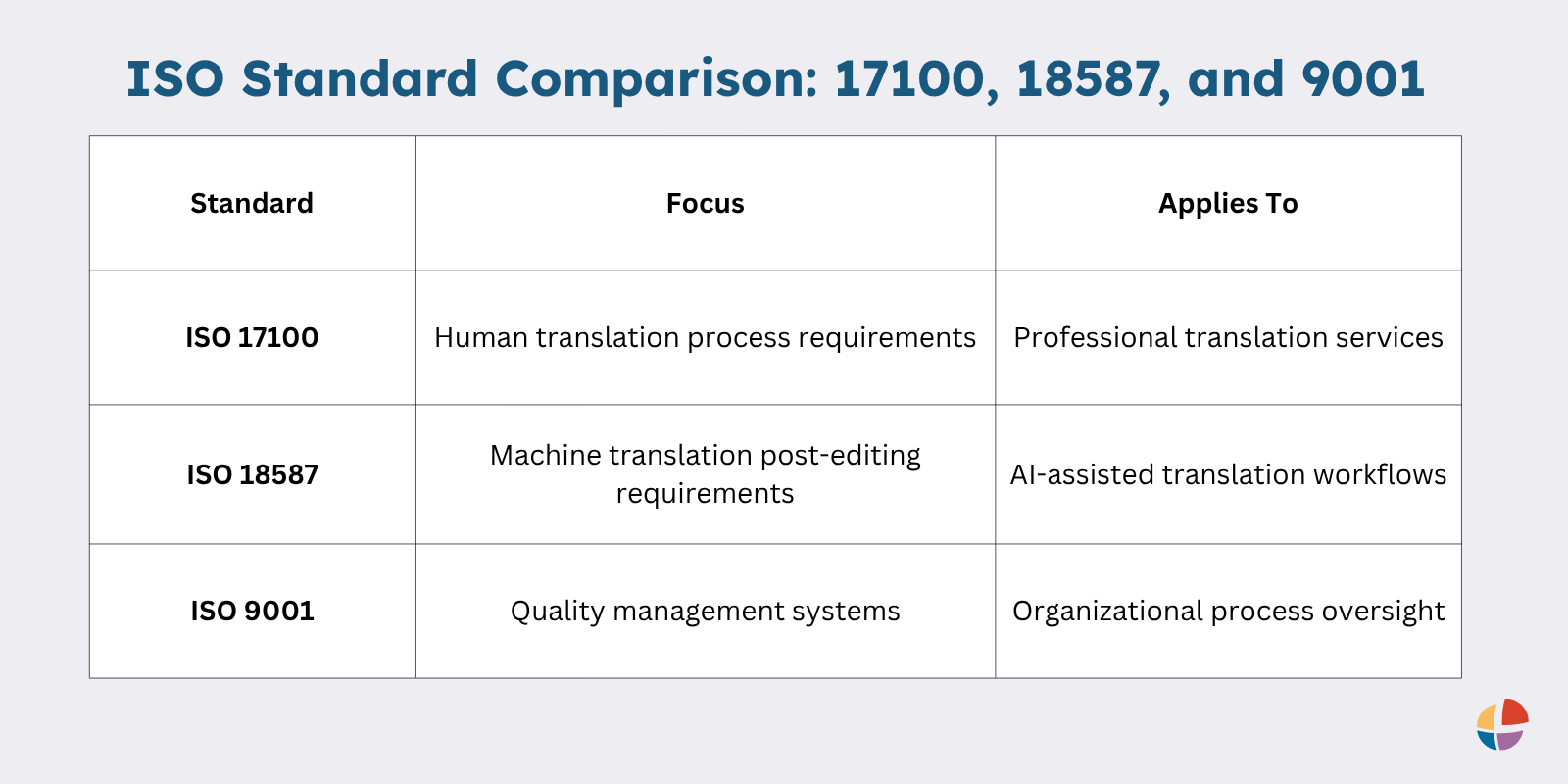
A comparison of ISO 17100, ISO 18587, and ISO 9001 highlights how quality, post-editing, and process standards support modern localization workflows.
How to Make More Confident AI Translation Decisions
The industry can call itself whatever it wants: LSP, LSI, LTP. Those labels may signal direction, but they don’t solve the core challenge organizations are facing right now.
AI has expanded what’s possible in localization. It has not eliminated the need for decision-making, strategic localization workflows, or accountability in final translated communications.
The difference we see across organizations is how they’re using it. Teams seeing real impact are those with:
- Clearly defined workflows
- Guardrails around content and usage
- Human oversight where it matters most
- A consistent approach to quality and validation
That’s where risk is reduced. That’s where confidence comes from.
At Interpro, we provide you with clarity to navigate language decisions, connecting technology, processes, and expertise into a proven localization framework that delivers consistent, scalable results.
Category: Localization
Service: Consulting

Don't forget to share this post!



Stay Updated with Interpro
Subscribe to our newsletter for the latest updates and insights in translation and localization.