
Successful localization projects require planning and strategic project management. This blog walks you through each phase of a successful translation workflow, from setting SMART goals and aligning stakeholders to leveraging translation memory, managing internal reviews, and conducting rigorous QA. Whether you’re launching eLearning content or global marketing campaigns, this guide provides a roadmap for delivering high-quality, scalable, and on-time translations.
How to Plan and Execute a Successful Localization Project, From Kickoff to QA
Whether you’re training a multilingual workforce, launching an eLearning course, or introducing a new product in global markets, how you manage translation projects directly impacts your outcomes. This blog outlines a complete strategy for managing translation and localization projects, from kickoff through QA and performance review. You’ll walk away with a roadmap to ensure every step, from planning to execution, is efficient, scalable, and error-resistant.
Successful translation initiatives require more than good linguists; they need strategic project management. This guide outlines a comprehensive, end-to-end workflow for managing translation projects that are on time, on budget, and on brand, from the first kickoff meeting through final QA.
Phase 1: Set the Foundation with Smart Planning
Define SMART Objectives
Start by setting SMART goals, specific, measurable, achievable, relevant, and time-bound. These goals might focus on time-to-market, training completion rates, regulatory compliance, or engagement across multilingual regions. Without clear KPIs, it’s impossible to gauge success. Clearly defined project goals also help stakeholders prioritize deliverables. For example, a medical device manufacturer might need to localize safety instructions into 15 languages ahead of a product launch. The SMART framework keeps teams aligned around what success looks like and how it will be measured.
Advanced tip: Align objectives with broader business goals and target markets. Interpro can help guide you with global expansion through language.
Align Stakeholders Early
Successful translation projects depend on collaboration. This means involving legal, marketing, training, engineering, and internal review teams early in the process. Aligning these stakeholders ensures expectations are clearly communicated and reduces last-minute changes that can derail timelines.
A translation project that involves a training module for a global audience, for instance, may require input from instructional designers, subject matter experts (SMEs), and LMS administrators. Clarifying who owns what from the start reduces confusion and improves efficiency.
Scope the Full Project
Scoping means defining exactly what will be translated, where it will live, and how it will be used. It’s easy to overlook things like embedded text in visuals, captions, or layered software strings. Creating a centralized content inventory and identifying all source materials up front helps avoid surprises and ensures full coverage.
Advanced tip: Develop a risk matrix and scenario analysis to anticipate and manage challenges.
Phase 2: Build a Bulletproof Localization Strategy
Choose the Right Localization Partner
Choosing a strategic localization solutions partner is critical. An experienced and consultative partner will help provide guidance on:
- avoiding costly localization pitfalls,
- best practices for seamless global communication, and
- managed turnkey localization services.
Evaluate potential partners based on their expertise, linguistic capabilities, and cultural understanding. The ideal partner will bring deep experience in your industry, support for a wide range of content types, and a commitment to quality through ISO certifications and proven QA workflows. Ask about their team structure: Do they use native-speaking translators with subject matter expertise? Can they scale quickly? Will they provide dedicated project managers?
Interpro’s approach centers around being a collaborative partner, not just a vendor, by advising on tools, file formats, and best practices.
Advanced tip: Explore language technology advancements like neural machine translation.
Estimate Timeline and Budget
Localization projects often come with significant costs. Carefully budget and allocate resources to maximize efficiency. Translation costs vary based on word count, complexity, number of languages, source and target languages, and required services (e.g., DTP, voiceover, or subtitling). Partnering with a provider who uses translation memory (TM) can reduce cost over time, especially for repeated content. Plan for at least 20–30% of your timeline to be dedicated to internal reviews and approval cycles.
Advanced tip: Consider leveraging machine translation and AI tools to optimize costs while maintaining quality.
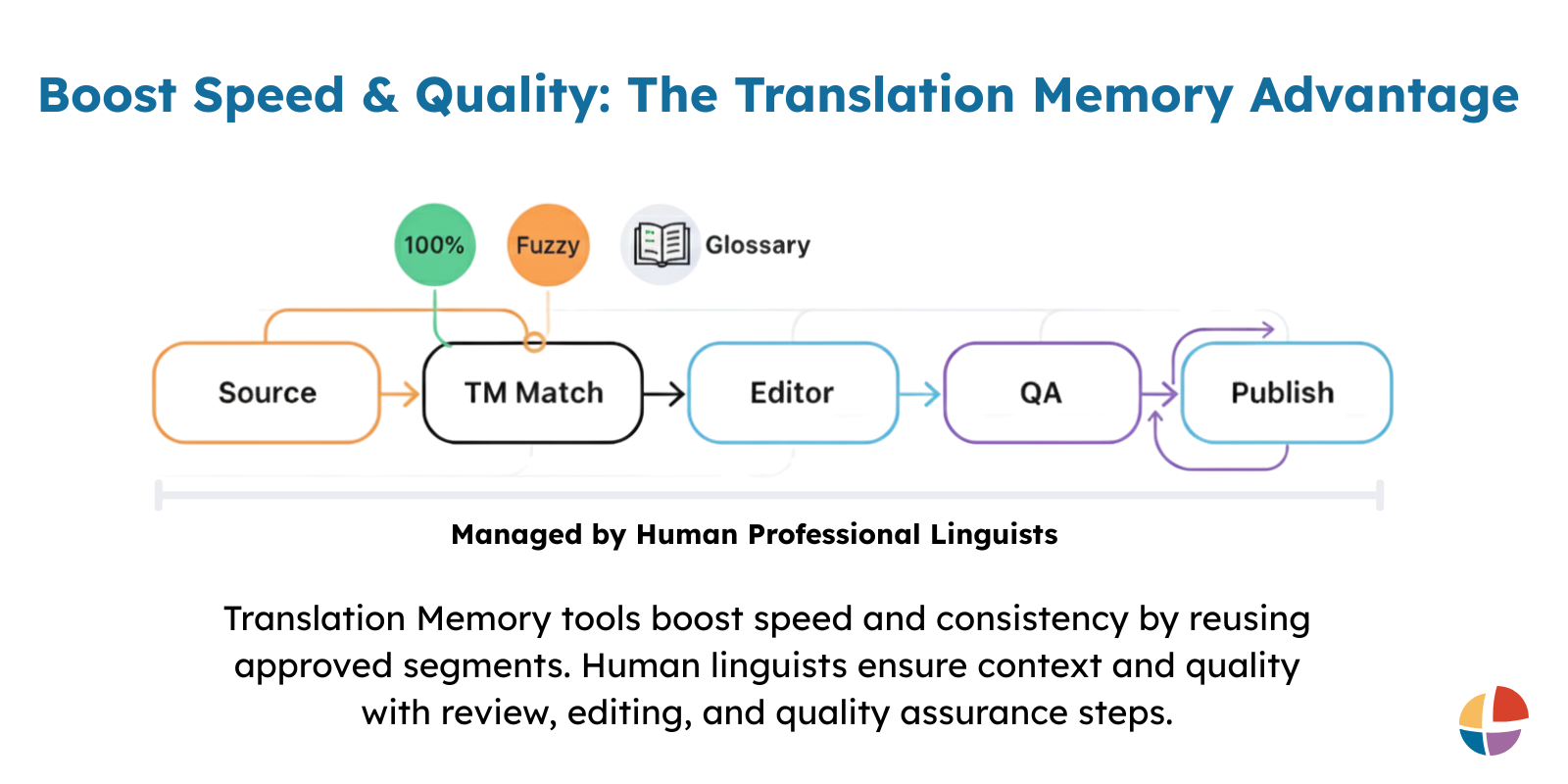
A diagram showing how translation memory tools streamline translation processes by reusing previously translated content.
Develop Assets: Glossary & Style Guide
A glossary outlines preferred translations for industry-specific terminology. A style guide documents tone, formatting rules, and voice guidelines. Together, they help ensure that translations remain consistent across regions and campaigns. Without these assets, reviewers may introduce inconsistency, which erodes brand clarity.
Advanced tip: Update glossaries and style guides regularly to reflect evolving brand language.
Phase 3: Set Up for Scalable Execution
Translation Memory & Asset Management
Translation Memory stores previously translated segments to ensure consistency and accelerate future projects. If you’ve translated similar content before, leveraging TM can help you avoid re-translating phrases that already exist.
Tools like CAT (computer-assisted translation) software allow translators to work faster and more accurately, especially when paired with style guides and glossaries. Interpro maintains and updates these assets across projects to ensure linguistic consistency.
File Engineering and Platform Integration
Today’s content comes in many formats: HTML, XML, JSON, SCORM packages, InDesign files, and more. Proper engineering ensures that text is extracted cleanly and reintegrated without issues.
If you’re managing an LMS, marketing CMS, or design platform, make sure your localization partner has the tools and technical know-how to work with your environment. Integrations can streamline the translation process and reduce errors during handoff.
Automate Where It Makes Sense
Some steps in the localization workflow, like file handoffs or version tracking, can be automated through API integrations or project management tools. Automation reduces manual tasks, especially on recurring or high-volume projects.
Advanced tip: Don’t over-automate. Human review (Human in the Loop) and QA should always remain part of the process.
Phase 4: Execute with Excellence
Launch in Phases
For large-scale localization efforts, launching in waves or by language tier can mitigate risk. Starting with high-priority or high-volume markets allows you to test the workflow and gather feedback. A phased rollout is especially helpful for global eLearning programs or compliance training.
Internal Review Management
In-country and internal reviewers play a vital role in validating translation accuracy and tone. However, too many reviewers, or reviewers without clear guidelines, can create delays. Establish review criteria, deadlines, and escalation paths. Interpro supports clients through structured ICR (internal customer review) and REMM (reviewer feedback management) processes.
Advanced tip: Interpro can help set up your ICR workflow or operate as your third-party reviewer.
Linguistic & Technical QA
Linguistic QA involves proofreading and editing for grammar, spelling, consistency, and style. Technical QA verifies that formatting, layout, functionality, and media elements remain intact. For regulated industries like healthcare or manufacturing, QA is non-negotiable.
Phase 5: Communicate, Evaluate, and Optimize
Stay Connected
Clear, ongoing communication with your translation partner can make or break a project. Use regular check-ins to review status, resolve blockers, and adapt to shifting priorities. Shared dashboards, email summaries, and milestone meetings ensure everyone stays aligned. Designate a single point of contact for both your team and your vendor.
Document Lessons Learned
After project completion, conduct a retrospective. What worked? What caused friction? What can be improved next time? Capturing these insights builds a repeatable framework that can be refined with every project.
Analyze and Scale
Track KPIs like turnaround time, cost per word, review cycle duration, and rework percentage. These metrics highlight where the process can be optimized. A strong localization infrastructure allows for agile responses to emerging business needs.
Project Closure and Reporting
Final Review and Feedback
Conduct a thorough project review, soliciting feedback from team members and stakeholders. For advanced insights, consider a post-project audit to identify areas for improvement.
Performance Metrics and Reporting
Measure project success against objectives and generate advanced reports using reporting tools and dashboards. Implement a continual improvement framework for ongoing optimization.
Final Thoughts: Your Roadmap to Multilingual Success
Planning and executing a translation project that truly delivers results takes more than word-for-word conversion. It requires a strategy, a system, and a team that understands how to make it all work efficiently, accurately, and at scale. From setting SMART objectives to navigating complex legal regulations, mastering these skills ensures projects are completed on time and at a high standard.
Whether you’re managing multilingual eLearning content, global marketing campaigns, or internal training for a multilingual workforce, following this structured workflow ensures better outcomes at every stage. Embrace adaptability and continuous learning to stay competitive in the global market.
Additional Resources
To further your knowledge and to network with industry professionals, here are some recommended resources:
- Books:
- Industry Organizations:
Need a partner who can guide you from kickoff through QA and beyond? Interpro provides full-service, ISO-certified localization project management tailored to your needs. Ready to improve your localization workflow? Contact Interpro for a consultation.

Don't forget to share this post!



Stay Updated with Interpro
Subscribe to our newsletter for the latest updates and insights in translation and localization.