

AI Machine Translation enables enterprises to scale multilingual content faster and more cost-effectively, but automation alone is not enough. While neural engines and quality estimation models dramatically reduce turnaround times and per-word costs, risks such as hallucinations, terminology errors, and cultural missteps remain. A Human-in-the-Loop approach that combines AI efficiency with expert linguistic review ensures brand integrity, regulatory compliance, and consistent quality. Interpro’s human-focused AI framework helps organizations turn translation from a bottleneck into a strategic growth driver.
Why Machine Translation Deserves C-Suite Attention
Global audiences expect immediate answers in their own language; missed expectations create churn, compliance exposure, and lost deals. Industry analysts peg the machine-translation market at nearly USD 2.7 billion by 2030, growing at double-digit rates each year. Enterprise AI adoption is moving just as fast, with more than two-thirds of companies boosting budgets for generative-AI solutions in 2025. The message is clear: leaders who ignore AI Machine Translation risk falling behind competitors who launch faster and localize better.
How AI Machine Translation Works Today
AI engines rely on massive transformer networks trained on trillions of bilingual tokens. A user’s source file flows through several layers:
- Secure ingestion from a CMS, CRM, or code repository.
- Neural inference that drafts a translation in milliseconds.
- Quality-estimation models such as COMET-Kiwi flag high- and low-confidence segments.
- Human post-editors perfecting tone, terminology, and nuance.
- Automated Quality Assurance to catch tags, numbers, and brand terms.
When these steps live in one cloud pipeline, content cycles shrink from weeks to days, and quality remains predictable.
Business Challenges Solved by AI Machine Translation
- Shipping multilingual products and updates on release day.
- Scaling support centers without endless hiring sprees.
- Meeting regional content regulations with auditable quality trails.
- Lowering per-word costs so marketing budgets stretch further.
- Unlocking SEO value in long-tail keywords across new territories.
Why Pure Automation Still Fails
Large language models are astonishing, yet they hallucinate facts, mishandle brand names, and misapply cultural references. The 2024 WMT shared task reports state-of-the-art correlation between automatic quality estimates and human scores, but even the best systems leave error bands that only people can close. Human-in-the-Loop processes remain the single most reliable safeguard against reputational and legal risk.
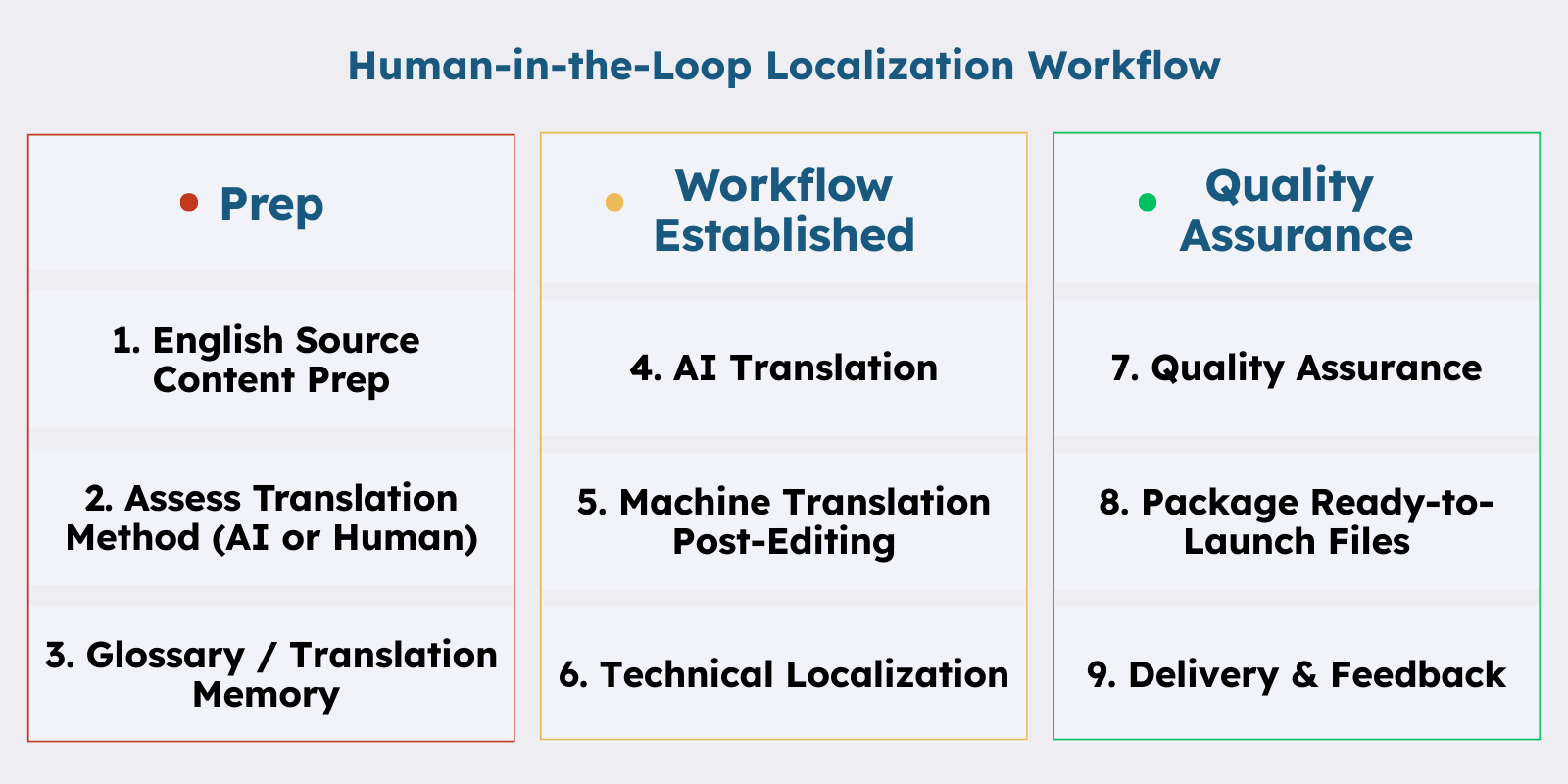
How AI Machine Translation is integrated into a Human-in-the-Loop localization process, emphasizing source content preparation, Machine Translation Post-Editing, technical localization, and multi-step quality assurance to deliver reliable, launch-ready multilingual content.
Interpro’s Human-Focused AI Blueprint
- Discovery workshops map content types, brand voice, and risk profiles.
- Custom engine fine-tuning raises baseline quality by several BLEU points for each domain.
- Linguists using processes in accord with ISO Standards post-edit low-confidence output and audit high-confidence auto-publications.
- Private-cloud or on-prem hosting protects confidential data.
- Live dashboards track savings, turnaround, and Translation Quality Scores in plain language for stakeholders.
Building an Effective Evaluation Checklist (build a downloadable PDF)
- Check comprehension – intent carries through with no critical meaning loss.
- Inspect fluency – sentences read naturally to native speakers.
- Verify glossary matches – all protected terms appear exactly as approved.
- Confirm numbers, dates, and units – no wrong decimals, no mismatched formats.
- Scan regulatory language – required clauses stay intact.
- Review cultural tone – imagery, idioms, and color choices respect local norms.
- Assess formatting – every tag, link, and placeholder is reproduced.
- Document edits – create an audit trail for ISO 17100 and EU AI-Act compliance.
Applying this checklist in combination with neural quality estimation lets busy teams release trustworthy content at speed.
Frequently Asked Questions
What languages see the biggest quality jump?
High-resource pairs such as English–Spanish or English–German gain the most immediately, but custom-trained engines increasingly lift lower-resource languages as well.
Will AI remove the need for professional translators?
No. Professionals shift from typing every word to curating, reviewing, and guiding brand voice across cultures.
How often should an MT engine be retrained?
Every quarter, or whenever there is a major terminology or product-line change.
Is AI Machine Translation safe for legal or medical text?
Only with full human review and strict glossary enforcement. Interpro routes all high-risk content to specialists.
Can Interpro plug into our current TMS?
Yes. Connectors integrate with leading platforms such as Phrase, Smartling, and Trados.
Efficiently Leverage AI for Translation Today
If you’re still trying to figure out how to use AI to reduce costs, maintain translation accuracy, and launch in more languages faster, you’re not alone. Many of our clients start by asking, “How can AI translation work for us?”
Our answer: It depends, but Interpro can help you craft a tailored localization strategy for your content, your industry, and your audience. A quick strategy call with the Interpro team provides you complimentary consultative advice. We’ll help you:
- Identify which content types are a good fit for AI translation
- Estimate if there are cost savings by using AI translation + MTPE workflow
- How to integrate the AI workflow with your team
Work with Interpro to build a strategic localization workflow that aligns with your content, your risk level, and your business goals.
Category: AI Translation
Service: AI Translation

Don't forget to share this post!



Stay Updated with Interpro
Subscribe to our newsletter for the latest updates and insights in translation and localization.