

Associations expanding their eLearning programs globally need more than translation. Successful multilingual learning requires localization, thoughtful planning, the right mix of AI and human review, terminology management, LMS readiness, and a strategy for maintaining content over time. The organizations that see the best results treat localization as an ongoing part of the learner experience, not a one-time project.
Association leaders are under increasing pressure to make education, certification programs, and professional development more accessible to broader audiences. As organizations expand their reach, translation often becomes part of the conversation. The challenge is that many organizations focus only on translating words when the larger opportunity is creating a learning experience that works across languages, cultures, and markets.
This article summarizes the key ideas covered in our ASAE presentation, Now You’re Speaking My Language! A Guide to Translating eLearning provides practical considerations for associations evaluating multilingual education strategies.
Contact Interpro for a free consultation if you’re planning a multilingual learning program and would like guidance tailored to your organization. Get your content, goals, timeline, and available resources evaluated by subject matter experts to determine the right localization strategy for your needs.
Why More Associations Are Exploring Multilingual Learning
Many associations are investing in global growth initiatives, expanding educational offerings, and seeking new ways to increase access to member resources.
As organizations reach more diverse audiences, language can become either a barrier or a bridge. Translation is often one component of removing those barriers, but successful multilingual learning programs require a broader strategy focused on learner experience, accessibility, engagement, and long-term sustainability.
These tips should help you with expanding into new markets.
1. Translation and Localization Are Not the Same Thing
Translation converts words from one language to another.
Localization adapts the full learning experience for a specific audience. That may include modifying content, design, examples, terminology, graphics, formatting, and cultural references to better align with learner expectations.
Organizations frequently discover that a course can be accurately translated while still creating confusion for learners because important context was never localized.
2. Localization Extends Beyond Language
Localization projects often involve far more than text.
Depending on the content and audience, organizations may need to account for graphics, user experience, local preferences, regulations, formatting conventions, currency references, measurements, and other market-specific considerations. These elements can have a meaningful impact on how content is received and understood.
3. There Is No One-Size-Fits-All Localization Strategy
Every association has different goals, budgets, resources, and risk profiles.
Some programs rely heavily on internal subject matter experts. Others use professional language services, AI-powered workflows, or hybrid approaches that combine technology and human review. The right approach depends on the audience, the importance of the content, the update frequency, and the consequences of errors.
From Interpro’s perspective, the question is rarely whether AI or human translation is best. The better question is what combination of resources will achieve the required level of quality while supporting business objectives.
A Marketing Campaign Localization Example
A short marketing tagline may seem easy to translate, but a few words can carry significant cultural and reputational risk.
An Interpro client once needed to localize the City of Chicago’s tagline, “Never Done, Never Outdone,” for an Italian audience. Interpro’s professional Italian linguists translated it as “Instancabile. Ineguagliabile.” The client ultimately chose a different translation suggested by a family friend: “Mai finito. Mai superato.”
When that version appeared on a billboard in Italy, it received strongly negative feedback from local audiences because the message sounded incorrect and did not communicate the tagline’s intended meaning. The client ultimately returned to the translation Interpro had originally provided.
This example illustrates why effective marketing localization requires more than replacing individual words. Even when the source content is short, professional linguists must consider tone, intent, cultural context, and how the final message will be understood by the people who encounter it. A tagline that works in one language may need to be carefully adapted to preserve its impact in another.
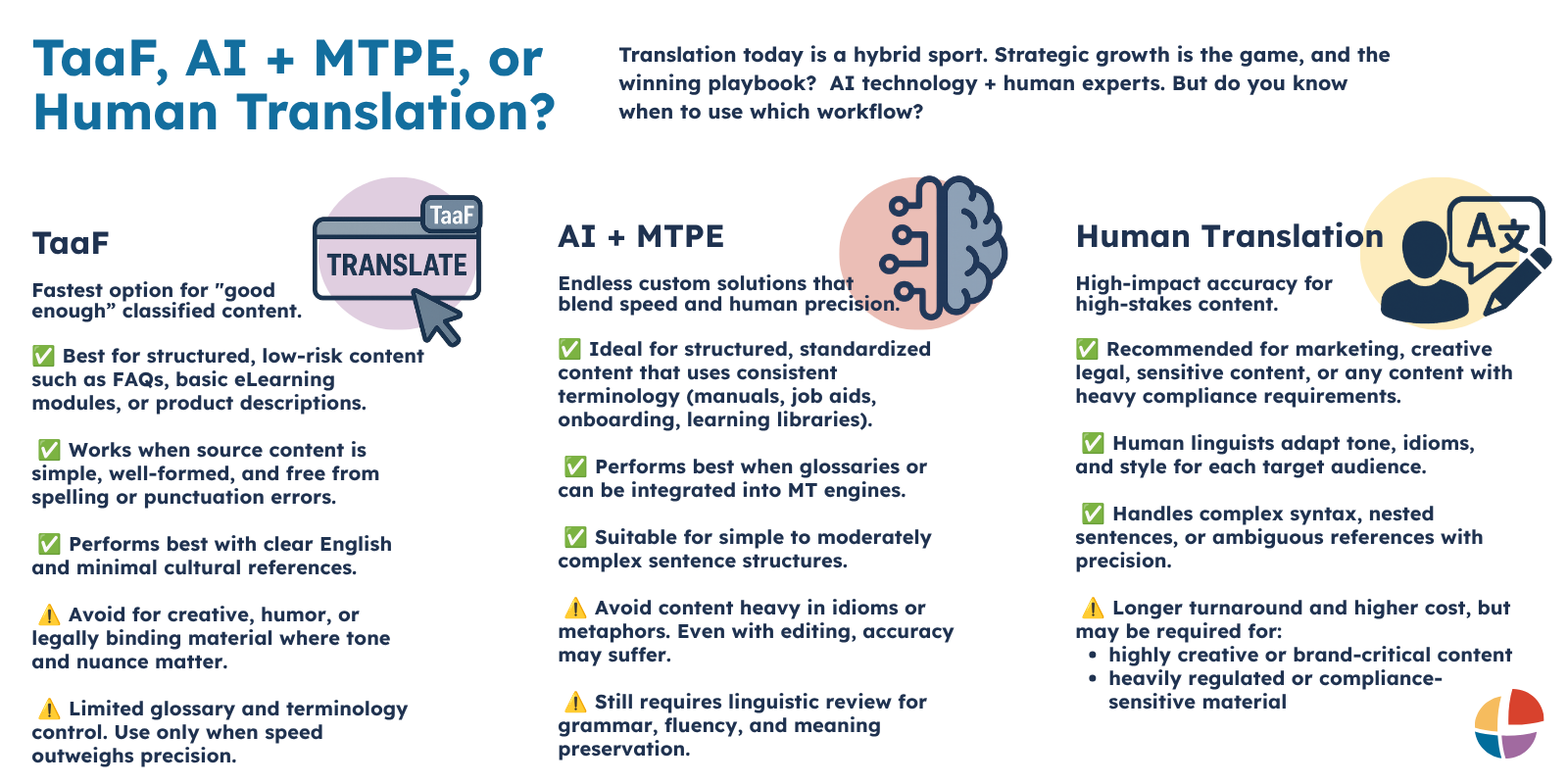
A side-by-side comparison of translation workflows to help organizations choose the right balance of speed, cost, and quality.
4. Build Your Process Before You Scale
One of the most common challenges organizations face is attempting to localize content without a documented workflow.
Successful programs generally follow a structured process that includes planning, translation, review, quality assurance, publication, and ongoing maintenance. A repeatable system creates consistency, improves quality, and reduces the amount of rework required later.
Localization becomes significantly easier when organizations establish their process before multilingual content begins to scale.
5. Terminology Management Creates Consistency
Educational content often contains industry-specific terminology, professional credentials, program names, and technical concepts.
Without terminology standards, those terms may be translated differently throughout courses, assessments, marketing materials, support documentation, and future updates.
Many organizations benefit from creating glossaries and terminology resources early in the localization process. These tools help maintain consistency across content, reviewers, translators, and future projects.
6. Where AI and MTPE Can Add Value to Localization
Artificial intelligence has created new opportunities for organizations seeking faster multilingual content workflows.
Machine Translation Post-Editing (MTPE) combines machine-generated translations with human review and refinement. This approach may be appropriate for specific content types such as transcripts, captions, lower-risk materials, and projects where turnaround time is a primary consideration.
The most important step is establishing quality expectations before work begins. Organizations should understand what level of quality is required and select the workflow that aligns with those expectations.
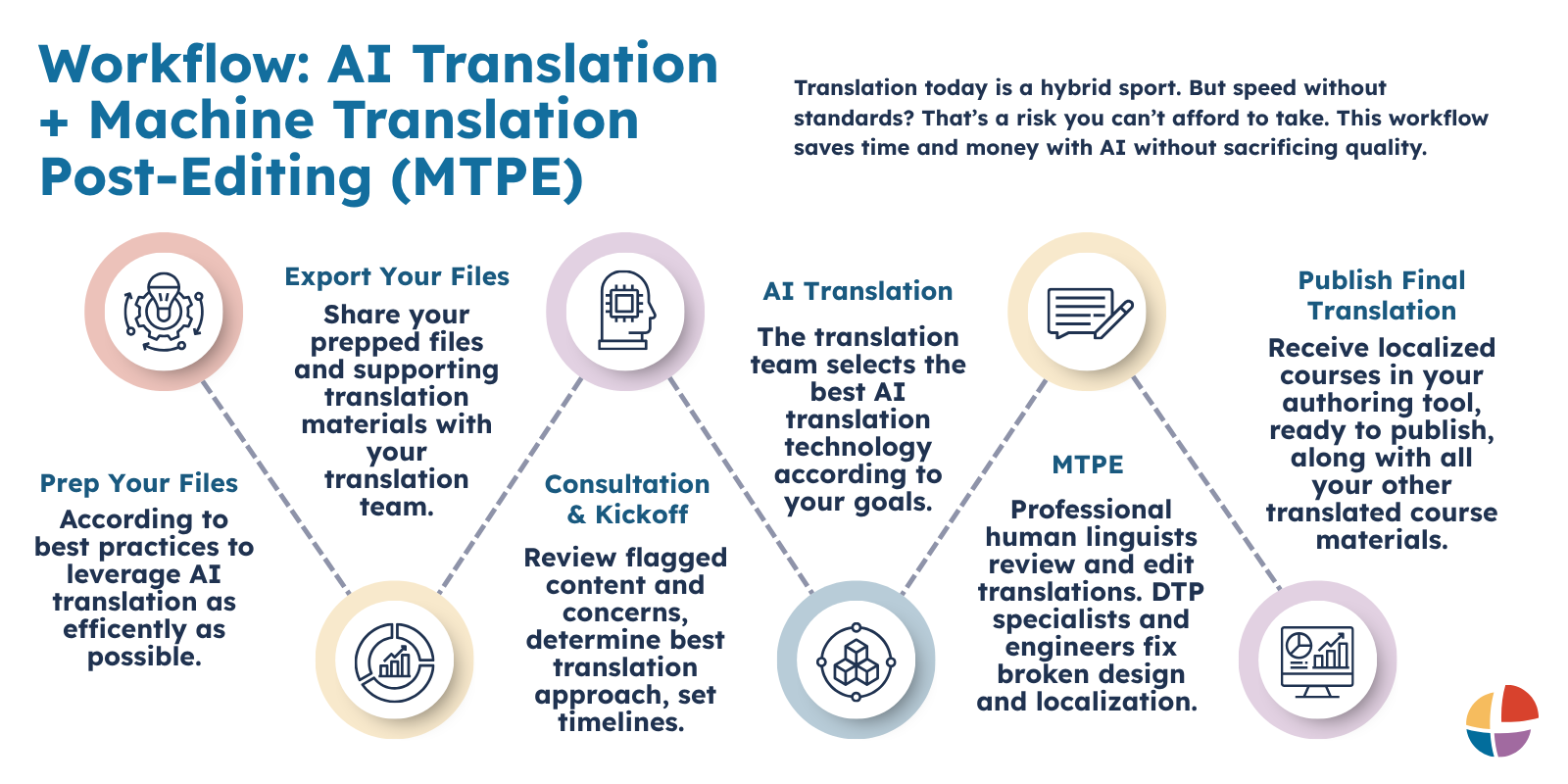
Step-by-step workflow illustrating how AI translation and human post-editing work together to deliver localized content.
7. Human Expertise Still Plays an Important Role in AI Translation
AI can support localization workflows, but technology does not eliminate the need for human review.
Subject matter expertise, cultural understanding, in-country review, quality assurance, and stakeholder feedback often remain important parts of the localization process. Human reviewers help validate meaning, identify context issues, and ensure content aligns with audience expectations.
This is particularly important for educational content where learner comprehension and trust are directly affected by the outcomes.
8. Common Localization Mistakes to Avoid
Many localization projects encounter similar challenges.
Common issues include treating translation as an afterthought, skipping terminology planning, limiting reviewer participation, relying on AI without sufficient quality controls, and failing to assign long-term ownership for future content updates.
Most of these challenges can be reduced through better planning before translation begins.
9. Budgeting for the Entire Content and Localization Lifecycle
Translation is rarely a one-time expense.
Organizations should consider not only the initial localization effort but also future updates, reviews, maintenance requirements, staffing availability, and quality management processes. Courses that change frequently may require a very different strategy than content that remains relatively stable for years.
10. Learner Discovery and Experience Matters Too
A translated course cannot create value if learners never find it.
Organizations should think beyond the course itself and consider how multilingual audiences discover educational opportunities. Marketing, website content, course catalogs, community engagement, learner communications, and support resources all contribute to the overall learner experience.
Localization should support the entire learner journey, not just the educational content itself.
11. Securing Leadership Support to Invest in Localization
Successful localization projects are often tied directly to organizational goals.
Leadership teams frequently respond more strongly to discussions around member engagement, workforce development, accessibility, global growth, credential adoption, and risk reduction than to conversations focused solely on language. Positioning localization as a business and mission support initiative can help organizations gain alignment and support.
12. Treat Localization as an Ongoing Strategy
One of the central themes from this presentation is that localization is not the finish line.
The most successful programs continuously evaluate audience needs, update content, review performance, gather feedback, and improve the learner experience over time. Translation should be viewed as part of a larger content lifecycle rather than a standalone project.
Organizations that approach localization strategically are typically better positioned to scale educational content, improve learner outcomes, and support long-term growth initiatives.
Need help building a multilingual learning strategy?
Contact Interpro for a free consultation and discuss your goals with our team. We’re happy to help you evaluate content, priorities, resources, and workflow options for your next eLearning localization initiative.
Category: Events, Localization
Service: eLearning Translation

Don't forget to share this post!


Stay Updated with Interpro
Subscribe to our newsletter for the latest updates and insights in translation and localization.