
Selecting a Translation Services Provider: An RFP Guide to Choosing a Localization Partner


Learn what makes a successful translation services request for proposal (RFP) that evaluates more than pricing and language coverage. The right localization partner should demonstrate strong quality assurance, controlled AI translation, human review processes, scalability, and documented workflows that support your organization’s goals and risk tolerance.
Organizations buying translation services today face a very different decision than they did even a few years ago. Translation procurement is no longer simply about finding a vendor that supports a specific language pair at the lowest cost. Buyers are now evaluating AI-enabled workflows, quality governance, terminology management, compliance requirements, scalability, and long-term accountability.
The challenge facing many organizations is not selecting between AI and humans. It is determining how to make localization decisions and building an efficient localization system that balances cost, quality, risk, and operational reality. Interpro positions itself as a strategic localization solutions partner that helps organizations make defensible decisions through structured workflows, human oversight, and governance.
Whether you are preparing your first translation services RFP or re-evaluating existing language providers, this guide will help you create a more effective vendor selection process and identify the qualities that matter most in today’s AI-driven localization environment. Organizations evaluating providers should consider the full range of modern Translation & Localization Services, from traditional human translation to AI-enabled localization workflows.
Why Translation Vendor Selection Has Become More Complex
Not long ago, translation and localization procurement focused primarily on language coverage, turnaround times, cost per word, and industry expertise.
Those factors still matter. However, modern organizations are increasingly asking larger strategic questions:
- Can AI translation be used safely?
- When is human review required?
- How is terminology controlled?
- Who is accountable when quality issues arise? Or worse, errors that impact reputation, conversion, or compliance?
- What documented processes support consistency across thousands of projects?
For procurement teams, marketing leaders, HR departments, training groups, marketing and communication teams, compliance stakeholders, and localization managers, selecting a language services provider now requires evaluating an entire localization system rather than an isolated translation service.
What Should Be Included in a Translation RFP?
A strong translation services RFP creates a level playing field for vendor comparison while uncovering the operational realities behind each provider’s proposal.
At a minimum, your RFP should include:
Organizational Background
Help vendors understand:
- Your industry
- Business objectives
- Global footprint
- Target audiences
- Existing localization challenges
Scope of Translation Requirements
Clearly define:
- Languages required
- Content types
- Volume expectations
- Project frequency
- Required turnaround times
For example, Document Translation, Website Translation, Software Translation, and eLearning Translation projects often require different workflows, technologies, review processes, and subject matter expertise.
Technology Requirements
Include questions regarding:
- AI translation capabilities
- Translation Management Systems (TMS)
- Translation Memory usage
- API integrations
- Content management workflows
Quality Expectations
Define expectations for:
- Human review
- Quality assurance procedures
- Linguistic testing
- Terminology consistency
- Review processes
Security and Compliance
Address requirements involving (especially when using AI translation):
- Data protection
- Confidentiality
- Industry regulations
- Access controls
- Secure file handling
Vendor Evaluation Criteria
Provide transparency regarding:
- Decision factors
- Scoring methodology
- Evaluation timelines
- Final selection process
The better your RFP defines expectations, the better your vendor responses will be.
Questions Every Translation RFP Should Ask
Many organizations focus heavily on pricing while overlooking the systems that ultimately determine translation quality and business outcomes.
The following categories help reveal how providers actually operate.
Quality Management
Ask:
- How is translation quality measured?
- What quality standards guide your workflows?
- How do you handle corrective actions?
- Can you demonstrate repeatable quality processes?
Look for providers with documented workflows rather than subjective quality claims.
AI Translation Workflows
Ask:
- Which AI translation technologies are used?
- How do you determine whether content is appropriate for AI?
- What safeguards exist for sensitive content?
- How is AI output evaluated?
Many organizations evaluating modern localization providers also ask whether the vendor offers dedicated AI Translation Services and how AI outputs are governed throughout the localization process. Problems typically arise when organizations lack structured AI decision-making frameworks, terminology control, quality assurance, and human oversight.
Organizations that are still defining their AI strategy may also benefit from specialized AI Translation Consulting to help establish governance frameworks, workflow design, and content suitability guidelines.
Human Review Processes
Ask:
- When are linguists involved?
- What levels of review are provided?
- How are reviewer qualifications verified?
- What content requires human validation?
Human review remains a critical risk management tool, particularly for high-visibility, regulated, or customer-facing content.
For AI-enabled localization programs, many buyers specifically ask about AI Machine Translation Post-Editing workflows, where professional linguists review and refine machine-translated content according to quality requirements and business risk.
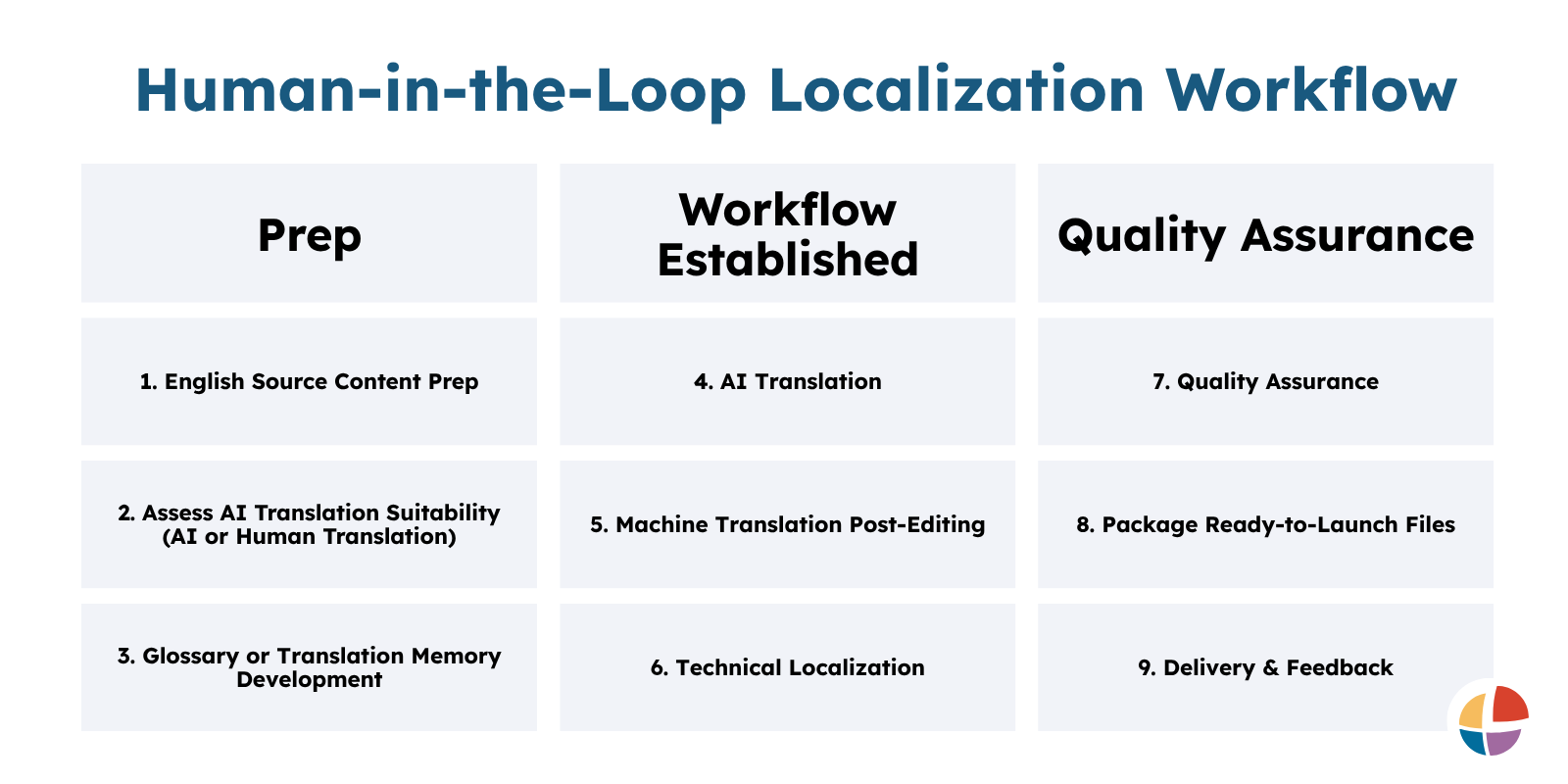
Human-in-the-Loop localization combines AI translation, linguistic review, terminology management, technical localization, and quality assurance within a governed workflow.
ISO Certifications
Ask:
- Which ISO standards does your organization maintain?
- How are those standards incorporated into daily operations?
- What auditing procedures exist?
Certifications represent evidence of documented process maturity rather than marketing claims.
Security and Compliance
Ask:
- How is client data protected?
- What security controls are in place?
- How are confidential projects managed?
- What compliance frameworks are supported?
Security becomes increasingly important as AI-enabled workflows process larger content volumes.
Terminology Governance
Ask:
- How are glossaries created and maintained?
- What terminology controls exist?
- How are brand standards enforced?
- How is terminology approval managed?
Terminology management often separates consistent localization programs from inconsistent ones.
Project Management
Ask:
- Who owns project accountability?
- What escalation paths exist?
- How are status updates communicated?
- How are competing priorities managed?
Strong project management reduces operational friction across multilingual programs.
Scalability
Ask:
- How do you support growth into new languages?
- How are large translation volumes managed?
- What happens during demand spikes?
- How quickly can resources scale?
Scalability matters when localization becomes a business growth initiative rather than a transactional service.
How to Evaluate Translation Providers Fairly
The most effective evaluation frameworks compare vendors on capability areas that directly affect business outcomes.
| Evaluation Area | What to Look For | Risk if Missing |
| ISO Certifications | Documented, repeatable processes | Inconsistent quality |
| Human Review | Accuracy validation and oversight | Errors reaching end users |
| Glossary Management | Terminology consistency | Terminology drift |
| Translation Memory | Reuse and efficiency controls | Repeated rework |
| AI Workflow Governance | Controlled AI implementation | Unmanaged risk |
| Security Controls | Documented compliance practices | Data exposure |
| Project Management | Clear ownership and accountability | Communication breakdowns |
| Consulting Support | Strategic guidance | Workflow inefficiency |
| Scalability | Ability to support growth | Operational bottlenecks |
A common mistake is assigning disproportionate weight to pricing.
Translation services that appear inexpensive initially can become significantly more expensive when poor quality, rework, inconsistent terminology, or compliance issues emerge later.
A better approach is evaluating overall operational value.
Strategic guidance is often overlooked during vendor evaluations. Providers that offer Localization Consulting can help organizations design scalable localization systems, establish governance models, and improve operational efficiency beyond the translation project itself.
Freelancer, Vendor, Full-Service Partner, or Team Extension?
Not every organization requires the same level of support.
The optimal provider model depends on business objectives, content complexity, risk tolerance, and internal resources.
| Service Model | Best For | Limitations |
| Freelance Translator | Small projects and occasional needs | Limited scalability and coverage |
| Translation Marketplace | High-volume, low-risk content | Minimal governance and accountability |
| Traditional LSP | Project-based support | May remain transactional |
| Full-Service Localization Partner | Ongoing multilingual programs | Requires greater collaboration |
| Team Extension Model | Complex global enterprises | Demands strategic partnership |
Organizations handling regulated content, global learning programs, software localization, multilingual marketing, or enterprise communications often benefit from providers capable of functioning as strategic partners rather than isolated vendors.
Full-service providers often support diverse multilingual programs that span marketing, training, product development, customer support, and global communications. This may include services such as Website Translation, Software Translation, and eLearning Translation.
This is particularly true when localization intersects with compliance requirements, digital transformation efforts, or AI adoption initiatives.
How ISO Certifications Reduce Business Risk
Many RFPs include certification requirements, but buyers do not always understand what those certifications actually signify.
ISO certifications do not guarantee perfect translations. But they do provide documented, repeatable processes that help reduce quality, compliance, and operational risk.
ISO 9001
Focuses on quality management systems.
This certification demonstrates that an organization maintains documented quality controls, continuous improvement practices, and consistent operational procedures.
ISO 17100
Specifically addresses translation services.
The standard establishes requirements for translator qualifications, project management, review processes, and quality management throughout the translation lifecycle.
ISO 18587
Addresses machine translation post-editing.
This standard provides guidance for integrating AI translation with structured human review processes.
As AI adoption grows, ISO 18587 becomes increasingly relevant because it defines expectations for achieving quality outcomes within machine-assisted workflows.
The key question is whether the provider can demonstrate how those standards are operationalized in daily work.
Organizations seeking to implement AI responsibly often combine ISO-governed processes with structured AI Translation Services and human review workflows to balance efficiency and quality.
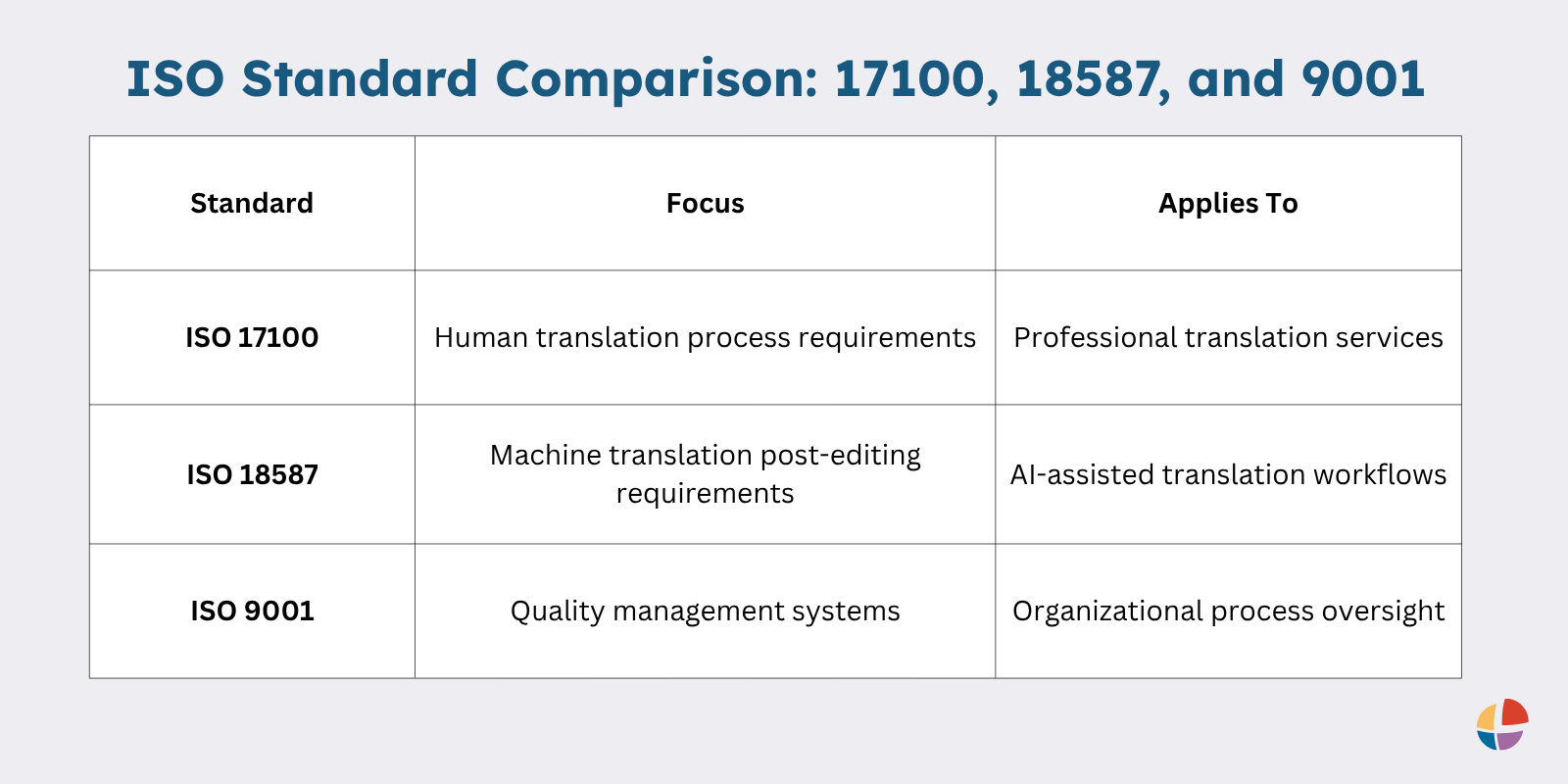
ISO 17100, ISO 18587, and ISO 9001 address different aspects of translation quality, AI-assisted workflows, and operational process management.
The Growing Importance of AI Translation Vendor Evaluation
AI translation has become a standard component of modern localization. The question is no longer whether AI should be used. Instead, organizations must determine when it should be used and how it should be governed.
This is where many RFPs fall short. They focus on the technology itself rather than the decision-making framework surrounding it.
A stronger evaluation approach examines:
- AI suitability assessments
- Human-in-the-Loop workflows
- Quality assurance controls
- Terminology management
- Risk categorization
- Escalation procedures
Interpro’s approved positioning emphasizes that organizations often believe they need the right AI tool when they actually need a structured localization system that governs how AI is used.
As AI adoption accelerates, buyers increasingly want partners that can provide both technology implementation and strategic guidance. Combining AI Translation Services with AI Translation Consulting can help organizations make informed decisions about where AI fits within their broader localization strategy.
Your Translation Vendor Is Really a Localization System Partner
One of the most important shifts occurring in the localization industry today is the recognition that translation is no longer a standalone task.
Translation is now part of a broader operational system.
That system includes:
- Content governance
- AI decision-making
- Human review processes
- Translation Memory management
- Terminology control
- Quality assurance
- Security requirements
- Reporting and analytics
Modern localization systems often encompass a wide range of services, including Document Translation, Website Translation, Software Translation, eLearning Translation, and even Interpreting Services. What matters is not simply the service itself but the governance, workflows, and quality controls supporting it.
Translation RFP Key Takeaways
As you evaluate providers through your translation services RFP process, resist the temptation to focus exclusively on language coverage or pricing. Instead, examine the systems behind the service.
Ask what quality is “good enough”.
Ask how AI is managed, and localization decisions are made.
Ask who is accountable when challenges arise.
Ask how terminology, compliance, and scalability are maintained over time.
Organizations that treat localization as a business system rather than a series of individual projects are often better positioned to scale globally. Working with a provider that offers both comprehensiveTranslation & Localization Services and Localization Consulting can help create the structure needed for long-term multilingual growth.
The organizations that achieve the best localization outcomes are rarely those that select the cheapest vendor. They are the organizations that choose a partner capable of supporting long-term multilingual growth with structure, consistency, and accountability.
Ultimately, the right choice is not simply the provider with the best proposal.
Choose the partner whose processes, workflow, and quality assurance match your organization’s risk tolerance and growth goals.
Category: Translation
Service: Translation Services
Don't forget to share this post!


Stay Updated with Interpro
Subscribe to our newsletter for the latest updates and insights in translation and localization.