

Most teams think eLearning localization means swapping the language and hitting publish. However, it’s a complex production process spanning text, images, audio, video, and quality assurance, and AI translation only touches one part of it. Here’s what actually happens behind the scenes, and exactly where machine translation post-editing (MTPE) fits into a system built to protect quality at scale.
Picture a learning and development manager, call her Maya, who gets a Friday afternoon request: “Can we get the new compliance training translated into six languages? Should be quick; the course is already built.” Maya forwards the files to a vendor, blocks two weeks on the calendar, and starts planning the rollout.
Three weeks later, she’s reviewing the localized course, and it isn’t going well. The Italian version cuts off button labels mid-word. The French narration runs two seconds ahead of the slide transitions. And someone on the German team has flagged that a screenshot in Module 3 still shows the English version of the software interface.
None of this happened because the translation was wrong. The words were accurate. It happened because the project was treated like a single task: translate the text, instead of what it actually is: a coordinated system with a lot of moving parts.
eLearning Localization Isn’t One Thing. It’s a Layered System.
eLearning localization is the process of adapting a digital training course, not just its text, but its images, audio, video, captions, and supporting files, so it functions correctly and reads naturally in another language. It’s a production pipeline, not a translation task.
A typical course includes far more than on-screen text. It includes images with embedded copy that have to be recreated, audio narration that has to be re-recorded or synthesized, video assets that need subtitles or voice-over, and caption files that have to stay in sync with whatever is happening on screen. Externally, there are often supporting PDFs and downloadable resources that need the same treatment, including:
- On-screen text inside the course interface
- Text embedded in images
- Audio narration and voice-over scripts
- Video content with spoken dialogue and on-screen text
- Closed captions and subtitle files
- External materials like PDFs and downloadable resources
Each of these elements moves through its own workflow. Some are extracted and reinserted, some are rebuilt from scratch, and some require dedicated multimedia engineering. They are not translated the same way, and they cannot be handled by AI translation alone.
This is the snag that caught Maya’s project. Her vendor translated the text correctly, but text was only one of six asset types in that course, and the other five didn’t get the same structured attention.
How Does the eLearning Localization Workflow Actually Work?
A well-run localization project doesn’t move straight into production. It follows a structured lifecycle designed to catch problems while they’re still cheap to fix. At a high level, the process looks like this:
- Files are analyzed and prepared
- Text is translated, reviewed, and validated
- Courses are rebuilt with localized content
- Audio and video are created or adapted
- Full-course QA validates functionality and user experience
- Final delivery is tested in the client’s LMS
Steps two and four are separated on purpose. On-screen text is finalized before any audio or video work begins, because audio and video are the most expensive elements to change. If a linguistic issue surfaces after voice-over has already been recorded, the fix isn’t a quick edit; it’s a re-record, a re-sync, and a delay.
This is exactly where Maya’s French audio problem started. The script was adjusted after the narration was already recorded, and nobody went back to re-sync the timing. A structured workflow exists specifically to prevent that sequence of events.
Where Does AI Translation plus MTPE Actually Fit in the eLearning Localization Process?
This is where AI translation, and more specifically, machine translation with post-editing (MTPE), comes into the picture.
AI translation doesn’t replace the workflow above. It plugs into it. Specifically, it accelerates one phase: the initial translation of on-screen text and supporting content. That output isn’t treated as final. It still moves through human review, revision, and proofreading, context validation inside the actual course, and QA across interactive elements.
That’s what MTPE is in practice. It’s not replacing human translation with AI; it’s AI-assisted translation as the first step in a controlled, quality-managed process.
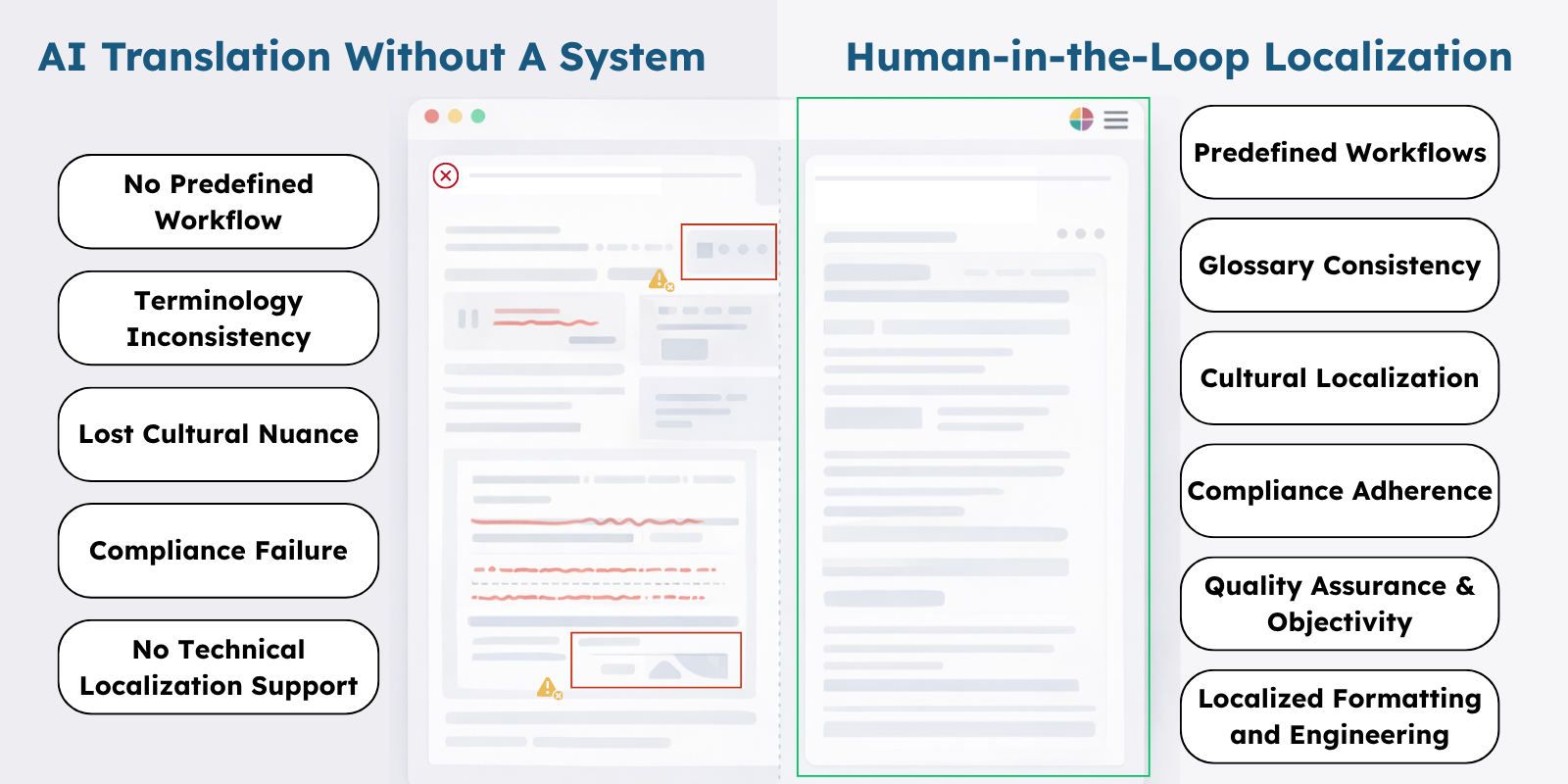
A side-by-side comparison showing how structured Human-in-the-Loop localization workflows support quality, consistency, compliance, and localization success beyond raw AI translation.
What Happens When Teams Skip the Process and Rely on Raw AI Translation Alone?
When that process gets skipped, when raw AI output goes straight into a course without the layers around it, problems show up fast, and they don’t show up at the sentence level. They show up inside the course itself.
Why Does Image Localization Trip Up AI Translation Tools?
Text embedded in images isn’t even part of the export most translation tools work from. It has to be manually extracted, translated separately, and reinserted into the visual design using design tools. AI translation has no path into that workflow; it requires engineering and design intervention every time. It’s also a useful way to think about where MTPE’s boundary actually sits: MTPE covers the text layer. Handling full asset complexity, images, design, and engineering is a separate, parallel track that has to run alongside it.
Why Are Screen Captures a Hidden Risk?
Translating the text inside a screenshot doesn’t guarantee the screenshot matches what users actually see in the localized version of the software. In Maya’s case, the German screenshot still showed English menu labels, not because anyone mistranslated anything, but because nobody captured a localized screenshot to replace it. In most projects, the only reliable fix is using client-provided, localized screenshots. Translation, AI, or humans can’t solve this on their own.
Why Does AI Voice-Over Struggle with Pronunciation?
Automated voice workflows hit limits quickly. Text-to-speech engines can mispronounce acronyms or industry terms; a common example is “IRS” coming out wrong in a Spanish narration, and the workaround sometimes means manually altering the spelling in the script just to coax a closer pronunciation out of the engine. Automation speeds up execution. It doesn’t replace the person checking whether what came out actually sounds right.
What Are the Different Paths for Video Localization?
Video localization alone branches into several distinct paths: burned-in subtitles, toggleable on/off captions, full audio replacement, or on-screen text replacement. Each comes with a different scope, timeline, and cost. AI translation touches exactly one part of this: the script. Everything else, like the engineering, the multimedia work, and the QA, runs on a separate track.
How Does Quality Assurance Work in eLearning Localization?
Quality Assurance (QA) in eLearning localization happens in at least two phases, and that two-phase structure is one of the biggest differentiators between a managed workflow and an AI-only approach.
First, translated content is validated inside the course before any audio or video is added; this is pre-audio QA, checking text and layout. Then, after multimedia elements are integrated, the entire course gets tested again for synchronization, playback, and functionality. Final delivery is tested once more inside the client’s actual LMS.
The issues that show up at this stage rarely look like translation errors. Text overflows a button. Layouts break. Quiz feedback fires incorrectly. Captions drift out of sync with narration. Formatting goes inconsistent across different states of the same interactive object. These are experience errors, not linguistic ones, and they only surface during full-course QA, which is exactly the stage that would have caught Maya’s stale screenshot before the course ever reached learners.
Is AI Voice-Over Actually Reliable for eLearning?
AI-generated voice-over is a legitimate option inside a structured workflow, but it’s never treated as a finished product on its own. It gets scoped, reviewed, and QA’d like every other component, and in many cases it’s directly compared against a professional human recording to confirm it meets the quality bar for the project. The technology is useful. It still operates inside the same controls as everything else.
Why MTPE Works as a Scaling Mechanism, Not a Shortcut
Used correctly, MTPE does real work for organizations translating training content at volume. It can increase translation speed in high-volume environments, maintain consistency across large course libraries, reduce turnaround time without sacrificing quality, and support more target languages inside the same operational window.
But it only delivers those gains when it’s paired with defined workflows, human linguistic review, engineering support, and QA at both the content and course level. Strip those layers out, and quality becomes unpredictable, a real problem in compliance-driven environments where training content carries legal and regulatory weight.
Why Does Process Transparency Matter?
The biggest challenge in this space is usually education. Some assume AI translation is instantly interchangeable with professional localization. Others assume MTPE just means “light editing after the fact.” Neither is accurate, and the gap between those assumptions and reality is exactly what derailed Maya’s first attempt.
Understanding the actual workflow matters for setting realistic timelines, aligning on quality expectations upfront, making informed decisions about where AI is genuinely appropriate, and avoiding the kind of downstream rework Maya ended up doing. Transparency here isn’t a nice-to-have; it’s what keeps projects on schedule and on budget.
Localization Today Is About Orchestrating the Process
At its core, eLearning localization is an orchestration problem. It means coordinating content, the technology platform the course is built on (Storyline, Rise, or whatever LMS environment it lives in), audio and video production, linguistic quality, and user experience validation, all at the same time, across however many target languages the project requires.
AI translation and MTPE are genuinely useful additions to that system. They are not the system. Organizations that get this right stop asking “Can AI replace this process?” and start asking “How do we integrate AI into a process that’s already built to deliver quality at scale?” That second question is the one that gets Maya’s next course launched on time.
Where AI Translation Fits and Where It Doesn’t
A quick reference for what AI translation can and can’t carry on its own:
| Asset Type | Can AI Translation Handle It Alone? | What It Actually Requires |
| On-screen text | Yes, as a first-pass draft | Human review, context validation, course-level QA |
| Embedded image text | No | Manual extraction, separate translation, design reinsertion |
| Audio narration | Partial — script only | Recording or synthesis, pronunciation QA, timing sync |
| Video (dialogue + on-screen text) | Partial — script only | Subtitle/caption engineering, sync QA, format decisions |
| Captions and subtitles | Partial — text only | Sync validation, formatting QA |
| Screen captures / UI screenshots | No | Client-provided localized screenshots or manual recreation |
| External files (PDFs, etc.) | Partial | Layout and design re-engineering |
AI Translation for eLearning Localization Key Takeaways
AI translation is changing the conversation around localization, but it hasn’t changed what it actually takes to deliver a functional, high-quality eLearning course across languages. That still requires structure. It still requires oversight. And it still requires a partner who understands how every one of these pieces fits together, because the difference between Maya’s first course launch and her second one wasn’t the translation quality. It was the process around it.
Frequently Asked Questions
Q: What is eLearning localization?
eLearning localization is the process of adapting a digital training course, its text, images, audio, video, and captions, so it functions correctly and reads naturally for learners in another language and region. It’s a multi-step production process, not a single translation task.
Q: What’s the difference between AI translation and MTPE?
AI translation is a raw, machine-generated output. MTPE (machine translation post-editing) is that same output run through human review, revision, and validation before it’s considered finished. AI translation is a starting point; MTPE is the controlled process that makes it usable.
Q: Can AI translation handle an entire eLearning course on its own?
No. AI translation can handle on-screen text as a first draft, but it can’t extract and reinsert text embedded in images, generate accurate localized screenshots, guarantee correct audio pronunciation, or validate how translated content behaves inside an interactive course. Those require human review and engineering.
Q: Why does on-screen text need to be finalized before audio and video work begins?
Audio and video are the most expensive elements of a course to change. Finalizing text first catches linguistic issues while they’re still cheap to fix, instead of after voice-over has been recorded and timed, which would require a costly re-record and re-sync.
Q: Is AI voice-over reliable for eLearning courses?
It can be, but it’s never used unchecked. AI voice-over is scoped, reviewed, and QA’d like any other workflow component, and pronunciation issues with acronyms or technical terms are common enough that they typically still need manual correction.
Q: What industries rely most heavily on structured eLearning localization workflows?
Compliance-driven industries, including healthcare, finance, manufacturing, and any regulated field with mandatory training, lean on structured workflows the most, since translation errors in required training carry real legal and regulatory risk.
Category: AI Translation

Don't forget to share this post!



Stay Updated with Interpro
Subscribe to our newsletter for the latest updates and insights in translation and localization.