

AI translation is advancing rapidly, but quality still determines success. MTQ evaluates how machine-generated translations measure up in fluency, meaning, terminology, and risk. TQS offers a post-editing score to guide decisions, while MTQE predicts quality pre-review to optimize workflows. Together, these systems help businesses scale content efficiently without compromising trust. Interpro advises combining scores, human review, and ISO standards to navigate the evolving AI translation landscape.
Translation Quality Still Makes (or Breaks) Global Brands
Accuracy is required for content that has to serve an audience across multiple languages – so monitoring AI translation quality is critical. A single mislabeled allergen, mis-translated drug dosage, or tone-deaf slogan can trigger recalls, PR crises, and even regulatory fines. Yet content velocity keeps rising: Technavio projects the machine-translation market alone will add USD 1.23 billion between 2024 – 2028.
However, using AI for translation has introduced as many new challenges for companies as it has benefits. Here are the methods global teams use to control AI translation quality so they can scale multilingual content that is accurate, compliant, and safe to trust.
PS before you read this article: Don’t let the word “machine” in MTPE throw you off – the term actually came from what we know as AI translation actually started as machine translation in the 1980s.
What is Machine Translation Quality?
Machine Translaation Quality (MTQ) is the umbrella term for how we judge the fitness of machine-generated output (aka AI translation output): fluency, adequacy, style, and risk. Early rule-based systems scored low on every front. Today’s AI translation engines can reach near-human fluency on many language pairs, but only when prepared and measured properly.
Key MTQ pillars:
- Adequacy: Does the target carry the same meaning?
- Fluency: Would a native reader call it natural?
- Terminology: Are product names and regulated phrases intact?
- Risk: Are there critical omissions (numbers, units, legal clauses)?
How Different Industries Might Use Machine Translation Quality:
For HR and Corporate Communications: Quickly translate internal memos, compliance updates, and safety notices for multilingual employees, then apply light post-editing for clarity and tone.
For eLearning Developers: Draft multilingual versions of course content and assessments, then refine with human linguists to localize learning objectives, technology, and regional nuance.
For Healthcare Organizations: Pre-translate large volumes of non-critical patient information using MT, followed by professional review for accuracy, accessibility, and regulatory compliance.
For Member Outreach: Translate newsletters or survey responses with AI to accelerate communication, then polish through native-speaking reviewers to ensure message consistency and resolve formatting issues.
For Manufacturers: Generate quick translations of product specs, parts catalogs, or engineering change orders using AI, then validate terminology and formatting.
For Marketing Agencies: Leverage AI to localize high-volume campaign assets like social posts or PPC ads, then fine-tune with creative linguists to retain brand voice and intent.
Because Machine Translation Quality is multifaceted, companies layer several metrics and human checks rather than relying on a single blue-ribbon score.
What is Machine Translation Quality Scoring?
Think of Translation Quality Scoring (TQS) as the consumer-grade thermometer, but for translations. A 0-100 number that blends multiple error categories into one glanceable grade. Platforms like Smartcat display Translation Quality Scoring in dashboards so project managers can decide whether to ship or rework a file.(help.smartcat.com)
How TQS is calculated:
- Reviewers tag each error by severity.
- The system applies weighted penalties (e.g., critical × 5, minor × 1).
- A formula converts the penalties into the final score.
How You Might Use Translation Quality Scoring:
HR and Compliance Teams: Ensure employee handbooks, codes of conduct, safety protocols, and DEI training are translated with linguistic accuracy and cultural appropriateness, minimizing legal risks and maximizing understanding across global or multilingual U.S. workforces.
eLearning Developers and Instructional Designers: Validate that translated courses meet learning objectives by scoring accuracy, terminology usage, and tone consistency across multimedia content, including voiceover, scripts, subtitles, and assessments.
Manufacturers with Global Operations:Maintain brand and technical integrity in product manuals, safety data sheets, and marketing collateral by identifying and correcting terminology inconsistencies or unclear translations through structured scoring methods.
Healthcare Providers and Nonprofit: Safeguard patient comprehension and community trust by evaluating translation clarity in consent forms, outreach materials, and digital health education content to ensure message delivery aligns with critical health literacy standards.
Marketing and Communications: Assess brand voice fidelity and localized creativity in multilingual campaigns, websites, and social media assets to protect brand equity and connect authentically with diverse audiences.
Unions and Membership-Based Organizations: Confirm that translated meeting minutes, contracts, member communications, and benefits guides reflect accurate legal and cultural nuance, supporting transparency and engagement.
What is Machine Translation Quality Estimation?
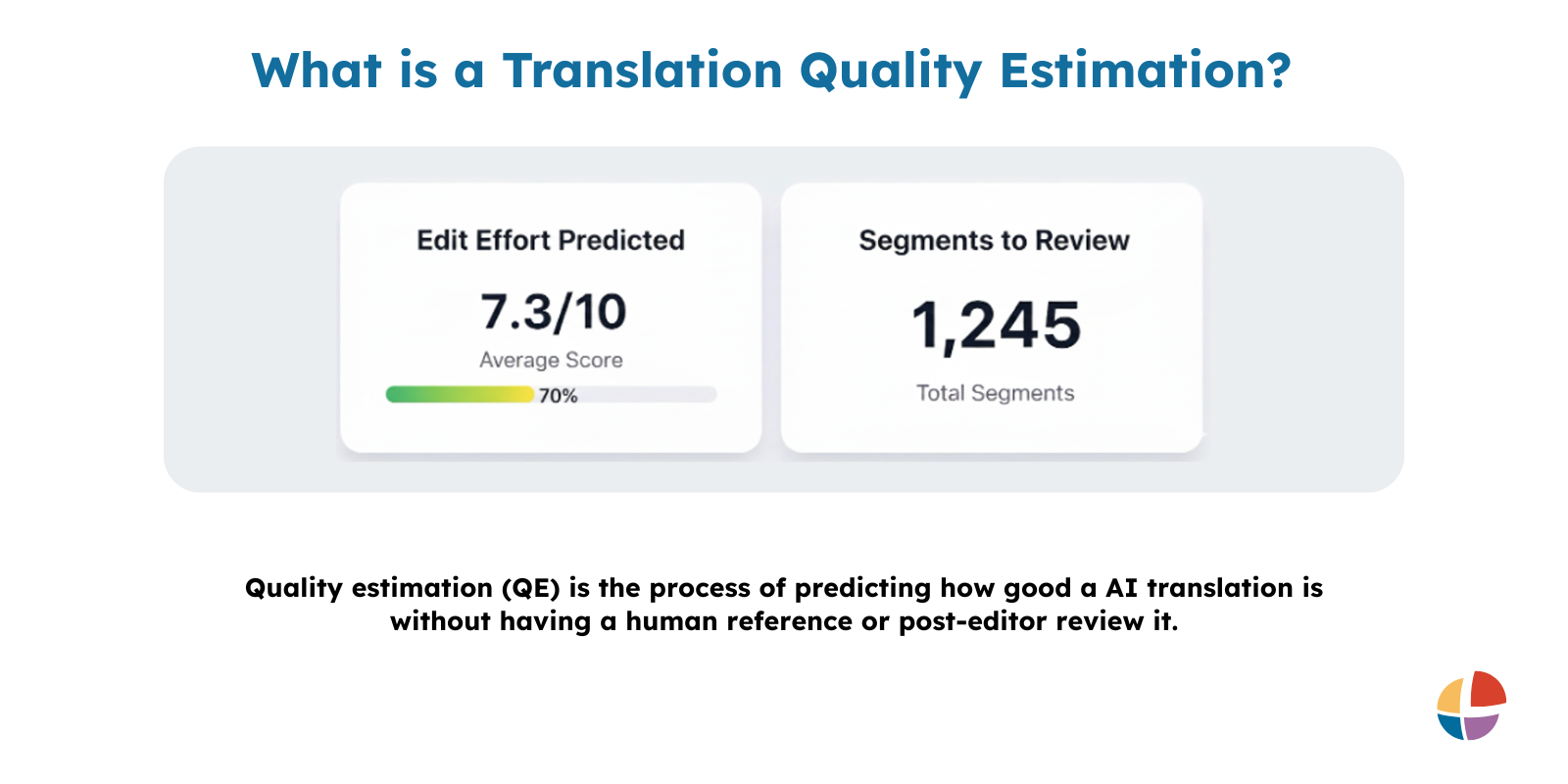
If Translation Quality Estimation (MQE) tells you what happened after review, Translation Quality Scoring predicts quality before a human sees the file. Modern MTQE models. COMETKiwi is the current benchmark and takes only the source and translated sentence, then outputs a confidence score and even word-level heat-maps.
Why MTQE matters
- Routing: Auto-publish high-confidence segments; send low-confidence ones to post-editors.
- Budget control: Spend human hours only where they move the needle.
- Speed: Continuous-localization pipelines release updates in minutes, not days.
How You Might Use Translation Quality Estimation:
You can use Translation Quality Estimation to quickly identify which AI-translated segments are strong enough to publish as-is, which ones need human editing, and which ones should be retranslated entirely. It helps you prioritize reviewer time, reduce costs, and speed up production by focusing human effort only where it matters most.
Other Machine Translation Quality Terms
If you’re seeking to learn more about the technical parts of preserving translation quality, here are some terms you may come across. Book a call with our team of professional experts to see if we can help you with understanding or implementing new machine translation technology and workflows.
BLEU (Bilingual Evaluation Understudy) is a measurement of the difference between an automatic translation and human-created reference translations of the same source sentence.
No single metric is king; savvy teams triangulate, then verify critical content with human review.
COMET (Crosslingual Optimized Metric for Evaluation of Translation) is a neural framework for evaluating machine translation quality. It’s designed to predict human judgments of translation quality by comparing machine-translated text with reference translations.
MQM-DQF (Multidimensional Quality Metrics – Dynamic Quality Framework) is a combined framework for evaluating the quality of language translations.
Translation Quality Score is a numerical or categorical assessment used to evaluate the linguistic accuracy, consistency, and appropriateness of a translated text.
Translation Quality Index is a standardized metric system that quantifies translation errors based on severity and impact.
Human-in-the-Loop Translation is a hybrid translation process that combines machine translation with expert human oversight. Human linguists review, refine, and contextualize machine output to ensure accuracy, fluency, and cultural relevance.
Machine Translation Post-Editing is the process of reviewing and improving raw machine-translated text by a professional linguist. MTPE ensures that the final output meets quality expectations, ranging from light edits for clarity to full rewrites for tone and technical precision, depending on project goals.
ISO 18587 MTPE Certification is a world standard details competencies for post-editors and process requirements for full MT post-editing.
EU AI Act is a comprehensive regulatory framework proposed by the European Union to govern the development and deployment of artificial intelligence technologies. The Act impacts how AI, including machine translation tools, is used, with a focus on transparency, accountability, and minimizing risk in high-stakes applications like healthcare, legal, and public services.
Workflows with AI that Support Professional Linguists: Turning Scores into Action
If you’re trying to build a workflow that incorporates the benefits of AI with the accuracy and refinement of a human translation team, Interpro is here to help.
As a translation, localization, and interpreting organization with 30 years of experience and global teams across the world, we have the expertise, talent, and technology to support any language goal you’re aiming to achieve. Whether you need guidance on when to rely on a fully human translation team, when AI translation is appropriate, or how to accurately assess and edit machine-translated output, we’re here to help you build a workflow and process that actually works for your organization. Contact our team or book a consultation today to see how we can support your next project.

Specialists view side-by-side versions of content in different languages to ensure consistency and accuracy, and grade the quality of the translation
Frequently Asked Questions
Is Machine Translation Quality Estimation accurate enough to skip human review?
Not for critical or creative content. Use it to prioritize human effort, not replace it.
What’s a good starting threshold for auto-publish?
Begin cautiously at Machine Translation Quality Estimation ≥ 85 and Translation Quality Scoring predictive ≥ 95, then adjust based on error audits.
Can Translation Quality Scoring be gamed?
Weighted severity and random spot-checks keep teams honest.
How often should we retrain Machine Translation Quality Estimation models?
Every 3-6 months or whenever your Machine Translation engine or terminology changes significantly.
Does ISO 18587 cover Machine Translation Quality Estimation?
Not directly, but it mandates quality processes that Machine Translation Quality Estimation supports.
Are low-resource languages hopeless for Machine Translation Quality?
No, custom data and domain-adaptation often lift BLEU/COMET by 10-12 points, though human review remains heavier.
Need Help Getting Started With Quality Estimation?
Numbers without insight are noise; insight without action is wasted budget. By combining Machine Translation Quality fundamentals, an objective Translation Quality Score, and predictive Machine Translation Quality Estimation, you can release global content faster, cheaper, and, above all, safer.
Contact Interpro Translation Solutions for a complimentary Machine Translation Quality audit. We’ll benchmark your current scores, design a Machine Translation Quality Estimation dashboard, and train your team to turn metrics into market-ready translations, every time.
Explore services:
Translation • Document • eLearning • Video & Multimedia • Consulting
Category: AI Translation, Translation
Tags: About Interpro
Service: AI Translation, Document Translation, eLearning Translation

Don't forget to share this post!



Stay Updated with Interpro
Subscribe to our newsletter for the latest updates and insights in translation and localization.