
Creating a Localization Friendly Source File: Resolving Common Issues Before Translation


Localization succeeds when preparation happens upstream. This guide shares practical fixes (acronyms, bilingual formatting, UI strings, external references, cross-references, and brand terms) so teams can create a localization-friendly source file that reduces cost, prevents rework, and speeds delivery. Interpro pairs clear source authoring guidance with professional linguists for accuracy and cultural fit.
Why Source Authoring Matters for Localization
Resolving common issues before translation protects quality, schedule, and budget. Small source changes like defining acronyms, using automatic cross-references, and clarifying UI strings create big downstream savings. See Interpro’s Translation Services for how we help teams to align process and content for successful translations.
Definition: Creating a localization-friendly source file means to author content so translation is easier, faster, more consistent, with predictable outcomes. Considerations include definite acronyms, UI labels clarified, references structured, and automatic cross-references so translators can deliver accurate, culturally fit results with less rework.
In this article we will provide specific localization solutions to the questions:
- How do you deal with acronyms in translation?
- What is bilingual formatting?
- What is User Interface translation?
- What is an example of User Interface translation?
- Translating external document references
- Translating manual cross-references
How to Create a Localization-Friendly Source File
Here are the practical tips and insights from the experts on our team to help you develop source files that are easier and chapter to translate.
Acronyms and Abbreviations
In general, it is a good practice not to overuse acronyms or abbreviations. Not only are they hard to translate, but also consider the audience. If the audience is unfamiliar with the acronym or abbreviation, it should be avoided or defined initially.
If your target audience is, for example, Spanish speakers in the United States, they are more likely to understand American acronyms and abbreviations. However, take that same document and give it to an audience from Latin America, and the message may not be understood.
Simple solution: At the beginning of any file or any page, when you first use the acronym, add the full explanation in parentheses () after the acronym. This will help the audience if they are not familiar with the term.
A Deeper Dive into Localizing Acronyms:
- In general, our language experts do not have a one-size-fits-all instruction to our different languages teams on how to handle acronyms because in general, different languages have their own best practices. For example, in Chinese, English acronyms will usually be kept in English, but in French, a lot of common English acronyms have official French acronyms.
- For clients working with a localization company, you can have a multilingual style guide created. These are similar to a brand guide, where a localization expert creates a company-specific document that will instruct translators on how to use acronyms and abbreviations. This helps ensure that your translated documents have consistent messaging across multiple documents over time.
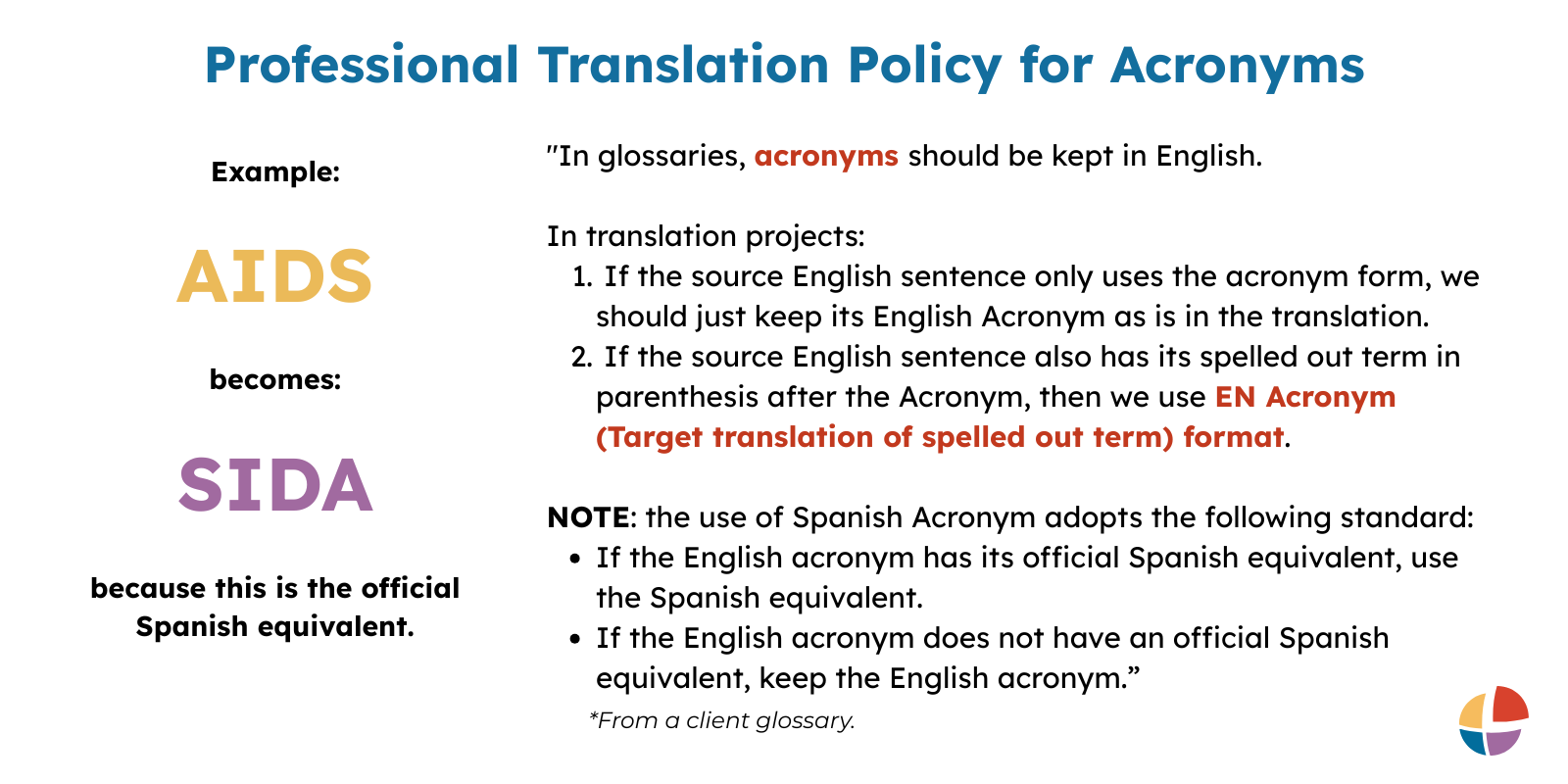
A common use for a translation glossary is to outline English acronyms and when to localize with a target market equivalent or if the term remains in English.
Bilingual Formatting
Bilingual formatting is a practice where linguists leave certain terms or phrases in English, but also provide a translation or explanation of the term in the target language in parentheses after the English.
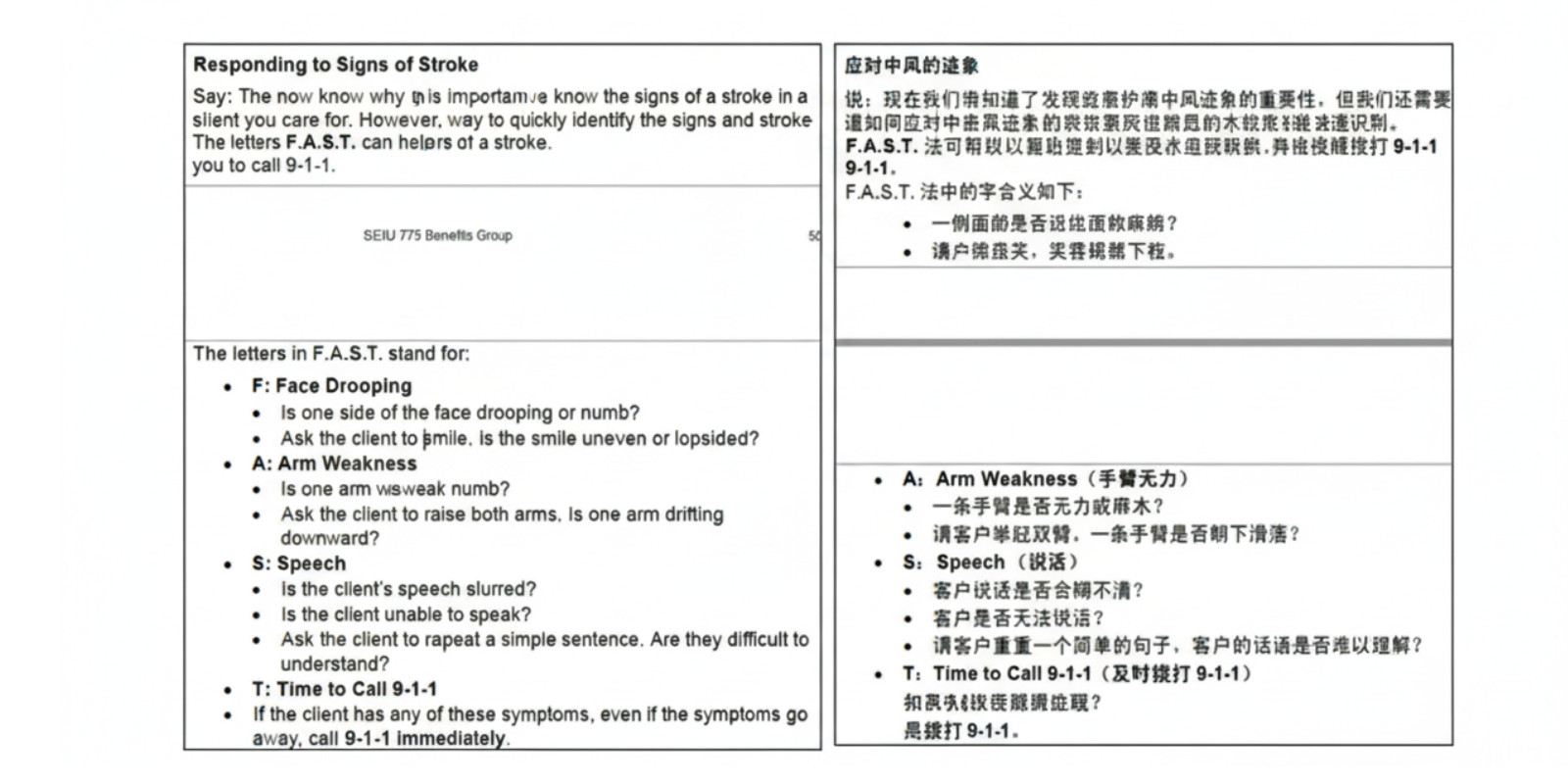
Bilingual Formatting Example
We see companies use this industry standard in the following scenarios. In these cases, the translator may use Bilingual Formatting as an option.
- When there are special instructions that are highly technical and specific to the brand, company, audience, or industry.
- When terms or concepts do not have direct equivalents in the target language.
- When the translated term doesn’t convey the intended meaning for that language.
- When referring to a UI translation, such as a URL in English.
- When referencing external documents, such as a book title or periodical.
These issues will require a team to collaborate and create the best localization strategy for moving forward. We generally recommend discussing strategy with (at minimum) a stakeholder from your company, a project manager, and at least one professional linguist that speaks your target language.
Bilingual Formatting Example
In the scenarios listed above, bilingual formatting may be recommended to support clarity and ensure the intended meaning is fully understood. How bilingual formatting is applied depends on the type of content challenge:
- #1 Technical Instructions: When instructions are highly technical, linguists will follow the provided guidance and apply language-specific best practices so the final output aligns with industry expectations in the target region.
- #2 No Direct Equivalent and #4 UI Translations: If a term cannot be translated directly or must remain in English for UI functionality, Interpro’s project managers provide clear instructions to ensure consistent terminology across all related content.
- #3 Doesn’t Convey the Intended Meaning: When a literal translation doesn’t carry the right tone or message, collaboration between the linguist, subject-matter experts, and the client ensures the localized version lands correctly.
- #4 UI Translations: User interface elements often have strict character limits or require certain English terms to remain unchanged for functionality. In these cases, bilingual formatting allows reviewers to see both the source and target text together, ensuring the translation is accurate, culturally appropriate, and technically compliant before it is implemented in the product.
- #5 External Documents: When referencing publications, websites, or legal citations, best practices differ across languages. The linguist will follow the standards of the target language to maintain accuracy and credibility.
This will make navigating localization issues that arise much easier on you.
When a partnership is formed, the localization agency has a stronger understanding of your language needs. This helps your project manager ensure the right language resources are in place for an accurate, localized translation.
Translating User Interface (UI)
What is User Interface translation?
User Interface (UI) translation is the process of adapting the text and visual elements of a software interface from one language to another, ensuring that users who speak different languages can understand and interact with the application effectively. However, some terms/buttons might be left in English, so the users can find them on the actual website.
UI Translation Example
Some examples of User Interface translation are in the images below.
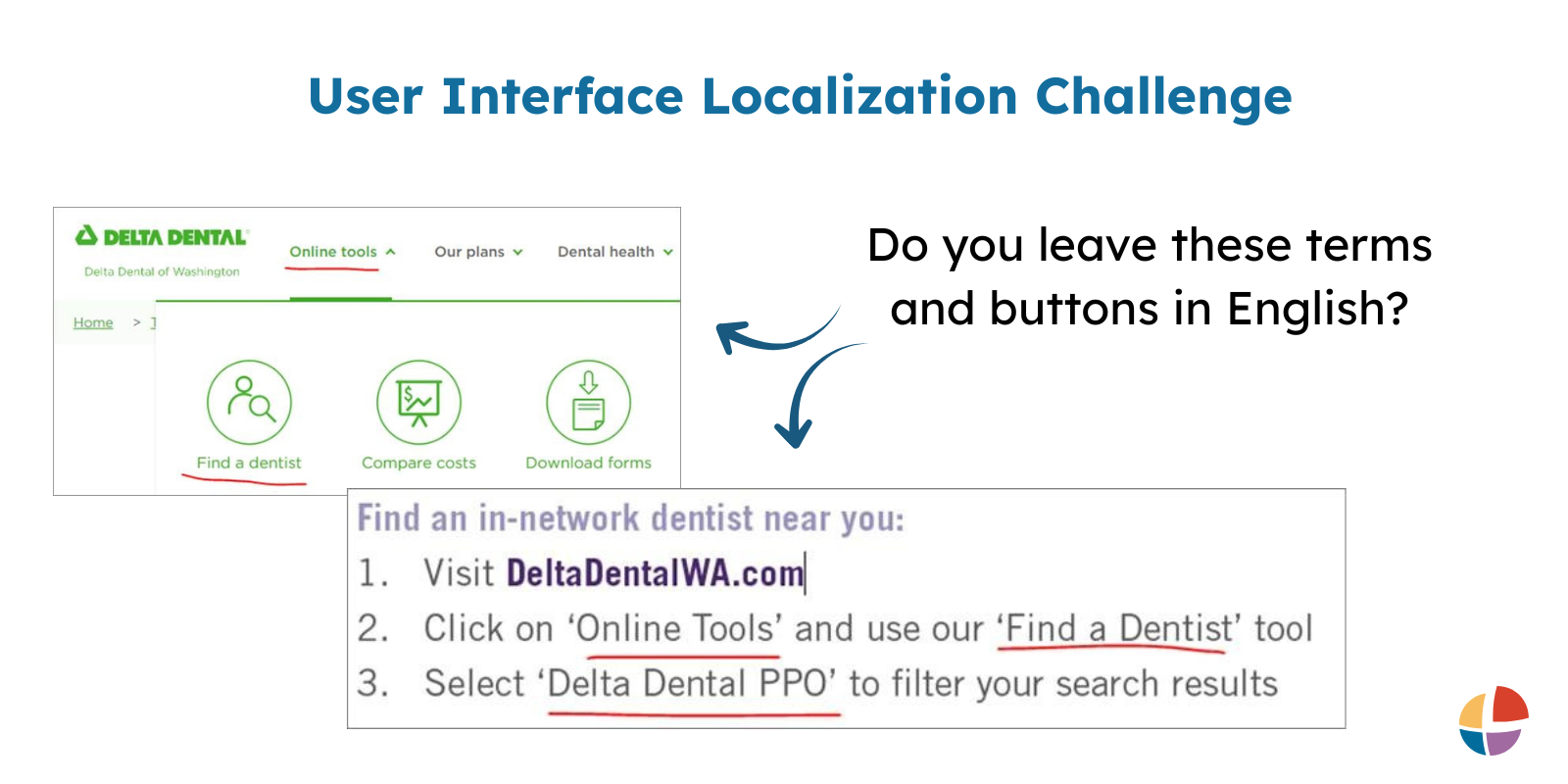
Would you translate these website navigation buttons? This example shows Delta Dental’s site with English UI elements such as “Online tools” and “Find a dentist,” but localization determines on the localization strategy of the website and educational materials.
If we just go ahead and translate those UI items, it’ll make it very hard for the reader to follow the steps to perform the actions, because they don’t see those translations in the actual website. So, these UI items have to be left in English to help the end-users navigate through the steps. But at the same time, to give them an idea of what these actions/menus mean, it’ll be helpful to put the translation in parentheses () after the English.
External Document References
When translating titles from a reference or bibliography entry, the approach depends on the purpose of the translation and the style guide followed (e.g., (APA, MLA, Chicago).
In general, there are several options:
1. Original title only (most common in academic work and when there is no official translation)
Smith, J. (2020). La psychologie de l’enfant. Paris: PUF.
2. Original + translated title in brackets (this is helpful for readers who don’t speak the original language)Smith, J. (2020). La psychologie de l’enfant [The psychology of the child]. Paris: PUF.
3. Translated title only (this is used only if the title is widely known or officially translated)Smith, J. (2020). The Psychology of the Child. Paris: PUF.
But it is important to note that each language team has their common practice for handling the article titles in a reference/bibliography entry.
Manual Cross-References (Opposed to Automatic)
It’s common to cross-reference information in manuals and policies.
However, cross-references in a document, such as “refer to page 38,” is not localization-friendly. Our team recommends avoiding using manual TOC or cross-references that refer to specific page numbers, appendices, images, or other information, as these may change during translation.
Translating manual cross references would require manual updates that can be time-consuming, costly, and leaves additional room for error. If any changes are made to the document, such as adding or removing pages, errors can occur if all the stakeholders don’t consistently update the document.
For example, the text on page 38 in English may not fit on page 38 in Spanish due to language expansion. So if the cross-reference is manually created and only refers to the page number, it may no longer be accurate in the localized version of the document.
Although localization agencies have a Quality Analysis step to catch errors, simplifying the English source and using automatic cross-referencing can save time and reduce the risk of errors. An extra benefit to this approach is that it makes the localization process more efficient, generally saving time and money long term.
Consistent English Verbiage and Terms
Keeping verbiage consistent in English helps keep consistency in the target language.
Keeping language consistent in English supports consistency in every translated version. When multiple terms are used to describe the same concept, translations can vary and cause confusion. Choose one preferred term—especially in multi-module or ongoing content—and use it consistently to ensure clarity across all materials and languages.
Consistency of Terms Example
For example, “abuse” and “misuse”. With some clients, these words are used with the same meaning when involving drug/alcohol. With others, the distinction between the two is crucial. This may lead to inconsistency between translations in different materials for the same term, especially in course series.
Avoid Idioms and Slang
Idioms, slang, and informal expressions often carry meanings that don’t translate directly into other languages. Phrases like “hit the ground running” or “off the hook” can confuse readers when translated literally. To ensure clarity across all languages and cultures, use straightforward language that expresses the intended meaning without relying on local sayings or casual shorthand. If a cultural reference is essential, briefly explain the concept so international audiences can fully understand the message.
Idioms and Slang Example
Avoid references to games, activities, or cultural elements that are only familiar in a specific region. When those references can’t be avoided, provide additional context so readers outside that region can understand the meaning. For true localization, consider if there is a replacement local game/activity that can be selected.
Consider Cultural Differences
Nowadays, professionals worldwide deliver services and products for an increasing number of culturally and linguistically diverse audiences. It is important for businesses and organizations to help build cultural awareness and increase access to culturally appropriate information.
Examples of Instructions for Translators
Example 1: “Most Asian people don’t address people older than them by name, especially for parents and the elderly, like grandparents, due to the high level of respect. When you provide a scenario of an Asian family, please be mindful of their way of addressing each other.”
Example 2: “In Chinese (and Japanese), the character for the number 4 is pronounced the same way as the character for the word “death.” Just as many American patients would not be comfortable in room 13 (a number that is considered bad luck) many Chinese and Japanese patients would prefer not to be in a room called “death.””
Be Diverse, Avoid Stereotypes
Another example would be the use of actors/actresses from different cultures to make the content more relatable. While diversity is important, it’s also critical to avoid stereotypes and unconscious bias.
For example, typical stereotypes in caregiving include “this is a female-dominated industry”, and “caregivers are mostly African American, Chinese, and Latino”. By using more actors/actresses from different cultures, races, genders, etc., the materials will help shatter stereotypes in the industry.
Image and Graphic Challenges
It’s generally a good idea to not have text in images unless you want to recreate/localize the image.
Be mindful of images. There are many cultural examples of everyday images that might cause offense, repulsion, or other negative emotions. Think about if your content has any “striking” images, such as exposed organs or body parts. The solution may be a simple sketches or illustrations may be preferred by the target market. for educational and training purposes.
Solving image and graphic challenges is an entirely different team and skillset from your translation, revision, and proofing team. We recommend checking out our series of articles on Multilingual Desktop Publishing to prepare for translation:
- Preserving Layout & Design in Every Language with Multilingual Desktop Publishing
- InDesign Translation: How to Translate Files Without Breaking Formatting
- How Professional Document Translation Supports Business Growth
- Steps to Prepare for Document Translation
- Why Professional PDF Translation Matters (and Free Tools Fall Short)
- A Founder’s Perspective: Professional PDF Translation to Avoid Google Gaffes and Ensure Accuracy
- How to Prepare for InDesign Translation in 4 Steps
Branded Verbiage
Many times, companies have a brand standard or a style guide to help maintain their brand across languages.

Brand Localization Example
One example would be a company named “Get Help Now”. Because they had specific instructions on how their brand name and call to action should be localized, they provided a glossary to help translate some terms that may be confusing for a translator.
- As a general rule, “Get Help Now” is our brand name that should be kept in English. Please note this in all future projects
- However, if the first letters of each word in “Get Help Now” are not capitalized, then it’s not a brand name but the descriptive text. Please translate as usual.
Example: Get help now, and find the emotional health resources for you today. - Sometimes even though the first letters are capitalized, it is still descriptive text and should be translated as usual.
Example: Get Help Now for your emotional wellbeing.
Usually in this case, you’ll find that it is a verb/action, instead of being used as a proper noun. Keeping it in English would make this sentence non-translatable.
It is always a good practice for the client to send specific instructions to help in developing more consistent and accurate translations the first time.
Drop the Schwa
This is an example of a localization challenge related to linguistic differences between English and Spanish.
“Drop the schwa” is a common term used in English language teaching to refer to the importance of pronouncing vowel sounds clearly without adding a schwa sound (-uh) at the end.
However, in Spanish, there is no equivalent term or concept of a schwa sound, and the phonetic system of Spanish is different from that of English.
In this example, the challenge is to find a way to convey the same idea to Spanish-speaking learners, but using terminology and examples that are appropriate and understandable in their cultural and linguistic context. The translation provided in the example uses the term “schwa” and explains its meaning, which may not be effective or relevant for Spanish learners. The localization challenge here is to find an appropriate way to convey the same idea without using a term that may not be familiar or relevant to the target audience. This challenge was solved in the approved adaptation.
| SOURCE | CURRENT TRANSLATION | ADAPTATION APPROVED | |
| Drop the Schwa
When teaching letter sounds, it is important to say them clearly without adding a schwa sound (-uh) to the end. |
No usen el sonido de schwa
Cuando enseñe los sonidos de las letras, es importante pronunciarlos claramente sin agregar un sonido de schwa (-uh) al final.
|
No usen un sonido adicional
Cuando enseñe los sonidos de las letras, es importante pronunciarlos claramente sin agregar al final un sonido semejante a un -ah, y que es causado por una salida corta de aire. |
The linguist who adapted the text successfully solved the challenge by providing an alternative translation that conveys the same idea in Spanish. The translation uses terminology that is more relevant and understandable for a Spanish-speaking audience, while still conveying the same idea as the original English text. The adaptation uses the phrase “un sonido adicional” (an additional sound) to refer to the schwa sound, and explains that it is important to avoid a sound at the end of the letter that is similar to “-ah” and caused by a short burst of air.
Get Started Localizing with Interpro
Creating a localization-friendly source isn’t just a technical step. It’s a strategic advantage for any brand looking to grow globally. By proactively identifying and resolving common localization issues before translation begins, organizations can significantly reduce costs, accelerate time-to-market, and ensure a more accurate and culturally resonant user experience.
Interpro is here to help from simplifying language and avoiding idioms to structuring content for flexibility and maintaining consistency, each step taken upstream empowers translators to do their best work and enhances the final product.
In short, when localization is built into your content from the start, it pays off in every language.
Need help getting started with localization? Get started with Interpro.
FAQs: Localization-Friendly Source Files
How do I handle acronyms in translation?
Define at first use; document language-specific rules in your glossary/style guide; avoid overuse when audience familiarity is low.
Should I translate UI labels in instructions?
Keep the live UI label in English for wayfinding and add a parenthetical translation for meaning, unless the product UI is localized.
What about references and bibliographies?
Follow the required style (APA/MLA/Chicago). Keep original titles, add bracketed translations, or use official translated titles where appropriate.
Why avoid manual page-number references?
Page counts change after translation. Use automatic cross-references so links and labels update post-layout.
Talk to Interpro about source authoring for localization.
Explore services:
Translation • Document • eLearning • Video & Multimedia • Consulting
Category: Localization
Service: Translation Services
Don't forget to share this post!



Stay Updated with Interpro
Subscribe to our newsletter for the latest updates and insights in translation and localization.