
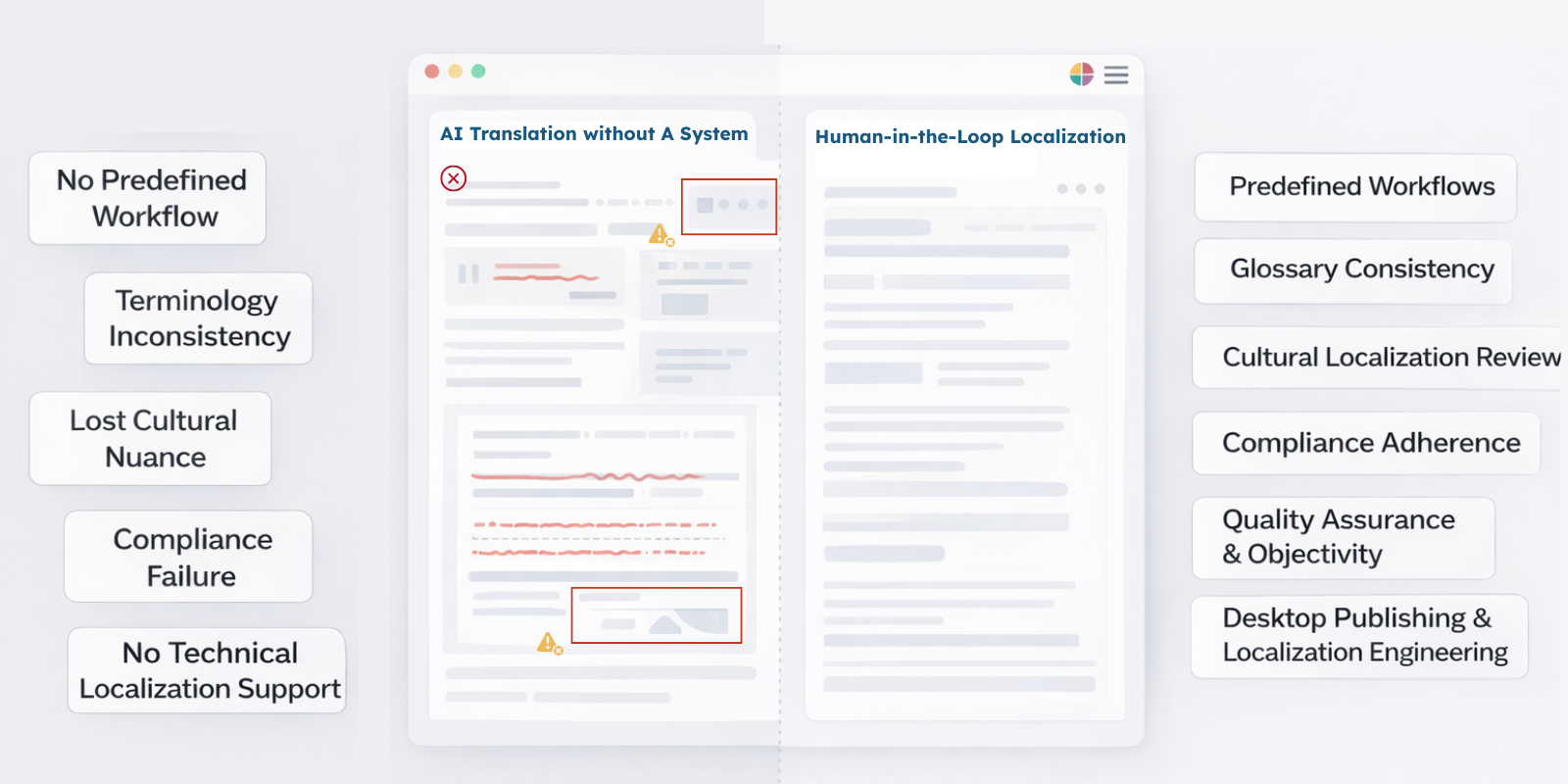
AI accelerates output but does not enforce compliance, terminology control, or brand consistency. A structured AI localization strategy aligns automation with governance, risk segmentation, and human oversight. Organizations that operationalize language systems scale faster and with less exposure.
Generative AI has transformed publishing speed. Campaigns launch in days. Product updates ship instantly. Knowledge bases expand overnight.
But speed is not scale.
AI can generate content across languages at volume. Without a defined AI localization strategy, that scale introduces risk. Terminology drifts. Messaging fragments. Regulatory phrasing weakens. Rework increases. If AI is part of your growth model, strategy must be part of your operating system.
Why AI Localization Strategy Matters Now
AI expands publishing velocity across every language simultaneously. That velocity multiplies both opportunity and risk.
Without an AI localization strategy, organizations experience inconsistent terminology, conflicting regional messaging, compliance gaps, and broken version control. These issues compound quickly at a global scale.
A strategy ensures that AI-generated content aligns with brand standards, regulatory requirements, and documented workflows.
AI drafts in seconds. Strategy protects what you publish long-term.
Speed Is Easy. Consistency Requires Structure.
AI can draft, translate, and repurpose content instantly. What it cannot do independently is enforce approved terminology, regulatory phrasing, or structured review checkpoints.
Consistency at scale requires systems.
A mature AI localization strategy integrates a Translation Memory (TM), glossary governance, documented review layers, and centralized version control into AI workflows. Risk scoring and defined approvals prevent automation from bypassing oversight.
When structure is embedded, AI accelerates growth. Without it, AI multiplies inconsistency.

An AI Localization Strategy integrates AI into translation workflows to increase speed, consistency, and scalability for global content delivery.
An AI Localization Strategy Is More Than Just Machine Translation
Machine translation is only one component of an AI localization strategy. It is not the strategy itself.
Localization must account for regulatory differences, cultural nuance, industry terminology, and accessibility standards. These variables shift across markets and industries.
In regulated environments such as healthcare, manufacturing, and financial services, defensibility matters. An AI localization strategy defines where Human-in-the-Loop validation is required, how approvals are documented, and who is responsible for final sign-off.
Automation without accountability increases exposure. Structured oversight reduces it.
Risk Segmentation Drives Smart Automation
Not all content carries equal risk.
Internal updates may move quickly through automated workflows. Marketing materials require a brand review. Regulatory documentation demands layered validation and traceable approval.
An effective strategy classifies content before translation begins. This segmentation allows speed where appropriate and protection where necessary.
Without it, organizations either slow everything down or move too quickly in the wrong places.
Efficiency Requires Governance
AI delivers cost savings when structured properly. When deployed without oversight, hidden costs appear in the form of re-translation, SME fatigue, compliance correction, and brand remediation.
Short-term automation without an AI localization strategy often creates long-term rework.
Disciplined workflow design ensures automation is applied strategically, human oversight is layered intelligently, and quality metrics are tracked consistently.
Lower costs don’t need to mean lower standards. They should mean smarter, more efficient systems.
AI Localization Strategy Is a Systems Decision
Translation is no longer a project-based task. AI turns multilingual publishing into a continuous operational function.
An effective AI localization strategy integrates AI tools, terminology databases, compliance documentation, and review workflows into a single, accountable framework.
The real question is not whether to use AI. It is how to implement an AI localization strategy in a way that is scalable, compliant, and defensible.
AI alone does not create global growth. Structured systems do.
Putting It All Together
AI is not replacing language strategy. It is amplifying the consequences of ignoring it.
The organizations that succeed with AI are not simply moving faster. They are operating with structure. They define terminology governance. They segment content by risk. They document review workflows. They assign accountability. They measure quality. They treat AI localization strategy as infrastructure, not as a shortcut.
If your organization is scaling globally with AI, the most important decision is not which model you deploy. It is how you design your AI localization strategy around governance, segmentation, and control.
Interpro helps organizations build localization strategies that balance automation with compliance and efficiency with protection.
Ready to evaluate your AI localization strategy? Contact our team today to discuss your multilingual workflow, risk profile, and AI implementation goals. We will help you design a scalable, defensible system that supports long-term global growth.
Category: AI Translation
Tags: AI, strategic localization
Service: AI Translation, Consulting

Don't forget to share this post!



Stay Updated with Interpro
Subscribe to our newsletter for the latest updates and insights in translation and localization.