

If you’re implementing AI translation inside your training programs, your options depend heavily on your tech stack.
Some platforms now offer Translation-as-a-Feature (TaaF) within your authoring tool. Others require exporting files and running an AI + human post-editing workflow. Both accelerate translation. But they are not equal in control, risk exposure, or long-term scalability.
If you’re responsible for learner outcomes, compliance, and brand consistency, you need to understand the difference before you click “translate.”
This article covers how:
- Translation-as-a-Feature (TaaF) works inside tools like Articulate and Vyond, offering instant drafts.
- AI + MTPE (Machine Translation Post-Editing) add professional linguistic review for higher accuracy and compliance control.
- TaaF is fast but limited in glossary control, multimedia handling, and risk mitigation.
- AI + MTPE provide greater long-term consistency, scalability, and learner protection.
AI Translation Option 1: Translation-as-a-Feature (TaaF)
Definition: Translation-as-a-Feature (TaaF) refers to translation tools built directly into an eLearning platform (like Articulate Rise and Storyline) that automatically translate course text without exporting source files.
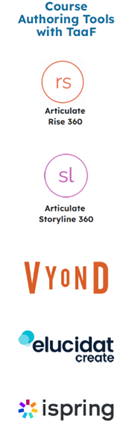
Common eLearning authoring tools like Articulate, Vyond, and Elucidat offer Translation as a Feature, enabling instant AI-generated drafts directly inside the platform.
If you develop on these platforms, you may already have built-in TaaF available to you:
- Articulate Storyline 360
- Articulate Rise 360
- Elucidat Create
- iSpring
- Vyond
- Many more
How it works: Select the target languages within your authoring tool, and the platform applies an internal AI model to instantly translate editable text fields. Depending on the platform, the translation may cost extra or be based on a credit-per-translation system. TaaF can be ideal if you’re already developing inside a platform that offers this feature and want to leverage the advantage of translating within your authoring tool.
TaaF Pros:
- Fast and seamless. No file exports or exchanges required. Minimal setup if using a supported platform.
- Enables quick testing or internal course previews.
- Works best if your team writes in controlled, easy-to-translate English.
TaaF Cons/Watch-outs:
- Accuracy depends heavily on how well English source content is written (simplified syntax, clear terminology avoiding highly technical topics).
- Still produces errors that often require manual correction.
- Limited control over terminology, tone, or brand consistency.
- Limited glossary and translation memory support to control style preferences and terminology.
- Unable to leverage previously translated content to improve future translation quality and keep consistency within past and future terminology and style.
- May not handle videos, quizzes, or interactive elements.
- Requires alternate solutions for any other supporting learning materials.
TaaF Explained (Simplified):
In your authoring tool:
- You select your target language.
- The platform applies its internal AI engine.
- Your editable text is translated instantly.
If your team writes in simplified syntax with consistent terminology, output improves significantly. But here’s where L&D teams often run into friction:
- Glossary and translation memory control is limited
- Brand tone may shift
- Terminology may vary across courses
- Video, quizzes, triggers, captions, and voiceovers often require manual fixes
- Previously translated content cannot always be leveraged to improve future output
- Formatting shifts
And that’s the hidden cost of choosing TaaF: potential rework and inconsistencies. TaaF gets you a draft. It is not guaranteed to give you localization.
AI Translation Option 2: AI Translation + Machine Translation Post-Editing
Definition: AI Translation and Machine Translation Post-Editing (MTPE) offer more flexibility than TaaF, while still maintaining speed and quality control. This approach translates all your source files for any learning management system, authoring tool, voiceover, video, quiz logic, on-screen text, workbooks, websites, quizzes, certifications, and surveys.
How it works: AI Translation + MTPE is the process of providing source files for AI translation, followed by a professional native-speaking linguist editing the AI output. Your content is examined, and then the right AI translation tool and post-editing linguistic team are selected based on a few different variables. Human post-editing ensures that translations are accurate, culturally appropriate, compliant, and consistent, where the automated systems can miss nuance. The translated messages are then finalized and localized, with quality assurance steps applied so you receive a translated, ready-to-publish file.
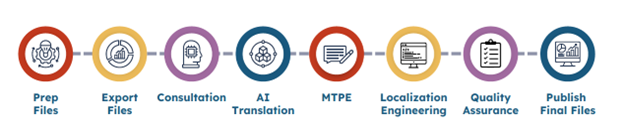
A structured AI translation plus MTPE workflow includes file prep, AI output, human post-editing, localization engineering, and quality assurance before final delivery.
AI Translation + MTPE Pros:
- Offers the highest balance of speed, accuracy, and brand consistency.
- Works across any content type or authoring platform.
- Enables the use of translation memories and glossaries for fewer rework cycles and better long-term savings.
- Human review ensures localization of tone and terminology for learner comprehension.
AI Translation + MTPE Cons/Watch-outs:
- Requires file export and collaboration with both a translation partner and the engineering team to import and format the text after translation.
- Slightly longer turnaround than instant AI features.
- Higher upfront cost.
- Some content won’t be a fit for AI translation, even with proper prep and review.
AI + MTPE Explained (Simplified):
- You export your source files (course text, captions, quizzes, scripts, PDFs, etc.).
- The best AI translation tool is selected based on content analysis.
- AI generates the first draft translation.
- A professional native-speaking linguist reviews and edits the AI output.
- Localization engineering reintegrates and formats the translated content.
- Quality assurance verifies accuracy, functionality, and consistency before final delivery.
If your content is high volume, structured, and terminology is documented, and glossaries or translation memories are applied, output improves dramatically over time.
But here’s what L&D teams should plan for:
- File export and reintegration are required
- Collaboration with a translation partner and the engineering team is necessary
- Turnaround is slightly longer than instant in-platform translation
- Upfront investment is higher than TaaF
- Highly creative, idiomatic, or compliance-heavy content may still require full human translation
The tradeoff for the extra effort? You gain control over terminology, tone, compliance, formatting, and long-term consistency across every course component — not just editable text.
Build a Reliable Localization Workflow for Either Method
Book a consultation to assess your translation risk and build a defensible AI localization process that you can trust.
If you’re evaluating AI translation implementation, the first step is not choosing a tool. It’s assessing your content and understanding your risk.
Interpro helps you evaluate your current localization workflow, identify where AI can be applied safely, and design a Human-in-the-Loop process that protects compliance, quality, and brand integrity.
Whether you need AI translation services, MTPE, full human translation, or strategic localization consulting, we’ll help you build a system that scales without exposing your organization to unnecessary risk.
Don't forget to share this post!



Stay Updated with Interpro
Subscribe to our newsletter for the latest updates and insights in translation and localization.