

Human-in-the-loop localization combines AI translation with human expertise to ensure accuracy, consistency, and compliance. AI handles speed and scale, while linguists review, refine, and validate the output. The result is a structured, reliable workflow that produces publish-ready content without the risks of using AI alone.
In this guide, you’ll learn:
- What Human-in-the-Loop localization actually means
- How AI translation differs from a managed localization workflow
- The risks of using AI without guardrails
- How to build a scalable, compliant, and defensible translation system
What Does Human-in-the-Loop Localization Actually Mean?
AI Translation = raw translated output from an AI translation tool. It’s fast. It produces text. But it is still just output.
Human-in-the-Loop Localization = the process that determines the appropriate localization approach (AI or human linguists), combined with a structured AI translation post-editing process. Every translation is then formatted, localized, and reviewed by professionals.
It’s not just about generating words. It’s about governing how those words are produced, reviewed, and delivered.
AI translation is a tool and one step of the human-in-the-loop localization process.
AI translation does the drafting and accelerates the workflow. But it does not validate compliance, nuance, or technical precision on its own. Nor does it localize the file to be ready to publish.
Human-in-the-Loop is the strategic localization solution that creates an accountable process that governs when and how that tool is used.
It defines the guardrails and sets the standards before translation ever begins so you can create a predictable, reliable output. It determines when AI is appropriate and when human expertise is required. Machine translation post-editing ensures that any grammatical or formatting error is caught and fixed before publication.
Many teams think they are looking for the “right” AI translation tool when, in reality, they need to build a strategic system.
The Risks of Using AI Without Guardrails
AI translation is powerful. But without a structured Human-in-the-Loop process, it introduces predictable risk. Most failures are not obvious mistranslations. They are operational problems that surface later, when the translation is used in real workflows, decisions, or customer interactions.
Inconsistent Terminology
AI may translate the same term differently across documents or languages. Over time, brand language becomes inconsistent, and internal teams spend time correcting it manually.
A Human Resource team translated a training library into French Canadian using the authoring tool’s AI translation as a feature. The word-for-word translation was not grammatically correct, and nuance critical to culture and compliance was lost. The team ultimately had to rework large sections to align with Canadian French norms, terminology, and regulatory expectations, eliminating the time savings they hoped AI would provide.
Diluted Engagement
AI can translate words, but it doesn’t always preserve tone, clarity, or cultural context. Over time, messages become technically accurate but emotionally flat. What once felt clear and aligned starts to feel generic or slightly off, especially in internal communications where nuance matters.
Some teams are using Microsoft Copilot to translate internal emails, but have found that message clarity leads to lower engagement across teams.
Compliance Exposure
In regulated industries, small shifts in wording can create real consequences. Clinical documentation, financial disclosures, safety instructions, and employee training materials require precision. AI alone cannot validate regulatory nuance or audit requirements.
In one review of multilingual safety documentation, an AI tool translated a critical regulatory term inconsistently across U.S., EU, and Latin American markets. In the U.S. version, the term aligned with OSHA labeling requirements, while the EU version used phrasing tied to REACH compliance standards, and the LATAM version reflected a more general safety warning with no direct regulatory equivalence.
While each translation was linguistically correct, the inconsistency created compliance gaps across regions. The materials required additional legal and regulatory review to reconcile terminology, delaying approval and distribution timelines.
Hidden Rework
AI creates a draft quickly. But internal reviewers often spend hours correcting grammar, adjusting tone, fixing formatting, or reconciling terminology. The time savings disappear.
One eLearning development agency had to re-create Storyline courses for their client when the AI translation feature inside Storyline corrupted the original English source files after trying to fix the grammatical errors (not to mention the transcripts and voiceovers said two entirely different things).
Here are 12 ways that you can save on translation costs and fix hidden rework costs.
“Good Enough” Uncertainty
Without defined quality thresholds, teams debate whether AI output is acceptable. There is no objective standard guiding when AI is appropriate and when human translation is required.
One global manufacturer translated all content with a Human-in-the-Loop process — except Haitian Creole, which required full human translation due to AI’s misunderstanding of the subject matter in the target language.
Publish-Ready Gaps
AI translates text. It does not localize files for final delivery. Formatting breaks, captions fall out of sync, quizzes malfunction, and layout expansion creates additional work.
PowerPoint presentations were translated for a conference using the embedded AI translate button, but the formatting broke and added an unexpected 30 hours of internal repair time just days before the event.
None of these risks are caused by AI itself. They happen when AI is treated as the solution instead of one step inside a strategic localization system.
How to Build a Scalable, Compliant, and Defensible Human-in-the-Loop System
If AI is a tool, the system around it is what makes it reliable.
Building a Human-in-the-Loop localization process does not require complexity. It requires structure. Here’s where to begin.
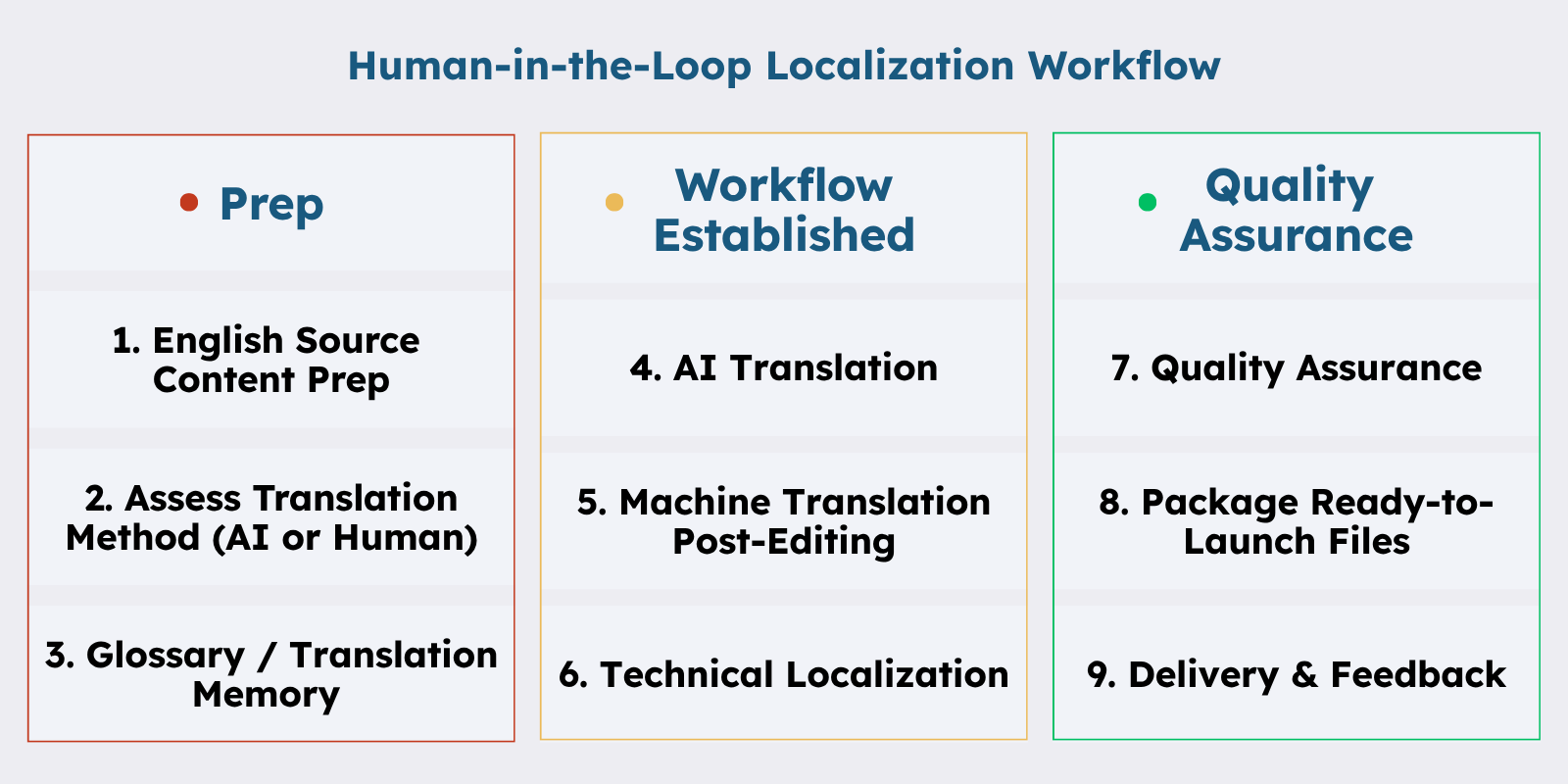
A structured Human-in-the-Loop localization workflow ensures AI translation is governed by preparation, post-editing, and quality assurance before final delivery.
1. Start with Preparation, Not Translation
Most translation problems begin before translation ever starts. Prepare your source content by:
- Standardizing terminology
- Developing an approved glossary
- Building translation memories from validated content
- Writing in clear, controlled English
- Identifying regulated or safety-sensitive material
Preparation reduces ambiguity. Clear source content improves AI output and reduces downstream corrections.
2. Classify Content by Risk Level
Not all content carries the same level of risk. Low-risk content may include FAQs or internal updates. High-risk content may include regulatory filings, clinical documentation, product safety instructions, or financial disclosures.
This classification determines:
- When AI is appropriate
- When AI + Machine Translation Post-Editing (MTPE) is required
- When full human translation is necessary
Risk-based decision-making for localization projects removes guesswork and creates predictable outcomes.
3. Implement Structured Machine Translation Post-Editing (MTPE)
AI produces a draft. Human expertise ensures accuracy. Machine translation post-editing introduces professional linguists to:
- Review AI output against the source text
- Correct terminology tied to compliance standards
- Preserve technical precision
- Adjust tone and cultural nuance
- Eliminate formatting inconsistencies
This step transforms AI from raw output into controlled localization.
4. Apply Quality Assurance and Documentation
A defensible system includes formal review cycles, ensuring that final drafts look good in the new language. Linguistic Quality Assurance should validate:
- Terminology consistency
- Formatting and layout integrity
- Functional elements such as quizzes or triggers
- Accessibility standards
- Compliance documentation
In regulated industries, documentation of the process is just as important as the final translation.
Build a Localization System You Can Defend
Book a consultation to assess your translation risk and build a defensible AI localization strategy.
If you’re evaluating AI translation for regulated or high-risk content, the first step is not choosing a tool. It’s assessing your content and understanding your risk.
Interpro helps you evaluate your current localization workflow, identify where AI can be applied safely, and design a Human-in-the-Loop process that protects compliance, quality, and brand integrity.
Whether you need AI translation services, MTPE, full human translation, or strategic localization consulting, we’ll help you build a system that scales without exposing your organization to unnecessary risk.
Category: Translation
Tags: AI Translation, About Interpro, Compliance, Global Content, Human-in-the-Loop, MTPE, localization strategy, translation workflow
Service: AI Translation

Don't forget to share this post!



Stay Updated with Interpro
Subscribe to our newsletter for the latest updates and insights in translation and localization.