
Top 8 FAQs for eLearning & AI Translation: What Breaks, What Works, and Responsible Workflows


AI has made translation faster, but it’s also made it easier to ship training that looks translated while quietly breaking comprehension, consistency, compliance language, accessibility, or course functionality.
The good news: most AI translation failures aren’t caused by the technology itself. They happen when AI is used without structured multilingual training workflows, terminology control, quality assurance, and human oversight.
Interpro helps Learning & Development (L&D), Compliance, and HR teams apply AI translation responsibly, so speed doesn’t come at the expense of clarity, learner outcomes, audit readiness, or your reputation.
Top FAQs from Learning & Development Companies
Interpro works closely with d’Vinci Interactive across many client projects. In a recent discussion, these questions were top of mind for eLearning course authors and training library managers.
Why these FAQs and why now?
In training localization, “translation” rarely means converting words from English into another language. Training and educational content includes multiple moving parts that must still work as a learning experience: on-screen text, audio scripts, captions, PDFs, knowledge checks, quizzes, LMS metadata, and ongoing updates over time.
AI can generate multilingual output quickly, but it does not automatically preserve instructional intent, maintain approved terminology, account for dialect/regional requirements, verify course functionality, ensure accessibility alignment, or provide quality scoring that your stakeholders can defend.
That’s why responsible AI translation for eLearning isn’t about picking the “best model.” It’s about implementing a system that makes AI safe.
AI has made translation faster and more accessible than ever, but also easier to get wrong. What’s changing right now in how organizations are approaching translation?
Organizations are shifting from “translation as a one-time task” to “translation as an ongoing system.” AI increases speed, but it also exposes workflow gaps, like unclear ownership, missing terminology controls, lack of validation, and no shared definition of “good enough.”
Many teams are being asked to “use AI” to move faster, reduce costs, and support scalable updates across regions. But when AI translation is treated like a shortcut instead of a workflow, problems show up where training is most sensitive: learner comprehension, compliance language, and version control.
A key shift is that L&D teams are now forced to map the full translation scope, not just visible slide text. Training ecosystems include: course text, audio/voiceover scripts, captions and transcripts, assessments and logic rules, PDFs and job aids, LMS titles/descriptions/metadata, and recurring updates.
AI drafts text quickly, but accountability, consistency, and validation come from the workflow.
Example: An L&D team uses an authoring tool’s “Translate” feature to launch a compliance course in five languages. Everything looks fine at first, until they discover late in the cycle that captions don’t align, some quiz logic behaves differently, and policy terminology drifts across modules because there’s no terminology asset or review standard.
There’s a growing assumption that AI can handle translation end-to-end. What are some of the biggest misconceptions you’re seeing right now?
The biggest misconception is that “fluent” equals “correct.” AI output can read well while still failing in terminology, compliance precision, instructional intent, or functional validation, especially in training content with assessments, variables, and accessibility requirements.
Here are the misconceptions we see most often in L&D and eLearning localization:
Misconception #1: If it reads well, it must be accurate.
Training is uniquely sensitive content. Small shifts in terminology can change meaning, introduce risk, or undermine learner trust, even if the sentence sounds polished.
Misconception #2: The model choice is the solution.
Teams debate neural machine translation vs. LLM translation, but in practice, model type matters less than whether you have a governed workflow that controls terminology, review, and validation.
Misconception #3: AI reduces effort overall.
AI may reduce initial translation time, but it often shifts the effort to internal reviewers. Without clear ownership, quality thresholds, and documentation, review cycles expand, and SMEs become bottlenecks.
Misconception #4: Embedded translation features cover everything.
Many internal teams fall into the “translation button” blind spot: the course appears complete, but critical elements (logic, captions, accessibility, layout) aren’t fully validated until late, triggering rework and manual patching.
Example: A team auto-translates a product training course and only checks whether the text “sounds right.” After launch, they find inconsistent terminology across slides, a few knowledge-check items become ambiguous, and layout breaks due to text expansion, causing a rushed rebuild.
Where does AI-driven translation actually perform well today, and where does it start to break down?
AI performs well for structured, low-risk, high-volume content, especially when terminology is simple and review criteria are clear. It breaks down when content requires compliance precision, instructional nuance, consistency across updates, or functional validation (quizzes, logic, accessibility, formatting).
AI can be a powerful draft engine for the right content, especially when you’re translating high volumes and can validate the results.
- Translation-as-a-Feature (TaaF): best for fast drafts of low-risk content, but risky without terminology controls and validation steps.
- AI + Human-in-the-Loop (HITL): often the best fit for scalable internal L&D that still needs quality and defensibility (plus quality scoring).
- Full human translation: for high-stakes, regulated, safety-critical, audit-ready content.
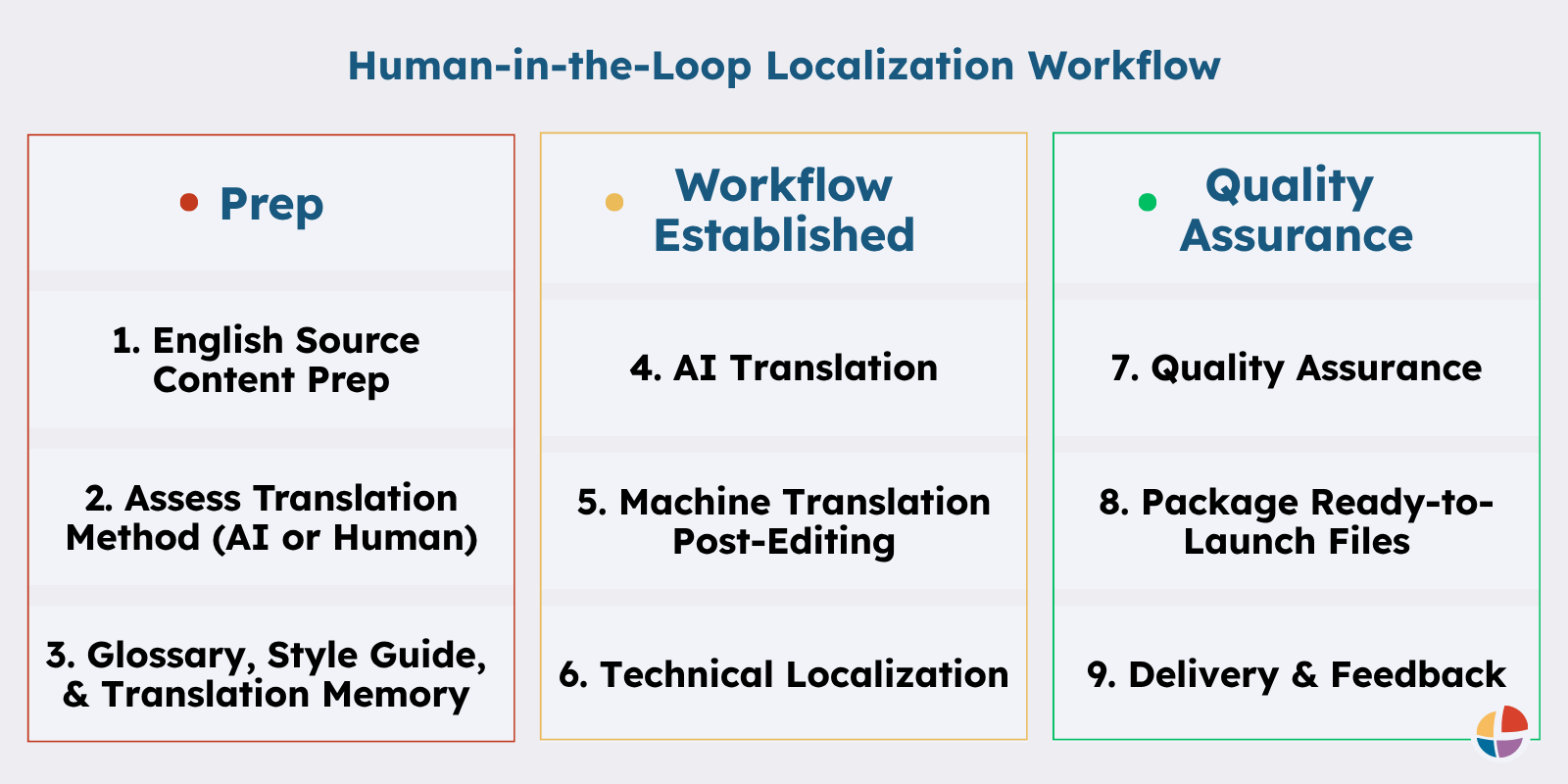
Human-in-the-Loop workflows combine AI efficiency with expert review, quality assurance, and localization best practices to create learner-ready training.
Subject-matter drift, loss of instructional intent, layout collapse, assessment/logic failures, accessibility gaps, update amplification, and documentation/audit gaps.
Example: AI does well translating low-risk onboarding modules, but struggles when the team applies the same approach to compliance training with scenario branching and assessments. Without validation, logic errors slip through and policy terminology drifts across versions over time.
You talk a lot about the importance of “Human-in-the-Loop.” What does that actually mean in practice, and why is it so critical?
Human-in-the-Loop (HITL) means AI output is reviewed and improved by qualified humans as a defined step in the workflow, protecting terminology, meaning, instructional intent, and compliance precision while ensuring the final course is learner-ready.
HITL is not “have someone bilingual skim it.” In a responsible workflow, HITL includes:
- terminology alignment (glossary + approved policy language),
- meaning validation (beyond fluency),
- instructional intent preservation (objectives, sequencing, emphasis),
- consistency across modules and updates,
- and review roles with clear ownership and thresholds.
This is also where translation quality scoring becomes a force multiplier. Scoring creates a shared standard for “good enough,” reduces subjective debates, tracks recurring error patterns, and supports continuous improvement.
Example: A team uses AI to draft translations for a training library, then applies HITL post-editing for terminology, compliance precision, and instructional clarity, followed by functional QA to verify formatting, quizzes/logic, and accessibility alignment before publishing.
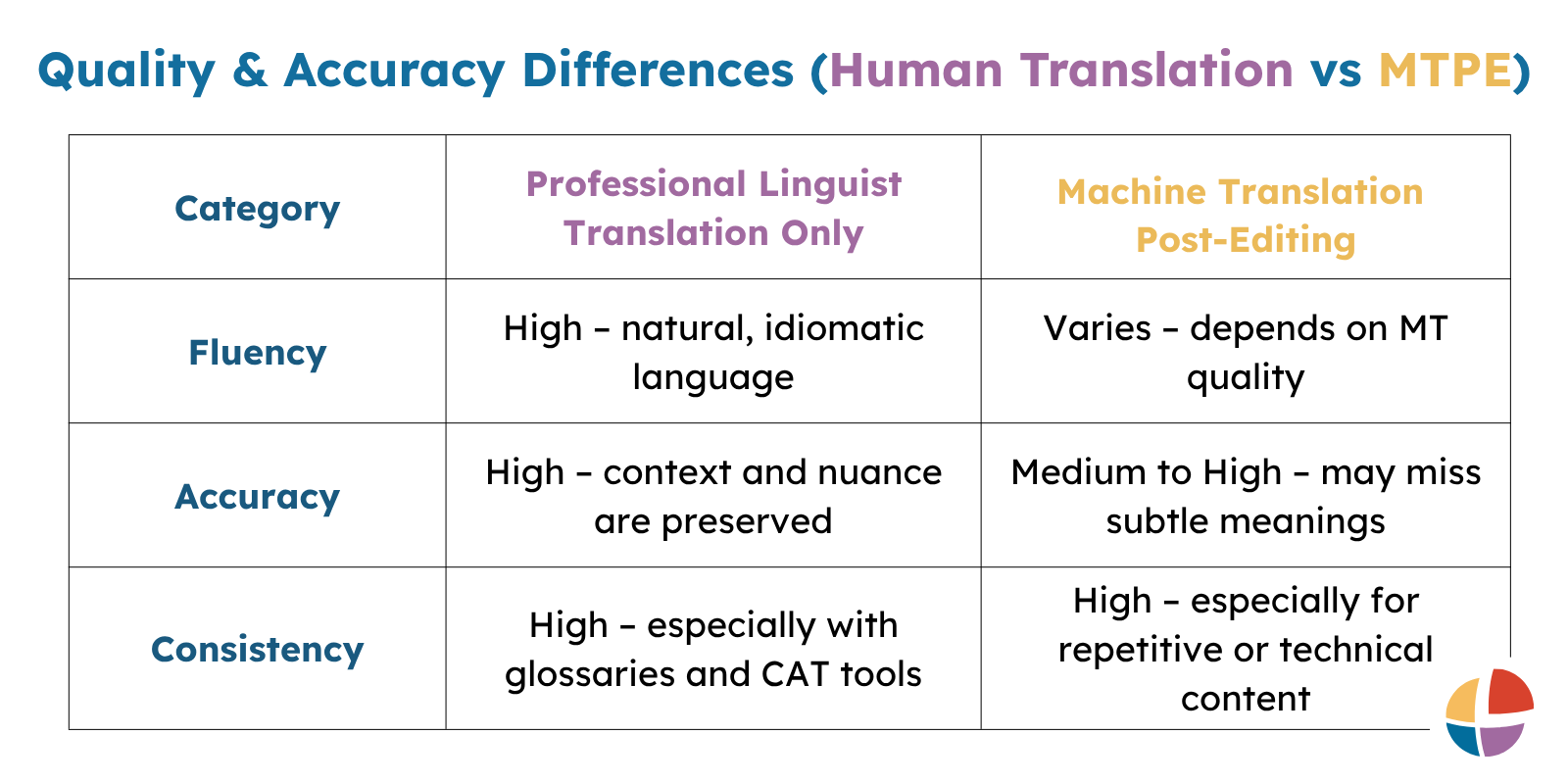
The right translation approach depends on content risk, quality requirements, and learning objectives, not just speed or cost.
In industries like healthcare or compliance, the margin for error is incredibly small. What are the real risks if organizations rely too heavily on automated translation?
The real risks include meaning drift, inconsistent policy language, broken assessments, accessibility gaps, and missing documentation, issues that undermine compliance defensibility, learner outcomes, and organizational credibility.
Training is used to drive behavior, support safety, document policy understanding, and demonstrate compliance.
That makes it uniquely vulnerable to small translation issues that compound into big consequences:
- terminology shifts that change meaning,
- inconsistent versions across regions and updates,
- silent failures in quizzes/logic,
- accessibility misalignment,
- and no record of review and approval.
AI tools generate output. They do not create accountability, enforce terminology, manage risk, or define ownership. A responsible system must do that.
Example: A healthcare compliance course is translated quickly with AI-only output. Later, reviewers flag that a key policy instruction has shifted meaning in one language, and the organization can’t easily demonstrate who reviewed it or what quality controls were applied, creating audit and operational risk.
Have you seen examples where poor translation, especially AI-only translation, led to real issues or unintended consequences?
Yes, common issues include policy language drifting across modules, assessments becoming ambiguous, and localized courses shipping with broken formatting or logic. These failures often look “fine” until learners struggle, reviewers flag inconsistencies, or audits require proof of review.
Most real-world problems aren’t dramatic, they’re subtle and cumulative. Subject-matter drift, inconsistent learner experience across regions, update amplification problems, and documentation/audit gaps.
When teams regenerate AI translations for updates without referencing previously-approved versions, they unintentionally multiply inconsistencies across languages and modules, turning “speed” into version chaos.
Example: A company updates a safety training module quarterly. They use AI-only translation each time. By the third update, the same safety concept has multiple translations across modules and regions, SMEs spend more time reconciling drift than reviewing content, and confidence in the training program drops.
Some of the biggest risks come from embedded translation tools that people don’t fully understand. What should organizations pay closer attention to?
Pay attention to the “translation button” blind spot: what the tool doesn’t translate, what it changes in formatting/structure, how it handles terminology, how updates are versioned, and whether the course is functionally validated before publishing.
Embedded translation features can be useful, especially for drafts, but the risk is that output appears complete even when critical learning components aren’t.
Here’s what organizations should validate (not assume):
- Scope coverage: course text, assessments, captions/transcripts, PDFs, LMS metadata, and updates
- Terminology control: glossary, style guidance, and reference materials applied consistently
- Formatting/layout stability: text expansion, line breaks, table overflow, slide layout collapse
- Logic integrity: quizzes, branching logic, variables, pass/fail behavior validated end-to-end
- Accessibility alignment: captions, transcripts, timing, alt text checked after translation
- Documentation: who approved what, what quality thresholds were met, what changed between versions
Example: An instructional designer uses an authoring tool’s built-in translation to produce a “ready” course, then discovers late that variables in scenario branching don’t behave properly in one language, and caption timing no longer matches the translated script.
As AI continues to evolve, how do you see the relationship between technology and human expertise changing in the translation space?
AI will increasingly handle first drafts, but human expertise becomes more valuable because teams still need terminology control, workflow ownership, functional QA, quality scoring, and defensible documentation to ensure training is accurate, consistent, and audit-ready.
As AI improves, the “work” shifts. Humans spend less time generating initial text and more time ensuring the system produces consistent, defensible outcomes. The more automation expands, the more important guardrails, accountability, and validation become.
In practice, future-ready teams will invest in:
- multilingual training workflows with defined ownership and validation steps
- terminology and reference assets to prevent meaning drift over time
- HITL review where it protects compliance with regulations and learner outcomes
- localization engineering + functional QA for learner-ready deliverables
- translation quality scoring + documentation to reduce subjectivity and support audit readiness
Example: A mature L&D org uses AI to scale across a training library, but relies on human expertise to keep policy language stable across updates, validate assessments, maintain accessibility requirements, and document decisions so training can be defended later.
Key Takeaways
- AI translation works best inside multilingual training workflows that define ownership, terminology control, and validation—not as a one-click shortcut.
- Human-in-the-Loop review and translation quality scoring help teams scale responsibly while protecting learner outcomes and audit readiness.
- Interpro supports learner-ready deliverables, not just translated words—including functional QA, consistency across updates, and documentation that stakeholders can defend.
Download the Highlights: Guide to AI Translation for eLearning Courses
Want the full framework, checklist, and decision guide? Download the full guide and use it to align L&D and Compliance/HR stakeholders on AI eLearning translation, multilingual training workflows, and quality scoring standards.
Book a Consultation
Need help deciding what is safe to automate? Book a consultation to assess your training content, identify risk areas, and design a defensible AI translation workflow that supports learner outcomes and compliance goals.
Category: AI Translation
Service: AI Translation, eLearning Translation
Industry: Learning and Development, Learning/Development
Don't forget to share this post!



Stay Updated with Interpro
Subscribe to our newsletter for the latest updates and insights in translation and localization.