

Delivering high-quality multilingual eLearning requires more than just translating text. Organizations must ensure courses are localized for language, culture, accessibility, and regional compliance while maintaining consistent terminology, functionality, and learner experience. By partnering with experienced eLearning localization providers, using tools like Translation Memories (TMs) and glossaries, testing accessibility and course functionality, and aligning translators with instructional designers, companies can create effective global training programs that improve learner engagement, reduce compliance risk, and scale across languages.
eLearning Translation Quality and Compliance FAQs
As businesses and educational institutions expand their reach, the demand for high-quality eLearning translation continues to grow. Effective multilingual training ensures learners worldwide receive the same instruction, regardless of their native language. However, maintaining quality and compliance in eLearning translation is not just about language; it requires meticulous attention to accessibility, cultural adaptation, instructional design, and legal compliance. In this guide, we’ll cover the critical aspects of ensuring your eLearning translations meet the highest quality and compliance standards.
How Do I Choose the Right Translation Provider for My eLearning Courses?
Choosing a translation provider for eLearning requires more than just ensuring linguistic accuracy. The ideal provider should have expertise in eLearning localization, instructional design, and compliance standards.
Look for a provider with experience in SCORM-compliant courses, Rise 360, Storyline, and other eLearning authoring applications. A strong portfolio in corporate training, compliance courses, and educational programs is essential. Ask for references from companies in your industry and review sample projects. Ensure the provider possesses the Certifications ISO 17100:2015 (for Translation Services) or ISO 18587:2017 (for Machine Translation Post-Editing) and ISO 9001:2015 (Quality Management). A dedicated project manager, native-speaking linguists, and robust quality control processes are also key indicators of a reputable provider.
How Do Translation Teams Work with Instructional Designers?
Instructional designers and translation teams must collaborate closely to ensure an eLearning course maintains its effectiveness across multiple languages. The process begins with a thorough content review, during which translation teams analyze course materials, learning objectives, and multimedia components.
Designers should provide glossaries, style guides, and explanations of industry-specific terminology to ensure accuracy and consistency across all translated versions. Localization engineers adapt course elements such as graphics, subtitles, interactive content, and voice-over. Regular feedback loops between designers and translators help refine translated content, ensuring it aligns with the instructional intent. Working with a translation provider experienced in eLearning localization streamlines this process, ensuring a seamless transition from the original course to its multilingual versions.
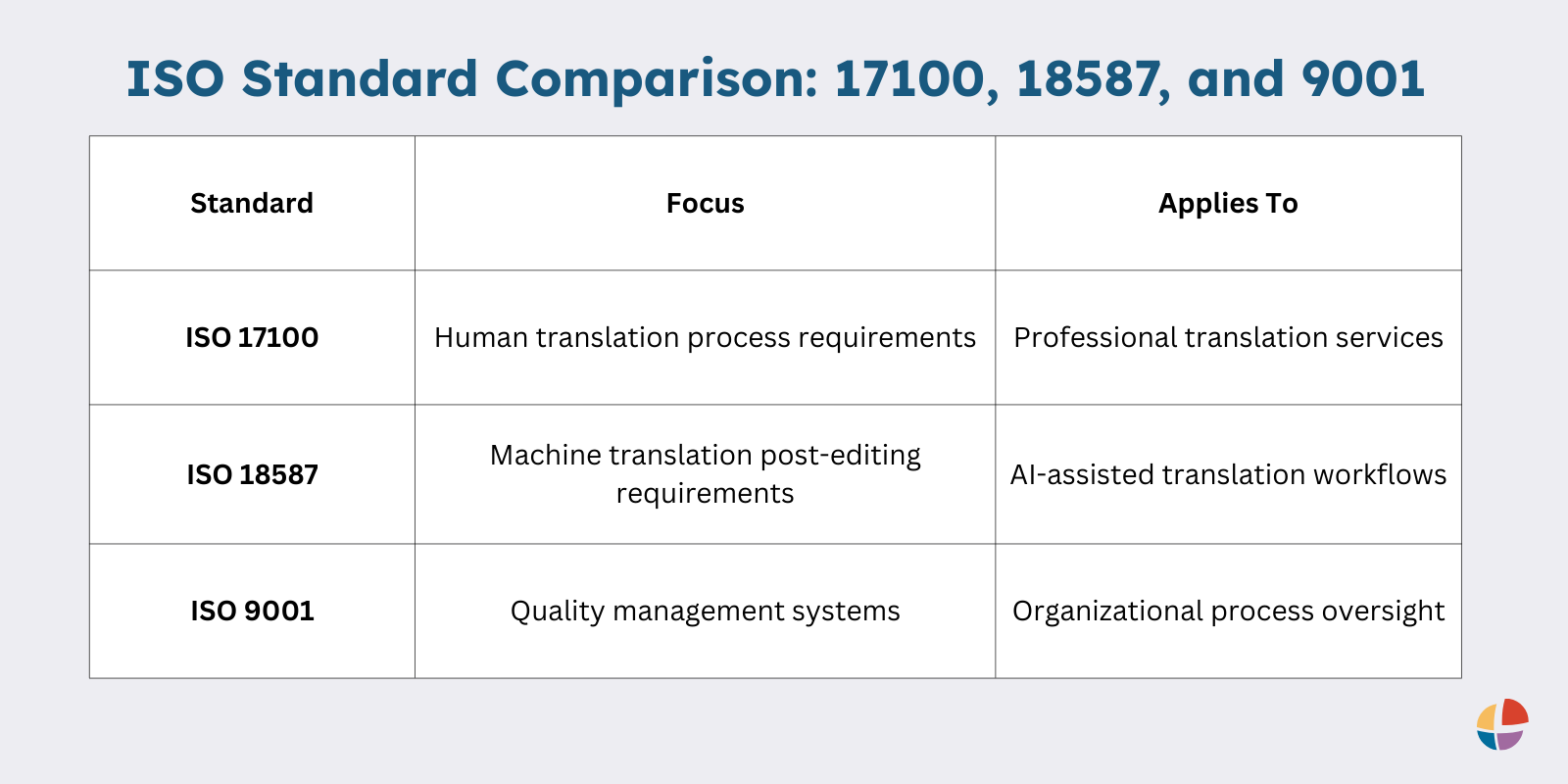
ISO Certifications for a translation company define standards for human translation processes, MTPE requirements, and organizational quality management systems.
How Do I Ensure My eLearning Course Is ADA-Compliant in Multiple Languages?
Ensuring that your eLearning content is accessible to all learners, including those with disabilities, requires compliance with the Americans with Disabilities Act (ADA) and Web Content Accessibility Guidelines (WCAG).
When designing and translating an eLearning course, you must provide alternative text for images, accurate captioning for videos, and accessible transcripts for audio content. Screen readers must be able to interpret translated text, meaning proper formatting and language tagging are essential. Color contrast and font size should be adjusted to accommodate learners with visual impairments. Voice-over and audio translation should be clear, avoiding overly-complex phrasing that might confuse learners who use assistive technology. Partnering with a translation provider who understands accessibility requirements ensures your course remains compliant across multiple languages.
What Are Common Quality Control Issues in eLearning Translation?
Several quality control issues can arise during eLearning translation, leading to errors that impact comprehension and engagement. Terminology inconsistencies across modules can create confusion for learners, especially in corporate training and technical courses.
Poorly-adapted subtitles and voice-over can disrupt the learning experience, making content seem unnatural or difficult to follow. Formatting issues, such as text expansion in languages like German or contraction in languages like Chinese, can cause misalignment in course layouts. Interactive elements like quizzes and assessments must be properly localized to function seamlessly in all language versions. Another frequent issue is failing to adapt idioms, cultural references, and regional examples, leading to content that feels out-of-place for the target audience. A rigorous review process that includes linguistic validation, in-country reviewer feedback, and functional testing can prevent these errors.
How Can I Maintain Consistency Across Multiple eLearning Modules?
Maintaining consistency in multilingual eLearning courses is crucial for an effective learning experience. Using Translation Memory (TM) tools ensures that repeated phrases and terms remain uniform across different modules, reducing errors and improving efficiency.
A centralized glossary with industry-specific terms and course-specific phrases helps translators maintain consistency. Style guides should define tone, formatting preferences, and instructional phrasing for each target language. Assigning the same translation team to work on all modules ensures familiarity with the content, preventing unnatural variations in style and terminology. Regular quality assurance checks at each stage of translation and localization help maintain coherence throughout the course.
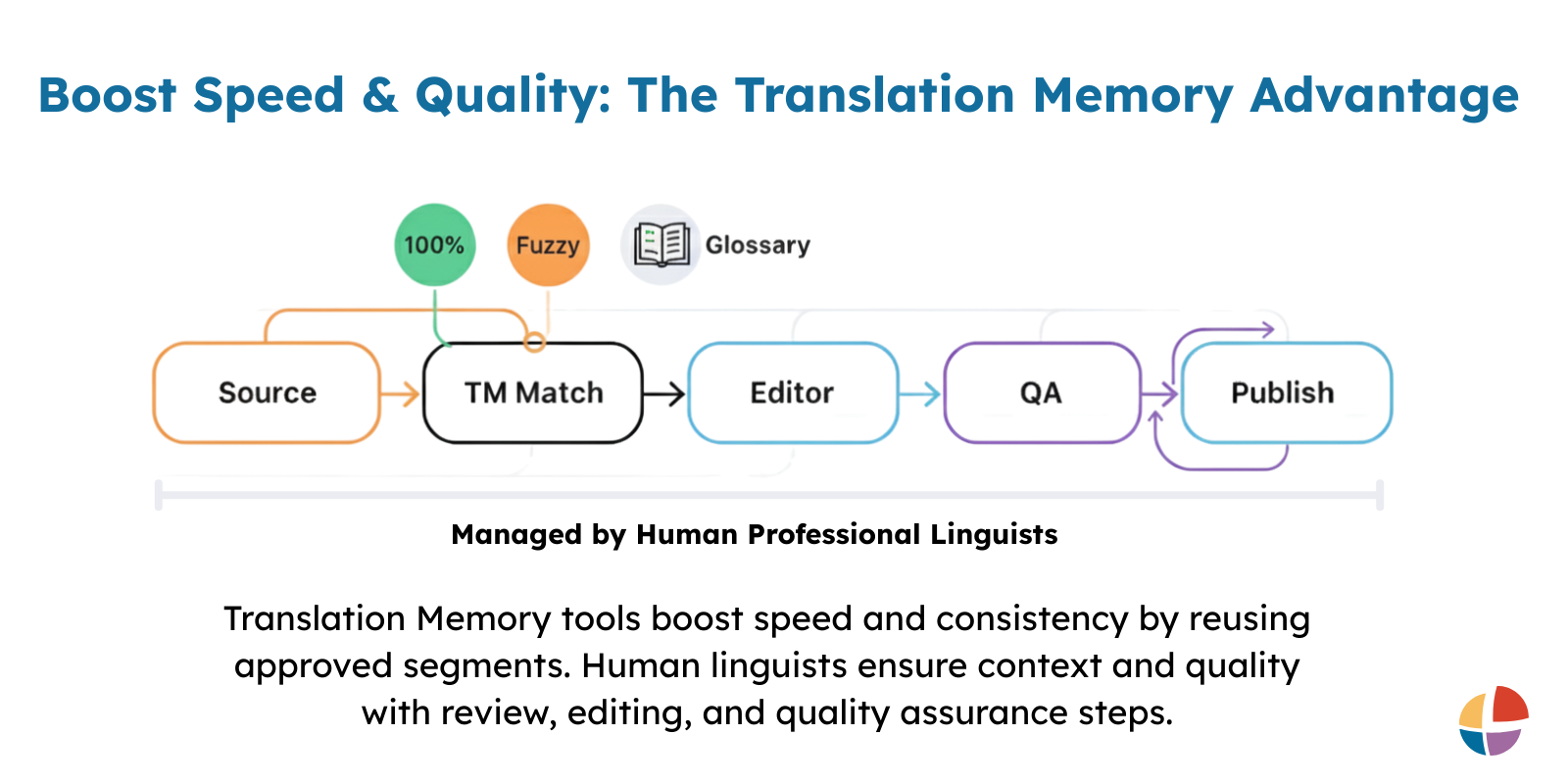
TM tools improve speed and consistency by reusing approved segments while professional linguists review, edit, and perform quality assurance before publishing.
How Do I Track Learner Engagement Across Different Languages?
Tracking learner engagement in multilingual eLearning courses requires the monitoring of key performance indicators (KPIs) across different language versions. Learning Management Systems (LMSs) provide data on course completion rates, quiz performance, and learner feedback.
It is important to analyze whether engagement and success levels vary by language, which may indicate translation quality differences or cultural mismatches in the content. A/B testing with localized versions of quizzes and assessments can reveal which translated materials are most effective. Heatmaps and interaction tracking can identify points where learners disengage, allowing for refinements in localized course design. Collecting direct feedback from learners in each language group helps assess if content is clear, culturally-appropriate, and engaging.
How Do I Handle Live Training Sessions in Multiple Languages?
Live training sessions require real-time language support to ensure all participants can fully engage with the material.
Remote Simultaneous Interpretation (RSI) allows multiple language channels to be available during webinars and virtual instructor-led training (vILT).
Consecutive interpretation can be used for in-person training, in which the speaker pauses to allow an interpreter to translate out loud.
Simultaneous interpretation is the real-time oral translation of speech as the speaker is talking. It is often used in international meetings, conferences, and negotiations to enable smooth communication between people who speak different languages.
Live captioning provides accessibility for deaf and hard-of-hearing learners while also assisting non-native speakers. Providing pre-translated training materials in multiple languages helps participants prepare before the session. LMS integration with multilingual chat support and AI-powered translation tools can facilitate real-time communication among learners from different linguistic backgrounds.
What Are the Best Languages to Translate eLearning Courses Into?
The best languages for eLearning translation depend on the target audiences and business goals. Globally, the most common eLearning languages are Spanish, French, German, Chinese, Japanese, Portuguese, and Arabic.
In North America, translating courses into Spanish and Canadian French is essential for reaching bilingual employees and students. In Europe, companies often require translation into French, German, and Italian to comply with local workforce training regulations. For international organizations, translating into Chinese and Arabic opens doors to major markets. Selecting languages based on workforce demographics, compliance requirements, and business expansion strategies ensures a high return on investment in translation.
How Does Localization Affect Certification and Compliance Training?
Compliance training must be localized accurately to meet industry regulations and legal standards in each region. A direct, word-for-word translation of compliance training materials is not sufficient.
Localized versions must align with country-specific laws, workplace safety guidelines, and professional certification requirements. For example, General Data Protection Regulation (GDPR) compliance training in Europe must be adapted for each EU member state’s language and specific regulations. OSHA training in the U.S. differs from workplace safety training required in Canada or the UK. Certification exams must also be localized, requiring terminology to remain precise and legally-valid in all languages. Localized compliance training reduces legal risks and ensures employees fully understand workplace policies in their native language.
What Are the Best Practices for Translating Corporate Training Materials?
Effective corporate training translation should follow several best practices to ensure clarity, engagement, and compliance. Content should be written in simple, concise language to improve translatability and reduce ambiguity.
Multimedia elements such as images, videos, and animations should be designed to be culturally-appropriate for each region. Translation Memory (TM) tools and glossaries help maintain consistency across multiple training modules. The use of native-speaking translators with expertise in corporate training ensures accurate terminology adaptation. Interactive components like quizzes and gamified learning experiences should be localized with care to maintain effectiveness. Finally, quality assurance testing, including linguistic reviews and functional testing on the LMS, ensures the translated training materials meet high standards.
Why High-Quality eLearning Translation Matters
Investing in high-quality eLearning translation is essential for businesses and educational institutions serving multilingual audiences.
Poor translation can lead to confusion, disengagement, and compliance risks, while effective localization enhances learner comprehension, engagement, and accessibility. By choosing the right translation provider, implementing robust quality control measures, and ensuring compliance with accessibility and legal standards, organizations can deliver effective multilingual training that supports global learners. Whether it’s translating corporate compliance training, adapting eLearning courses for international markets, or ensuring accessibility through ADA-compliant design, professional translation services provide the expertise needed to create impactful learning experiences across languages.
Build Your Custom Localization System with Confidence
Book a consultation to assess the best localization strategy for you.
Interpro helps you evaluate your current localization workflow, identify where AI can be applied safely, and design a Human-in-the-Loop process that protects compliance, quality, and brand integrity.
Whether you need AI translation services, MTPE, full human translation, or strategic localization consulting, we’ll help you build a system that scales without exposing your organization to unnecessary risk.
Category: Localization
Tags: About Interpro
Service: eLearning Translation
Don't forget to share this post!


Stay Updated with Interpro
Subscribe to our newsletter for the latest updates and insights in translation and localization.