

AI translation failures are rarely caused by the technology itself. They happen when AI is used without a structured localization system. Without workflows, terminology control, and human oversight, organizations risk compliance issues, technical inaccuracies, and broken content experiences.
The solution is not to avoid AI, but to govern it. A human-in-the-loop approach introduces the structure needed to ensure quality, consistency, and accountability at scale.
5 AI Translation Failures We’ve Recently Uncovered (Beyond Bad Grammar)
AI translation is now embedded in authoring tools, LMS platforms, CRMs, and enterprise software. From Translation-as-a-Feature to large language models, organizations are accelerating global content faster than ever.
But when AI translation is implemented without a structured Human-in-the-Loop localization workflow, the risk shifts from speed to exposure.
At Interpro, we’ve recently reviewed projects where AI translation didn’t just produce minor linguistic errors. It disrupted compliance language, broke course logic, diluted technical terminology, and created formatting failures days before launch. In every case, the issue wasn’t the technology itself. It was the absence of a defensible localization system governing how AI was used.
Below are five real areas where we’ve seen AI translation fail, and what separates reactive damage control from a scalable Human-in-the-Loop strategy.
The Common Root Cause of AI Translation Failures
All five examples share the same issue: AI was used as a solution instead of as part of a system. AI translation generates output. It does not:
- create accountability,
- enforce terminology,
- manage risk, or
- govern workflows.
When translation decisions affect compliance, safety, training accuracy, or brand integrity, structure matters more than speed.
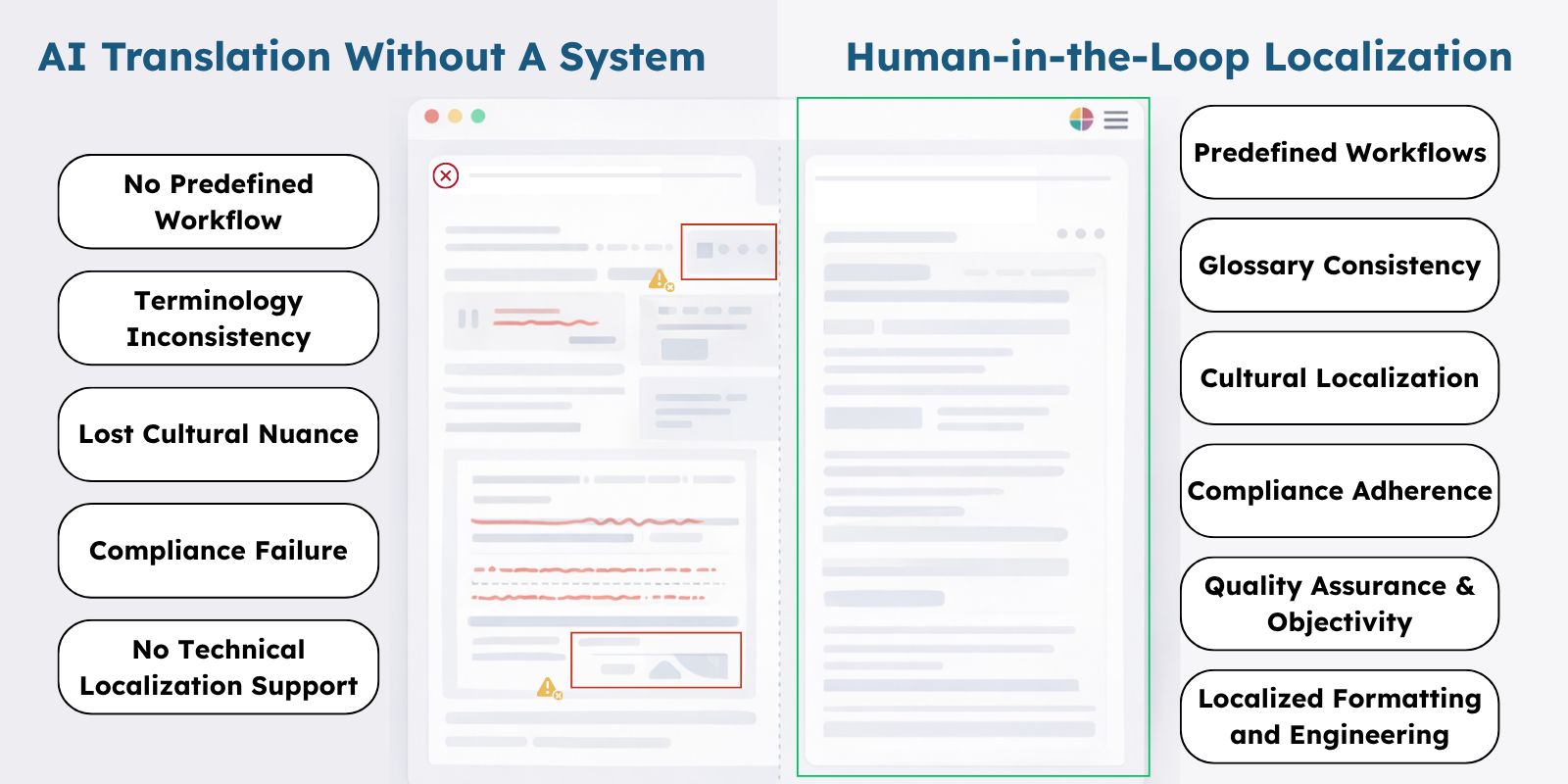
AI translation failures often stem from missing workflows, inconsistent terminology, and a lack of oversight, while Human-in-the-Loop localization introduces structure, accuracy, and compliance.
So let’s dive into the most common places where AI fails in the localization lifecycle.
5 Examples of AI Translation Fails
1. The “Translation-as-a-Feature” Blind Spot
An HR team translated a training library into French Canadian using the authoring tool’s AI Translation-as-a-Feature.
The translation was processed instantly. But word-for-word output lacked nuance. Cultural phrasing didn’t align with the region. Compliance language lost precision. Critical terminology shifted just enough to introduce risk. The problem wasn’t using AI. The problem was assuming the tool replaced the strategy.
What to do instead:
If you use Translation-as-a-Feature (TaaF), implement professional oversight. A linguist should review terminology, tone, and compliance-sensitive language. AI can draft. Humans must validate.
2. Subject-Matter Drift in Technical Content
One global manufacturer translated all content with a Human-in-the-Loop process, except German, which required full human translation due to AI’s misunderstanding of the subject matter in the target language.
The grammar was correct. The terminology was not. Subtle misunderstandings of industry-specific language created confusion in the target market. Accuracy in translation is not just linguistic. It’s technical.
What to do instead:
This issue is not unique to German. Depending on the language pair maturity, AI translation engine, and subject matter, you may get wildly different results. Match translators and post-editors to the subject matter. Human-in-the-Loop only works when the human has the right expertise. AI plus the wrong reviewer still creates risk.
3. Internal AI Without Governance
Some teams are using Microsoft Copilot to translate internal emails, but have found gradually diluted message clarity, leading to lower engagement across teams.
At first, it seems harmless. Over time, message clarity becomes diluted. Terminology shifts. Cultural tone flattens. Engagement drops across regions. Small inconsistencies compound.
Without guardrails, internal AI use becomes decentralized and inconsistent.
What to do instead:
Create an AI translation policy. Define where AI is acceptable, where human review is required, and how terminology should be standardized. Governance protects brand clarity at scale.
4. Workflow Corruption Inside Authoring Tools
One eLearning development agency had to re-create Storyline courses for their client when the AI translation feature inside Storyline corrupted the original English source files.
The export-import cycle broke source files. Formatting shifted. Quiz logic failed. Original English files required reconstruction.
The AI translation didn’t just introduce language errors. It disrupted the production workflow.
What to do instead:
Establish a structured localization workflow before launching AI translation. Include file prep, engineering review, and post-translation quality assurance. AI is only one step in a multi-step system.
5. Formatting Collapse Before a Live Event
PowerPoint presentations were translated for a conference using the embedded AI translate button, but the formatting broke and added an unexpected 30 hours of internal repair time just days before the event.
PowerPoint presentations were translated for a conference using embedded AI tools.
The translation is completed. But formatting broke. Text expansion wasn’t managed. Layout shifted. Teams spent 30 unexpected hours repairing files days before the event. AI handled words. It did not handle presentation integrity.
What to do instead:
Include localization engineering and formatting QA in your workflow. Translation isn’t complete until the final file is ready to publish, present, or distribute.
What Works Instead: A Structured Human-in-the-Loop Workflow
A responsible AI translation process includes:
- Content preparation and risk classification
- Terminology management (glossaries and translation memories)
- AI engine selection based on content type
- Machine Translation Post-Editing by subject-matter linguists
- Localization engineering
- Quality assurance and documented review
AI becomes powerful when it operates inside guardrails. Not when it replaces them.
Build a Localization System You Can Defend
Book a consultation to assess your translation risk and build a defensible AI localization strategy.
If you’re evaluating AI translation for regulated or high-risk content, the first step is not choosing a tool. It’s assessing your content and understanding your risk.
Interpro helps you evaluate your current localization workflow, identify where AI can be applied safely, and design a Human-in-the-Loop process that protects compliance, quality, and brand integrity.
Whether you need AI translation services, MTPE, full human translation, or strategic localization consulting, we’ll help you build a system that scales without exposing your organization to unnecessary risk.
Category: Localization
Service: AI Translation

Don't forget to share this post!



Stay Updated with Interpro
Subscribe to our newsletter for the latest updates and insights in translation and localization.