

Interpro is an ISO 18587 certified localization provider that breaks down the standard for Machine Translation Post-Editing. This standard helps provide a framework to manage and regulate AI translations with post-editing within your localization process. This article covers what the standard governs, how it differs from other ISO frameworks like ISO 17100 and ISO 9001, why compliance-driven and enterprise organizations rely on it, and how to evaluate whether a certified MTPE partner truly delivers the structure and accountability your content requires.
AI translation is fast. But when compliance, patient safety, legal accuracy, or public trust are on the line, speed alone is not enough.
If you’re evaluating machine translation post-editing (MTPE) services, you’ve likely come across ISO 18587. But what does this certification actually require, and why does it matter in an AI-driven localization strategy?
Interpro holds multiple ISO certifications, including ISO 18587 for Machine Translation Post-Editing (MTPE). We can help ensure that your human, AI-driven, or hybrid localization workflows are built on structured processes, qualified linguists, and human-in-the-loop quality assurance.
In this article, you’ll learn:
- ISO 18587 is the international standard for machine translation post-editing (MTPE).
- It defines how AI-generated translations must be reviewed, corrected, and validated by qualified linguists.
- It builds on ISO 17100 and ISO 9001 quality frameworks.
- It matters most for regulated, high-risk, and compliance-sensitive content.
What Is ISO 18587?
ISO 18587:2017 is the international standard that defines the requirements for human post-editing of machine translation output.
It does not regulate the AI tool itself. It governs what happens after the AI produces a translation. That distinction is critical.
The ISO 18587 standard outlines:
- Post-editor qualifications and competencies
- Defined linguistic correction requirements
- Clear distinction between light and full post-editing
- Structured revision processes
- Documentation of quality controls
In plain English: ISO 18587 ensures that machine translation output is treated as a draft that must be reviewed and validated by qualified human professionals before it is considered complete.
It introduces accountability into AI workflows.
To regulate what happens before and after AI translation, you’ll want a localization service provider with ISO 9001 (Quality Management) and ISO 17100 (Translation Services).
How ISO 18587 (MTPE) Is Different from ISO 17100 (Translation) and ISO 9001 (Quality)
ISO standards work together, but they are not interchangeable. Here’s how they compare:
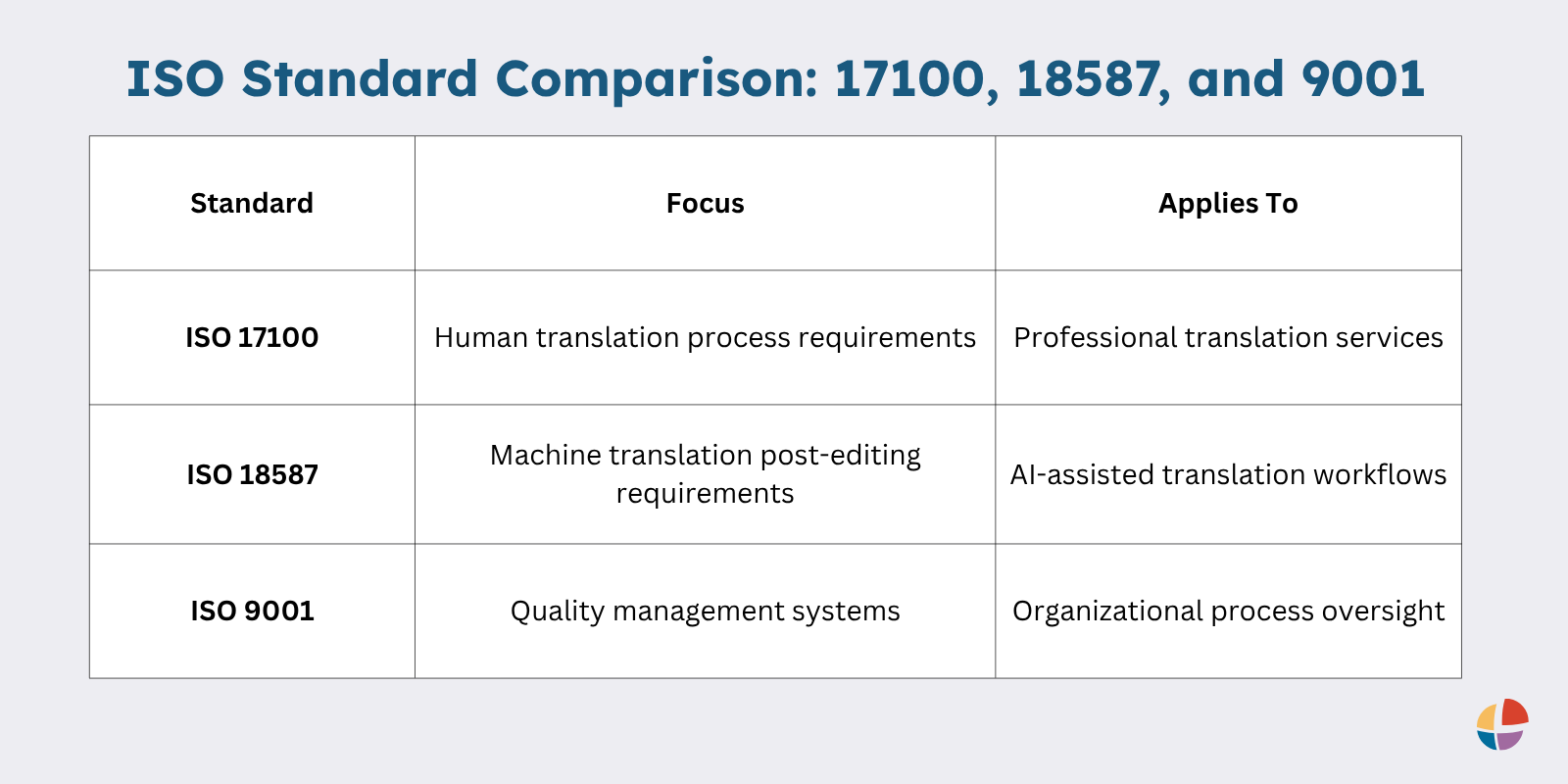
A comparison of ISO 17100, ISO 18587, and ISO 9001 showing how human translation, AI post-editing, and quality management systems work together to support compliant localization workflows.
ISO 17100 defines how fully human translation projects must be handled.
ISO 18587 extends that discipline into AI-assisted environments.
ISO 9001 provides broader quality management governance across operations.
Importantly, ISO 18587 does not replace ISO 17100. ISO 17100 still applies for organizations that require human editing processes for certain content.
That means MTPE workflows under ISO 18587 still require professional translators, revision stages, and documented processes. The AI component does not remove human responsibility. It adds another layer that must be governed.
For enterprises evaluating vendors, this distinction matters. A provider may use AI tools, but without structured post-editing standards, there is no defined accountability framework.
Why ISO 18587 Matters in an AI World
As AI adoption accelerates, governance is becoming the differentiator. For regulated industries such as life sciences, healthcare, legal, and finance, ISO 18587 may not be an option all the time. But when AI can be used for translation, ISO 18587 helps with:
- Auditability and traceability
- Defining roles and review stages
- Building defensible workflows
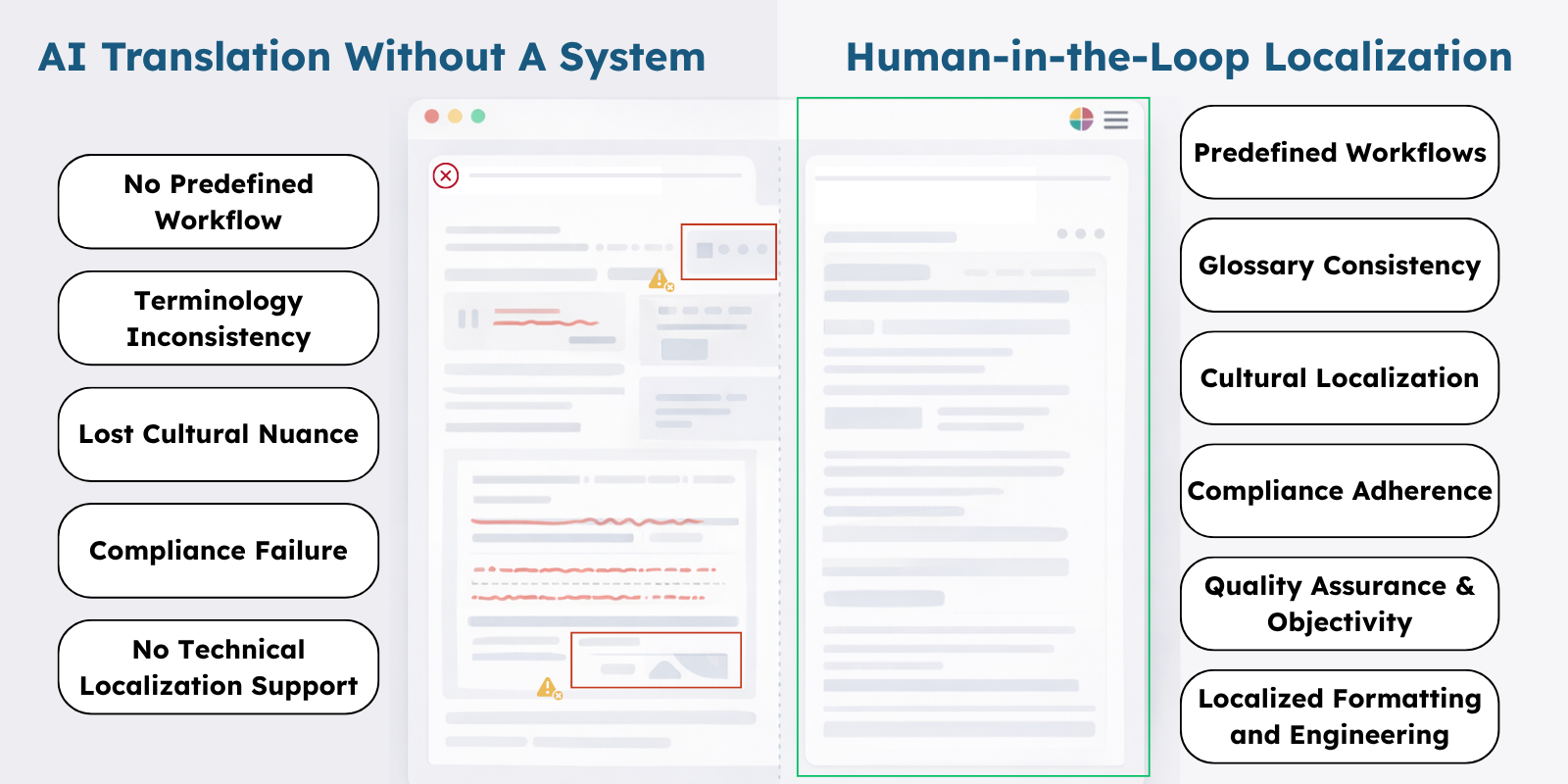
Unstructured AI translation leads to inconsistency, compliance risk, and loss of nuance. Human-in-the-loop localization introduces defined workflows, glossary control, and quality assurance for reliable outcomes.
If you operate in healthcare, diagnostics, or regulated manufacturing, you cannot defend a translation decision with “AI-generated it.” You must show how it was reviewed, by whom, and under what documented standards.
ISO 18587 provides that governance layer. When translation impacts employee benefits, safety communications, or public-facing information, structured review processes protect more than brand reputation. They protect people.
What ISO 18587 Actually Requires (Simplified)
Let’s break the standard into five core requirements.
1. Qualified Post-Editors
MTPE under ISO 18587 is not crowdsourced editing. It requires professional post-editors who must meet defined competency standards. This includes:
- Proven linguistic qualifications
- Experience in translation
- Subject matter expertise, where applicable
2. Full Post-Editing
You have heard terms distinguishing between light post-editing and full post-editing. ISO 18587 requires full post-editing, meaning:
- All errors impacting meaning must be corrected
- Terminology must align with approved glossaries
- Grammar and syntax must meet professional standards
- Style must be consistent with client expectations
The output should be comparable to a human-translated deliverable.
3. Revision Stage
With ISO 18587, there is no secondary professional revision stage to verify the post-editing changes. If you wish to have a second qualified professional review the post-edited content, then discuss that with your localization provider to add those steps from ISO 17100 (translation).
Learn more about AI translation output quality and conducting linguistic quality assurance:
- A Guide to Linguistic Quality Assurance with a Multi-Layer Approach
- How AI Translation Works, Where Human Review Still Matters, & What is Machine Translation
- 10 Insights on AI Translation Quality for Flawless Global Content
4. Defined Quality Controls and Output Quality Objectives
Under ISO 18587, post-editing is not complete simply because edits were made. The final translation must be fit for purpose and comparable in quality to a professionally translated deliverable.
This means organizations must establish the following (generally prior to beginning AI translation):
- Clear expectations for linguistic accuracy and terminology compliance
- Defined quality thresholds before content is approved
- Accountability for validating that post-edited output meets intended use requirements
This structured approach supports audit readiness, risk management, and defensible AI localization decisions. Working with an ISO-certified localization partner helps ensure that qualified linguists, documented workflows, and quality validation steps are consistently applied.
What ISO 18587 Does NOT Mean
A credible discussion of ISO 18587 must include its limitations. It does not mean:
- AI output is automatically perfect
- All AI translation output should use MTPE
- It is always the lowest-cost solution
- There is zero human involvement
Instead, it means there is a defined, accountable structure around AI-generated translation. That AI translation is implemented with a governance framework, not a magic one-click solution. It means understanding that localization and post-editing are separate from AI translation.
Organizations still must assess content risk levels before deciding whether MTPE is appropriate. High-risk regulatory submissions may still require full human translation without AI involvement.
Who Should Care About ISO 18587?
Not every organization needs a language service provider to adhere to ISO 18587 for every project. But certain sectors should consider it a priority, especially if you’re dealing with complex or high-risk communications:
- Life sciences
- Healthcare
- Financial services
- Legal
- Manufacturing safety documentation
These industries face regulatory scrutiny, compliance audits, and potential liability exposure. Structured AI translation governance reduces risk.
In these environments, translation quality impacts employee understanding, safety compliance, and organizational credibility.
The key is risk segmentation. Responsible AI adoption starts with understanding your content landscape before selecting workflows.
Responsible AI Decision-Making with Machine Translation Post-Editing
AI translation is becoming embedded in enterprise workflows. AI translation can be risky. Unstructured AI translation is. And the difference between “using AI” and “using AI responsibly” is a strategic localization system.
ISO 18587 represents the structured, accountable approach to machine translation post-editing. It brings professional governance into AI workflows and aligns innovation with compliance.
When you understand what the standard requires, you can make informed, defensible decisions about how and where AI fits into your localization strategy. If your organization is navigating AI adoption in regulated or high-stakes environments, start by setting up:
- Defined human oversight
- Documented review processes
- Accountability frameworks
- Audit-ready structure
If you’re evaluating AI translation, do not start by selecting a tool. Start by understanding:
- Your content risk levels
- Your compliance exposure
- Your governance requirements
- Your internal review capacity
Once you have that clarity, you can determine whether MTPE under ISO 18587 is appropriate for your organization.
Need Help Building Your AI Localization Workflow?
At Interpro, we help companies assess their AI translation workflows, identify where ISO-governed MTPE makes sense, and design defensible human-in-the-loop processes that align with compliance and operational goals.
Schedule a consultation to assess your workflows and explore how ISO-aligned processes can support responsible AI localization.
Frequently Asked Questions
Is ISO 18587 required for AI translation?
No. It is not legally required. However, regulated industries and enterprises seeking defensible governance often prefer vendors certified under ISO 18587 to reduce risk.
What is the difference between light and full post-editing?
Light post-editing focuses on correcting major meaning errors so text is understandable. Full post-editing, required by ISO 18587, ensures accuracy, terminology consistency, grammar, and style comparable to human translation quality.
Does ISO 18587 guarantee zero translation errors?
No standard guarantees zero errors. ISO 18587 ensures structured review processes designed to minimize risk and provide accountability.
How does ISO 18587 relate to ISO 17100?
ISO 17100 governs human translation processes. ISO 18587 extends a similar discipline to machine translation post-editing workflows.
Should regulated industries require ISO 18587 certification?
Organizations operating in highly regulated sectors should strongly consider it, especially when AI translation is introduced into compliance-sensitive workflows.
Category: Featured, Localization, Translation
Tags: About Interpro

Don't forget to share this post!



Stay Updated with Interpro
Subscribe to our newsletter for the latest updates and insights in translation and localization.