

Language consulting helps businesses move beyond basic translation by aligning multilingual content, technology, and workflows with broader business goals. In today’s global, AI-driven marketplace, organizations need expert guidance to avoid costly errors, meet compliance standards, and accelerate international growth. This blog outlines what language consulting is, the services it provides, and why it’s become a strategic priority for 2026.
Why Language Consulting Should Be a C-Suite Priority in 2026
Sharp Corporation lost 10 % of its market value after a mistranslated earnings note hit the wires.
Translation alone no longer covers the risk. Boards now ask: “What’s our growth strategy?” And often, growth involves successfully communicating across multiple languages. Strategic localization solutions designed to support growth through the discipline of aligning words, workflows, and technology with business goals is language consulting.
Strategic Language Consulting for Localization Solutions (More Than “Extra-Fancy Translation”)
At its core, language translation consulting is a strategic advisory service that helps organizations:
- Audit multilingual content and workflows
- Define governance (style guides, termbases, ISO certifications)
- Optimize tech stacks (CAT, MT, LLM prompts, connectors)
- Train teams and measure KPIs
- Manage the localization workflow efficiently
Translation = output. Language consulting = outcome.
Core Services on a Modern Language-Consulting Menu
Consulting isn’t a one-off deliverable. It’s an open communication channel and loops back for continuous optimization.
At Interpro, consulting begins before a single file is translated. We assess your workflow, content risk levels, technology stack, governance structure, and quality benchmarks to design the right localization strategy from the start.
But it doesn’t end there.
As projects move through AI-enabled workflows, human review, and QA checkpoints, gather performance data (quality scores, turnaround times, cost efficiencies, terminology gaps, and process friction). That insight feeds back into your strategy, and Intepro can assist you with setting up or managing that process.
| Service | What It Delivers | Best-Fit Scenario |
| Content & Tech Audit | Gap analysis, cost-leak map | Pre-IPO global rollout |
| Terminology Governance | Bilingual glossaries, style guides | Brand consistency overhaul |
| Translation Assessment | Engine benchmarking, MTPE KPIs | Scaling support knowledge base |
| Process Build-Out | 9001/17100 documentation, QA scorecards | Regulated industries (med-tech, fintech) |
| Change-Management Training | Playbooks, workshops | New CMS + translation connector launch |
Why Now? Three Macro Shifts Driving Demand
Globalization & Market Growth
Language services hit $75.5b in 2024 and will top $111b by 2033. (IMARC Group) Competition for international revenue forces companies to mature their localization strategy faster.
AI & MTPE Adoption
Average MTPE use rocketed from 26% in 2022 to 46% in 2024. Consultants help pick engines, assess source content usability for MT, design post-editing workflows, and prevent data-leak risks.
Remote Work & Collaboration Gaps
86% of executives cite poor communication as the top reason projects fail. Language consulting embeds consistent terminology and cross-time-zone processes.
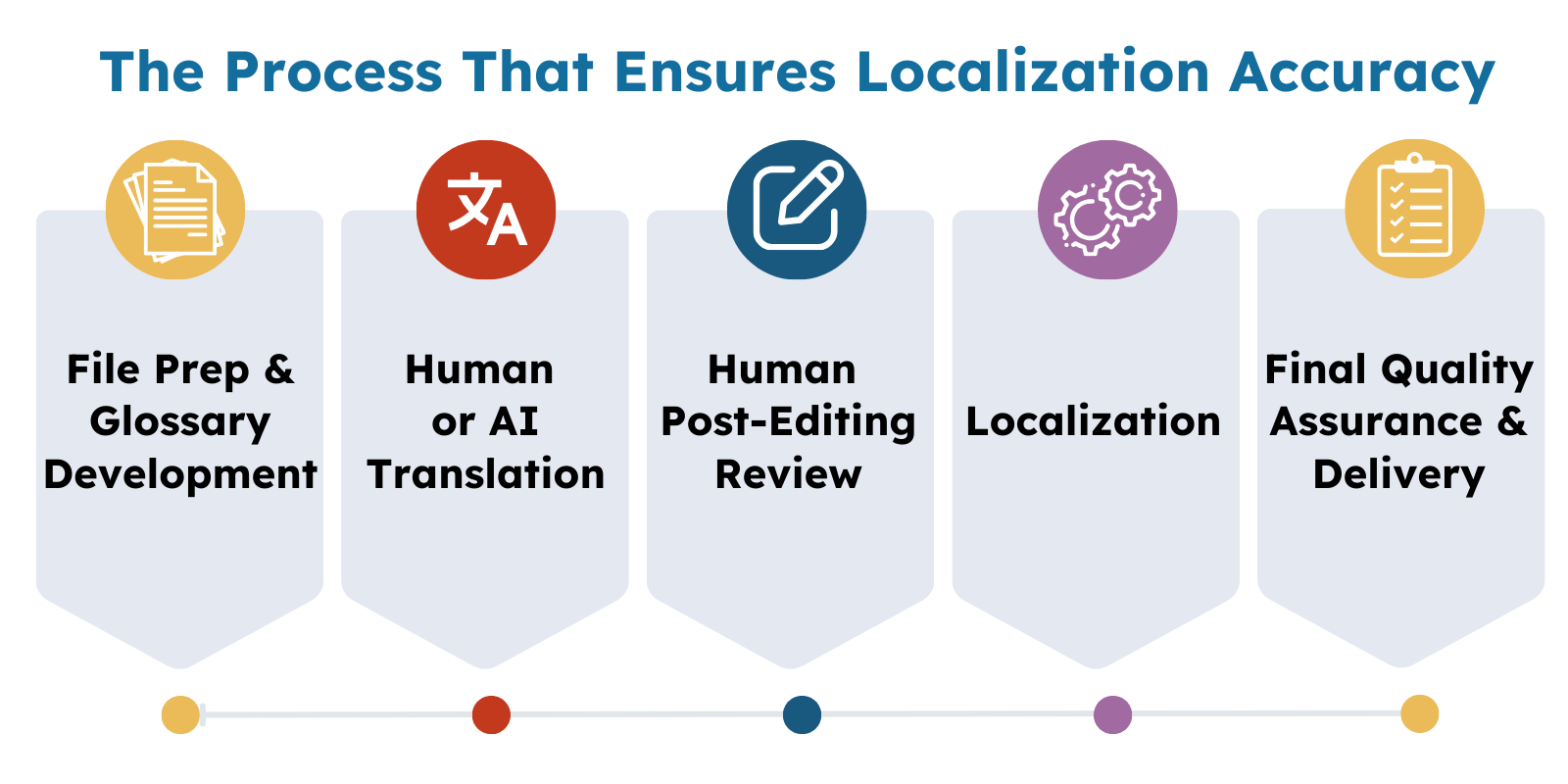
Language consulting process for ensuring translation accuracy through quality control steps.
Common Business Scenarios & Pain Points
Scenario 1 – “We’re Launching in 10 Countries. Help!”
Pain: Tight timeline. No established terminology. Limited internal trust. Speed-to-market directly impacts ROI and revenue performance.
Consultant fix: Strategic Localization Roadmap
When expansion pressure is high, translation must be strategic, not reactive.
A consultant helps prioritize high-ROI content, sequence market rollouts, and define what must be launch-ready versus phased. We quickly establish core terminology and brand language to prevent inconsistencies and rebuild internal confidence.
Next, we clarify governance and who approves, what qualifies as critical, and how quality is measured to reduce friction and protect deadlines.
Finally, we align workflow, risk segmentation, timeline projections, and quality benchmarks into a structured launch plan.
The result is controlled acceleration: faster market entry with protected brand integrity and predictable ROI.
Scenario 2 – “Our AI Translation Output Is a Mess. Fix It.”
Pain: Raw AI output lacks accuracy, terminology control, and brand voice. Confidence in the system is eroding.
Consultant fix: AI Governance & Human-in-the-Loop Framework
A consultant does not simply “edit the mess.” We diagnose why it’s happening.
First, we evaluate source content quality, terminology gaps, and workflow misuse. AI often fails because guardrails were never defined.
Next, we implement structured controls: glossary development, translation memory alignment, content risk segmentation, and clear post-editing standards.
Then, we activate a human-in-the-loop model with defined quality thresholds—ensuring linguists refine tone, enforce terminology, and correct meaning before release.
Finally, we establish feedback loops so recurring issues improve over time rather than repeat.
The result is AI that performs predictably—protected by governance, strengthened by human expertise, and aligned with your brand voice.
Scenario 3 – “Legal Said We Need Compliant Localization Workflows”
Pain: Regulatory pressure and documentation gaps with unclear accountability = high compliance risk if translations fail audits.
Consultant fix: Compliance-Driven Localization Framework
A consultant translates legal requirements into operational controls.
First, we assess regulatory exposure by content type and market, defining where human review is mandatory and where automation is acceptable.
Next, we establish documented workflows aligned with ISO standards, role-based approvals, and traceable quality checkpoints. Every step becomes auditable.
We implement terminology governance, version control, and documented review cycles to ensure consistency and defensibility.
Finally, we create reporting mechanisms so legal and leadership teams can see compliance metrics, not just translated files.
The result is not just localized content—but a defensible, documented system that protects your organization in every language.
Key Takeaways for Leveraging Language Consulting Services
Language translation consulting turns reactive translation spending into a proactive growth lever. By auditing assets, aligning stakeholders, and integrating AI securely, consultants:
- Cut costs up to 30%
- Reduce errors by 70%
- Helps accelerate global launches with less friction
Not sure where to begin, or need a rescue mission? Interpro can start, fix, or finish your global-content program.
👉 Book a free strategy call and get a custom roadmap within one week.
Frequently Asked Questions
Is language consulting only for large enterprises?
No. SMEs use “fractional” consulting to set up glossaries and choose MT tools.
How long does an engagement take?
Discovery to roadmap: 2–4 weeks. Full rollout can be phased over a quarter
Will consultants replace my in-house team?
No, they augment and upskill your team; knowledge transfer is part of the deliverable.
How is success measured?
Agreed KPIs (cost, quality, turnaround) plus qualitative stakeholder surveys.
What about AI data privacy?
Consultants design secure, on-prem or private-instance MT/LLM workflows.
Can Interpro jump in mid-project?
Yes, audit, triage, and stabilize before optimizing.
Category: Localization
Tags: Consulting
Service: Translation Services
Don't forget to share this post!

Stay Updated with Interpro
Subscribe to our newsletter for the latest updates and insights in translation and localization.