

Machine translation can generate content at scale in seconds. But what determines whether that content is usable, accurate, and safe comes after the machine finishes. This guide explains what actually happens in Machine Translation Post-Editing (MTPE), why human oversight still matters, and how structured workflows turn AI output into reliable, real-world content.
What is AI translation vs. MTPE vs. AI translation + localization?
Before diving into the process, it’s important to clarify three terms that are often used interchangeably but shouldn’t be.
AI Translation
AI translation refers to the use of machine learning models (such as neural machine translation engines) to automatically translate text from one language to another.
- It is fast and scalable
- It produces a draft output
- It does not guarantee accuracy, context, or usability
AI translation is best understood as a starting point, not a finished product.
Machine Translation Post-Editing (MTPE)
MTPE is the structured process of reviewing and correcting machine-translated content to ensure it is accurate, consistent, and usable.
This includes:
- correcting meaning and context
- aligning terminology
- fixing grammar and structure
- ensuring completeness
MTPE introduces human expertise into the workflow, transforming raw AI output into content that can actually be used.
AI Translation + Localization (Human-in-the-Loop Localization)
AI translation + localization is a broader, end-to-end approach that goes beyond translation alone.
It includes:
- AI translation + MTPE
- terminology management and glossaries
- localization of formatting, formatting rules, and cultural expectations
- quality assurance and workflow management
This is where organizations move from “translating content” to managing a complete localization system.
At this level, AI is not used in isolation; it is governed by process, standards, and human oversight.
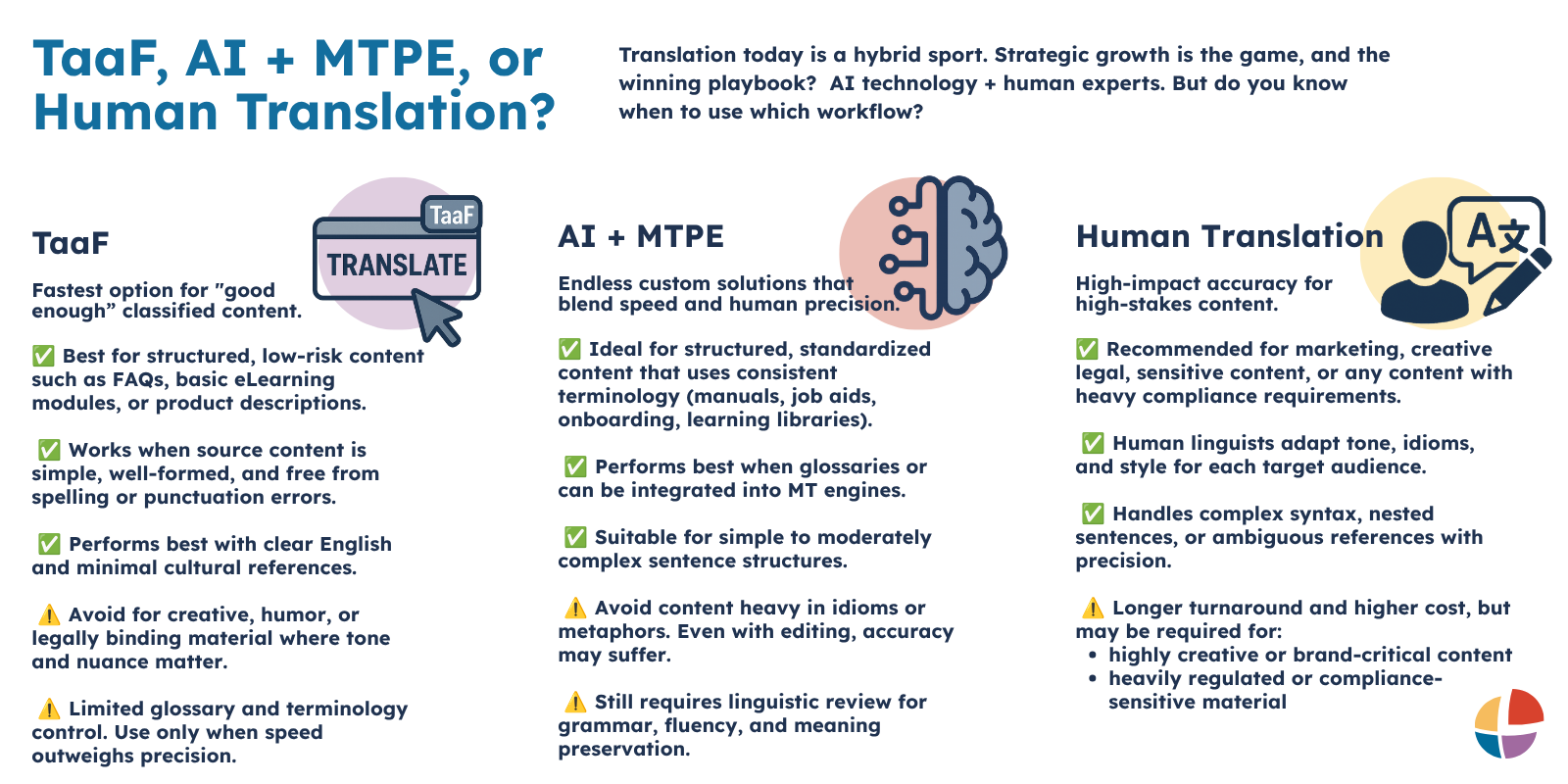
Choosing the right translation workflow depends on content complexity, risk, and quality requirements.
Can machine translation be used without human review?
No, machine translation alone is not sufficient for most business use cases.
While modern AI translation engines can process large volumes of content quickly, the output is not considered final. It may be understandable, but it is not guaranteed to be accurate, consistent, or aligned with your terminology, compliance requirements, or audience expectations.
That is why MTPE is a standard part of any structured translation workflow. Machine translation produces a draft. MTPE turns that draft into usable content.
Machine Translation Is Only the Starting Point
Machine translation engines are designed to predict language, not understand it in the way humans do.
They perform well when:
- content is structured
- terminology is consistent
- sentences are simple
But even then, the output can include:
- subtle meaning errors
- incorrect terminology choices
- unnatural phrasing
- missing or added context
These issues are not always obvious at first glance, but they become critical when content is used in real business scenarios.
That is why MT output is treated as preliminary, not final.
What Happens During MTPE?
MTPE is a systematic process performed by qualified linguists. It follows a defined set of responsibilities to ensure the translated content is accurate, consistent, and usable.
Correcting Meaning and Accuracy
The first priority is ensuring that the message is correct.
Post-editors compare the source content directly to the machine output. If the AI has misunderstood context, introduced ambiguity, or altered meaning, the linguist rewrites the content.
This step is critical for:
- product instructions
- compliance documentation
- training materials
Even small inaccuracies can create downstream risk.
Aligning Terminology
Terminology consistency is one of the biggest weaknesses in raw machine translation.
Post-editors:
- apply approved glossaries and termbases
- ensure consistent language across the entire document
- standardize domain-specific phrasing
This is especially important in industries where terminology must remain consistent for:
- legal clarity
- regulatory compliance
- brand integrity
MTPE ensures your content doesn’t drift across languages
Fixing Grammar, Structure, and Tone
Machine output often carries structural issues because it mirrors the source language too closely.
Post-editors:
- restructure sentences for clarity
- correct grammar and syntax
- ensure readability in the target language
This includes adjusting tone based on content type:
- technical documentation vs. marketing
- instructional vs. informational
The goal is simple: the content needs to read naturally and correctly.
Ensuring Nothing Is Added or Omitted
Accuracy is not just about wording. It is also about completeness.
Post-editors verify:
- all source content is included
- no unintended additions exist
- meaning is preserved exactly
This is particularly important in:
- compliance materials
- safety instructions
- regulated communications
Even minor omissions can create significant risk
Applying Formatting, Tags, and Structure
For structured content, such as software, websites, and XML-based files, post-editors ensure technical integrity.
This includes:
- preserving tags and formatting
- maintaining code integrity
- ensuring consistency across structured elements
For example, in Software Translation, improper tag handling can break functionality, not just language quality.
Final Quality Review
MTPE includes a final review phase to confirm that the content is:
- accurate
- complete
- usable
- appropriate for the audience
The output must be ready for real-world use, not just linguistically correct, but functionally effective.
Why Human Review Is Still Required
There is a growing assumption that AI can replace human linguists entirely.
In practice, organizations that attempt this often encounter:
- inconsistent messaging
- compliance risks
- increased rework
- poor user experience
Human review is required because:
- AI does not understand intent in context
- AI does not account for regulatory nuance
- AI does not ensure audience appropriateness
MTPE introduces human judgment into the process to ensure that translated content actually works in its intended environment.
Without that step, risk remains uncontrolled.
How Interpro Structures MTPE for Consistency
MTPE quality is not just about the linguist; it is about the workflow.
One Resource, Full Accountability
Interpro uses a model where:
- one linguist performs the post-edit
- that same linguist completes the final proofreading
This reduces:
- inconsistency between reviewers
- handoff errors
- conflicting edits
It also ensures that the person closest to the content maintains ownership through the entire process.
ISO-Aligned MTPE: Why It Matters
Interpro’s MTPE workflows are aligned with internationally recognized standards:
- ISO 18587:2017 – MT post-editing processes
- ISO 17100:2015 – translation quality requirements
- ISO 9001:2015 – quality management systems
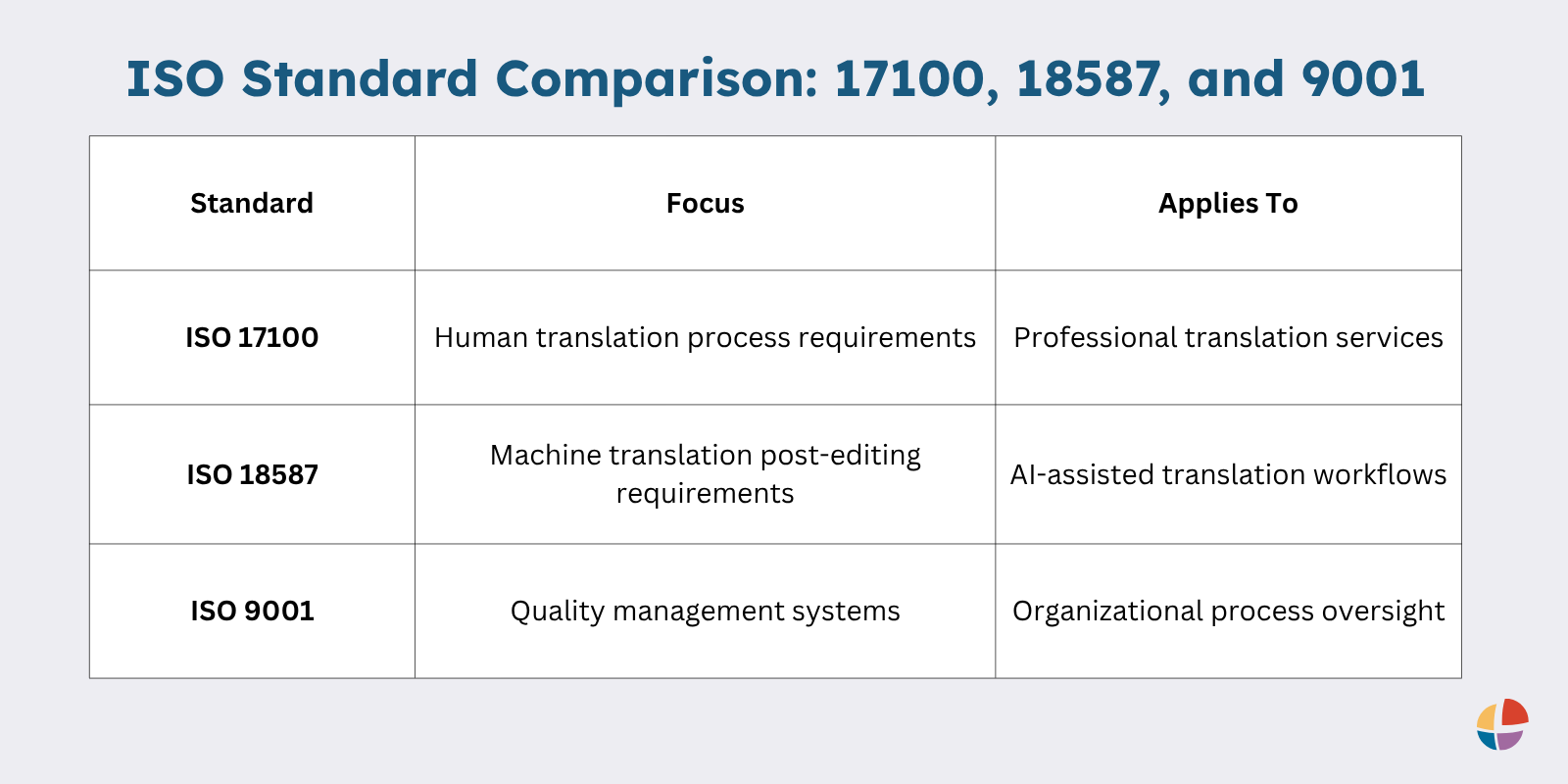
ISO standards provide the framework for consistent, auditable translation and MTPE processes.
These standards define:
- linguist qualifications
- process structure
- quality expectations
- documentation protocols
For organizations, this provides:
- consistency across projects
- auditability
- reduced operational risk
In environments like document translation, this level of structure is not optional.
Human Translation vs MTPE: A Practical View
Human Translation
- Delivers the most natural, nuanced, and audience-appropriate language
- Excels when context, creativity, and cultural adaptation are important
- Maintains strong consistency when supported by glossaries and translation memories
- Requires more time due to the fully human translation process
MTPE (Machine Translation Post-Editing)
- Combines AI-generated translation with human review and refinement
- Can achieve high levels of accuracy for many content types
- Provides excellent consistency, especially for repetitive or structured content
- Significantly reduces turnaround times compared to traditional translation
MTPE is not a replacement for human translation. It is a different workflow optimized for:
- scale
- repeatability
- structured content environments
Bottom line: Human translation prioritizes nuance and creativity, while MTPE prioritizes speed, scalability, and cost efficiency without eliminating human oversight.
Where MTPE Fits in a Localization Strategy
MTPE is most effective when used in the right context.
It works well for:
- technical documentation
- product content
- structured learning materials
- eLearning translation
It is less effective for:
- creative marketing content
- highly nuanced messaging
- culturally embedded language
Choosing the right workflow is part of a broader localization strategy, something often addressed through consulting.
The Common Misconception: “AI Translation Is Free”
Machine translation is often positioned as a cost-saving tool.
But in practice:
- MT requires infrastructure (tokens, credits, engines)
- MT output requires post-editing
- Errors can introduce downstream costs
Organizations that skip MTPE often end up paying more in:
- rework
- QA cycles
- customer-facing issues
MTPE is what makes AI translation viable.
Connecting MTPE to Real Business Use Cases
MTPE is not theoretical. It supports real-world workflows across multiple content types.
Examples include:
- scaling multilingual websites through website translation
- supporting global product launches with consistent terminology
- enabling internal training through accurate multilingual content
- supporting multimedia adaptation invideo translation
In each case, accuracy, consistency, and usability are non-negotiable.
MTPE Is What Makes AI Translation Work
Machine translation is powerful, but incomplete on its own.
MTPE introduces:
- human judgment
- structured workflows
- terminology control
- quality assurance
This is what turns AI-generated output into content that can be trusted, published, and used at scale.
For organizations investing in globalization, the question is not whether to use AI, but how to govern it effectively.
MTPE is the answer to that question.
MTPE FAQs
What is machine translation post-editing (MTPE)?
Machine translation post-editing is the process of reviewing and correcting AI-generated translations. It ensures accuracy, consistency, and usability by adding human oversight to machine output, making it suitable for business use.
Is MTPE better than human translation?
MTPE is more efficient for structured, high-volume content, while human translation is better for nuanced or creative content. The best choice depends on the content type and risk level.
Why is human review required after AI translation?
Human review is required because AI can misinterpret meaning, miss context, and introduce inconsistencies. Post-editors ensure the translation is accurate, complete, and appropriate for the intended audience.
What types of content are best for MTPE?
MTPE works best for technical documents, product descriptions, structured reports, and training materials where consistency and clarity matter more than creative expression.
How does MTPE support compliance and risk management?
MTPE ensures that translated content is accurate and complete, reducing the risk of regulatory violations, miscommunication, or legal issues—especially in industries with strict compliance requirements.
Category: AI Translation, Translation
Service: AI Translation

Don't forget to share this post!



Stay Updated with Interpro
Subscribe to our newsletter for the latest updates and insights in translation and localization.