

AI localization isn’t about replacing human translators. It’s about building the right system. The most effective organizations use a Human-in-the-Loop approach that matches the translation method to the content’s risk, purpose, and quality requirements. By preparing content for AI, creating structured workflows for different content types, and continuously monitoring quality, teams can reduce costs and improve efficiency without sacrificing accuracy, compliance, or brand integrity. The key is not treating every piece of content the same, but applying the right level of automation and human expertise where it makes the most sense.
AI shouldn’t be applied uniformly across all of your content. Instead, organizations need to segment and systematize.
That means evaluating:
- Content genre (marketing, technical, regulatory, HR, training, clinical, safety)
- Risk level (low-risk content to highly regulated, compliance-driven material)
- Language pairs and historical AI performance
- Required turnaround speed
- Acceptable quality thresholds
From there, you build defined workflows for each category:
- Translation as a Feature (TaaF)
- AI + Machine Translation Post-Editing (MTPE)
- Human linguistic translation, revision, and proofing
This removes ad-hoc decision-making. It protects budgets from being misallocated. It ensures human expertise is reserved for the content that truly requires precision. And it gives leadership a clear framework for explaining why automation is used in some cases and not others.
Getting this segmentation right is what separates teams who use AI as a shortcut from teams who use it as a strategic advantage. If you’re not sure where your content fits, that’s exactly the kind of audit the language people at Interpro can help you run.
AI Localization Is Hard. Let’s Name Your Problem.
The expectations around how quickly, cheaply, and easily content should scale across languages have shifted. With AI embedded in every tool, many teams find themselves moving faster than ever, but with less confidence in localization quality.
That’s because the challenge is much deeper than swapping a translation agency budget line for a new tool. Once teams begin AI implementation, they quickly find themselves asking:
- What is the best way to integrate AI into our existing localization workflow without disrupting what already works?
- How do we determine when AI can reduce costs safely, and when human localization is necessary to preserve message integrity?
- How do we implement AI translation without adding compliance or regulatory risk?
- When is AI output “good enough,” and who decides?
- How do we measure AI translation quality objectively and consistently?
- How much can AI reduce localization costs with structured preparation and post-editing?
- How much human review is required for different content types after AI translation?
- Is sensitive, confidential, or regulated information protected when using AI tools?
We’ve seen AI’s momentum create real pressure on teams across every industry, from global operations to life sciences and workforce training. Here’s what that pressure looks like in practice.
AI Bandwidth Illusion
AI implementation promises speed and savings, but hidden work adds cognitive load for the team. New workflow development, tool management, editing, and oversight create work that most teams aren’t resourced for.
Compliance Exposure Risk
AI adoption is happening in regulated industries (healthcare, life sciences, legal services, human resources), but high-risk industries cannot afford translation errors.
Source Content Chaos
AI magnifies bad source content. Poorly written and structured English content emphasizes inconsistent terminology and unclear writing. Unstructured files create downstream costs and translation inefficiencies.
AI Technology Overload
You’ve tried multiple AI tools, but they all seem to create more friction than efficiency. They don’t connect to your current localization workflow, translation memory, authoring tool, or review process.
Workflow Confusion
Not all content should be treated equally. High-risk regulatory or safety materials are being run through the same tools and workflows as low-risk technical manuals and creative marketing copy.
AI “Good Enough” Threshold
The quality of AI translation varies greatly by tool, language pair, and content type. But when is AI “good enough,” and when is human localization required? Without visibility into AI translation quality or acceptable standards, you can’t confidently balance efficiency with compliance.
Data Security Anxiety
Teams want AI speed but aren’t confident about data handling, PII exposure, or where their content is actually being processed.
AI Always Saves Money Gap
AI output isn’t always “light cleanup”. Sometimes message creativity and integrity require human translators. AI post-editing effort can rival human translation costs for challenging localization solutions.
Glossary & Translation Memory Implementation Failure
Many AI tools lack native glossary or translation memory support, and even integrated tools require proper setup to function correctly. Without deliberate implementation, terminology control breaks down and consistency erodes.
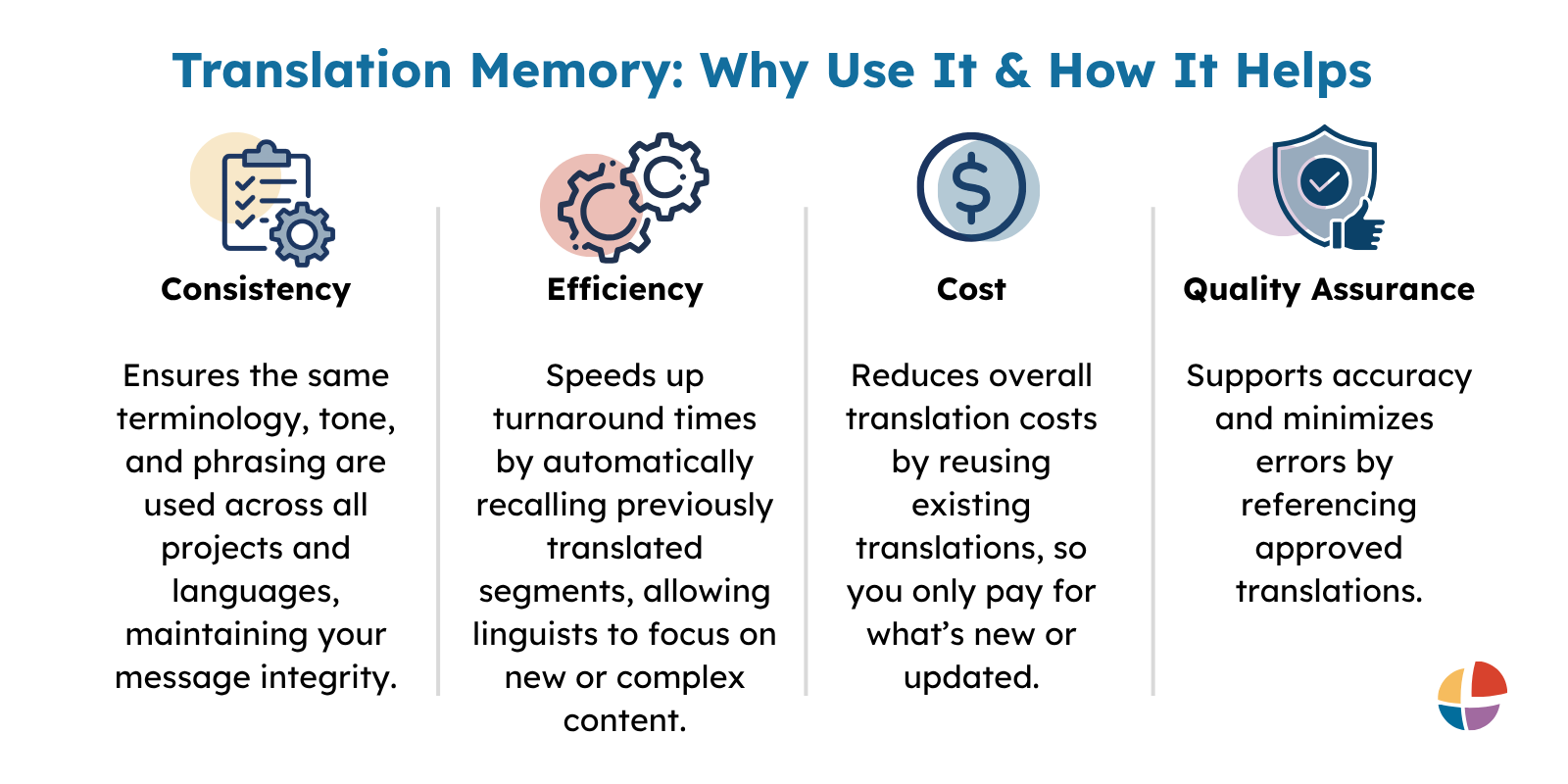
Translation memory provides the linguistic foundation that helps AI and human translators deliver more consistent, scalable localization results.
If you’re experiencing any of these challenges, the language people at Interpro can help you build a structured, accountable AI localization system, one that lets you move fast without losing control of quality, risk, or cost.
The Universal Solution to AI Localization: Human-in-the-Loop
Understanding your AI localization challenges and goals is nuanced, but getting clear on them is critical to building a workflow that actually delivers the results you want.
No matter how nuanced your challenges, the universal solution for implementing AI translation responsibly is Human-in-the-Loop localization. Human-in-the-loop localization supports decision-making about what gets translated with AI versus human effort, followed by human editing wherever AI output falls short, and a final localization review before files are ready to publish.
Not universal human translation. Not universal automation. But a system where AI operates inside intentional human oversight, applied wherever it’s most efficient.
When you implement AI responsibly, your localization process starts with two foundational moves.
Step 1: Prepare for AI Implementation
Prepping for AI implementation can be just as big a task as translation itself. If source files are inconsistent, AI will magnify those inconsistencies. With proper setup, AI becomes a scalable accelerator, but it has to be implemented deliberately.
That means:
- Diagnosing which AI tools and localization solutions are best suited to your content and language pairs
- Preparing source content for the best AI translation output, with clear structure and controlled terminology
- Establishing glossaries and translation memory before scaling output
- Defining quality benchmarks and what level of AI output is acceptable for your communication goals
- Determining when human linguists are essential versus when post-editing AI translations is sufficient
Without this preparation, AI magnifies inconsistency. With proper setup, AI becomes a scalable accelerator. AI success begins long before the first translation draft is generated.
Once your foundation is in place, the next move is systemizing how that AI actually gets applied across different types of content, which is exactly where most teams start to lose control. More on that next.
Step 2: Systematize Your Workflows by Content Type
AI shouldn’t be applied uniformly across all of your content. Different content carries different risk, different quality requirements, and different tolerance for error. Organizations that treat a regulatory compliance document the same as a social media caption are creating unnecessary exposure and wasting budget in the process.
Effective Human-in-the-Loop localization requires segmenting your content and assigning the right workflow to each category. That means evaluating:
- Content genre — marketing, technical, regulatory, HR, training, clinical, safety
- Risk level — from low-stakes informational content to high-compliance, regulated material
- Language pairs — and how AI has historically performed across those pairs
- Required turnaround speed — and how urgency affects the acceptable quality threshold
- Acceptable quality standards — defined in advance, not decided on the fly
From that evaluation, you build defined workflows for each category:
- Translation as a Feature (TaaF) — for low-risk, high-volume content where speed is the priority
- AI + Machine Translation Post-Editing (MTPE) — for content where AI provides a strong draft but human review is required before publishing
- Human linguistic translation, revision, and proofing — for regulated, high-stakes, or culturally sensitive content where precision is non-negotiable
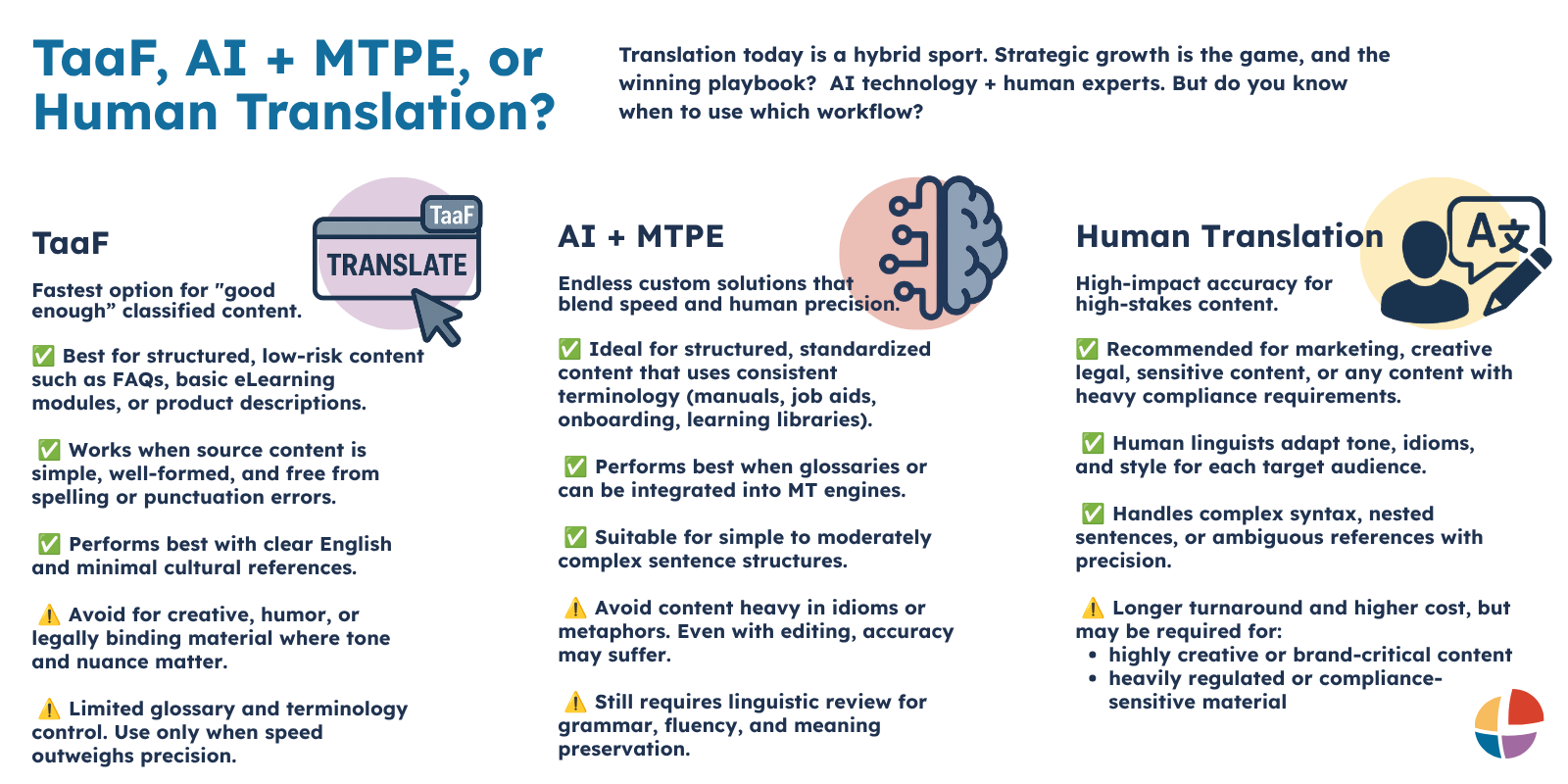
Different content requires different localization workflows. Choosing the right mix of AI and human expertise reduces risk while maximizing efficiency.
This removes ad-hoc decision-making. It protects budgets from being misallocated. It ensures human expertise is reserved for the content that truly requires it. And it gives leadership a clear, defensible framework for explaining where automation is used and where it isn’t.
Getting this segmentation right is what separates teams who use AI as a shortcut from teams who use it as a strategic advantage.
Step 3: Monitor Quality and Optimize Over Time
Implementation and segmentation get your system running. But Human-in-the-Loop localization only delivers sustained value when it includes an ongoing quality feedback loop.
AI translation performance isn’t static. It improves with better source content, grows more consistent with a well-maintained translation memory, and shifts as language pairs evolve and AI models are updated. Without monitoring, teams lose visibility into where the system is working and where it’s quietly degrading.
Ongoing quality oversight means:
- Measuring AI output against defined benchmarks — not just at launch, but at regular intervals across content types and language pairs
- Tracking post-editing effort — to identify where AI is a genuine accelerator and where it’s creating more work than it saves
- Updating glossaries and translation memory — as terminology evolves, products change, and new markets are added
- Reviewing human linguist feedback — to surface patterns in AI errors before they become systemic quality issues
- Adjusting workflow assignments — when content categories shift in risk level, volume, or quality requirements
This is where most organizations stall. They invest in setup, launch with good intentions, and then let the system run without accountability. Quality quietly erodes. Costs creep back up. And the original promise of AI-powered localization goes unrealized.
A true Human-in-the-Loop system doesn’t stop at implementation; it builds in the governance to keep AI working at the standard your content and your audiences require.
Your Language Partner in Building What’s Next
Interpro doesn’t just translate content; we help organizations build localization workflows that make AI work for them, not against them.
The challenges outlined in this guide aren’t hypothetical. They’re the real friction points we hear from our teams every day.
- AI tools that promise efficiency but deliver chaos;
- compliance risk that nobody accounted for;
- source content that wasn’t properly prepared; and
- workflows that were never designed to scale.
We’ve seen what happens when organizations rush to deploy AI without developing a system behind it.
How Interpro Can Help You Prepare for AI Localization
AI Readiness Assessment — We evaluate your current content, tools, and workflows to identify where AI can accelerate your localization process and where it’s creating compliance, quality, or cost risks before you scale.
Source Content Optimization — We prepare your English source material for the best possible AI output, cleaning up syntax structure, standardizing terminology, and eliminating the inconsistencies that AI magnifies at scale.
Glossary Development & Translation Memory Implementation — We build and maintain the standardized terminology and translation memory that afford your AI a consistent, accurate foundation across every language pair and content type.
Localization Workflow Design — We map your content by risk level, communication goal, and quality requirement, then assign the optimal translation method to each category so that high-impact content doesn’t get treated like a routine marketing email.
Machine Translation Post-Editing (MTPE) — Our linguists review and refine AI-generated translations to the quality standard your content requires, closing the gap between what AI generates and what your audiences actually need to understand.
Ongoing Quality Review & Linguistic Services — We provide continual oversight of your localization output, tracking performance, surfacing errors before they become patterns, and keeping your system calibrated as your content and markets evolve.
As your language partner, Interpro brings the expertise to guide you through every phase of the Human-in-the-Loop model. We help you assess your AI readiness before you scale, design workflows that match your content risk and quality requirements, develop the glossaries and translation memory that make AI output consistent and defensible, and build the quality governance that keeps your system performing over time.
This isn’t a one-size-fits-all solution. It’s a partnership built around your content, your industry, your risk tolerance, and your goals, supported by professional human linguists, localization engineers, and strategic advisors whose experience and expertise span healthcare, life sciences, legal, HR, and global enterprise environments.
If you’re navigating the challenges that AI localization presents and need a partner who can help you move fast without compromising quality, compliance, or cost, The Language People™ at Interpro are ready to help you harness the speed of AI while preserving the accuracy, nuance, and trust your global audience expects.
Category: AI Translation

Don't forget to share this post!



Stay Updated with Interpro
Subscribe to our newsletter for the latest updates and insights in translation and localization.