

Global expansion requires more than translating content. Businesses need a structured multilingual marketing strategy that localizes messaging, SEO, customer experience, and brand voice for each market. When content is adapted for language, culture, and search behavior, companies build trust, improve engagement, and increase conversions across international audiences. The most effective programs combine professional translation, localization, multilingual SEO, and human oversight of AI tools to keep messaging accurate, consistent, and scalable.
Businesses seeking to grow internationally must embrace multilingual marketing strategies to connect with global customers, increase engagement, and drive conversions. Simply translating content isn’t enough; companies must localize their marketing approach to account for cultural differences, SEO strategies, and customer behavior in each target market. This guide explores the best practices for multilingual marketing, explaining how translation enhances customer engagement, improves brand consistency, and optimizes content across multiple channels.
How Does Translation Improve Global Customer Engagement?
Translation enables businesses to break down language barriers, allowing customers to connect with brands in their native language. Studies show that 76% of online consumers prefer purchasing products from websites in their own language, and 40% will not buy from sites that are only in English. By translating and localizing content, businesses can:
- Improve customer trust and brand perception by speaking directly to local audiences.
- Reduce friction in the buying process by providing product details, FAQs, and customer support in multiple languages.
- Increase conversion rates by creating culturally-relevant messaging.
- Enhance customer loyalty by offering localized post-purchase support and engagement.
For example, Airbnb customizes its website content and customer support for each country, ensuring that users can browse listings, make reservations, and receive help in their preferred language.
What’s the Difference Between Multilingual SEO and Regular SEO?
SEO (Search Engine Optimization) strategies help businesses rank higher in search engine results, but multilingual SEO requires additional techniques to ensure content is searchable and relevant in multiple languages. Key differences include:
- Keyword localization: Regular SEO focuses on English-language search terms, while multilingual SEO involves researching region-specific keywords, which may differ from direct translations.
- Hreflang tags: These help search engines display the correct language version of a page to the right audience.
- Localized metadata: Titles, descriptions, and alt text must be optimized for each language.
- Country-specific search engines: Google dominates in many markets, but Baidu (China), Yandex (Russia), and Naver (South Korea) require different optimization strategies.
For example, IKEA localizes its keywords based on market research. While “bookshelf” is a common term in English, in Germany, the optimized term might be “Bücherregal,” ensuring the company ranks higher in German search queries for that product.
How Can I Optimize Website Translations for International Visitors?
An optimized multilingual website must offer a seamless user experience that feels native to each audience. Best practices include:
- Using professional localization instead of direct translation to maintain cultural relevance.
- Adapting currencies, date formats, units of measure, and contact information to match each region.
- Providing clear language selection options with drop-down menus or automatic geo-detection.
- Ensuring fast page loading speeds by optimizing translated images and scripts.
- Implementing a content management system (CMS) with multilingual support, such as WordPress, WPML, or Adobe Experience Manager.
For example, Amazon’s regional sites automatically adjust content, pricing, and language based on user location, making the shopping experience more intuitive for global buyers.
What Are Best Practices for Multilingual Social Media Marketing?
Social media is a powerful tool for reaching global audiences, but content must be tailored for each market. Best practices include:
- Creating separate social media profiles for different regions rather than using auto-translation on one profile.
- Localizing hashtags and captions to match cultural preferences and trends.
- Using region-specific imagery and cultural references to enhance engagement.
- Timing posts based on time zones and local holidays for maximum visibility.
- Engaging with followers in their native language through localized customer service responses.
For example, McDonald’s runs different X accounts for each country, ensuring marketing campaigns align with local cultural references, humor, and seasonal promotions.
What Industries See the Highest ROI from Translation?
Industries that require high levels of customer interaction, regulatory compliance, or technical accuracy see the greatest return on investment (ROI) from translation. These include:
- E-commerce and retail: Localized product descriptions and checkout processes increase conversions.
- Healthcare and pharmaceuticals: Compliance-driven translation ensures regulatory approval and patient safety.
- Finance and banking: Multilingual communication helps expand services globally while maintaining security standards.
- Software and technology: SaaS platforms need localized user interfaces, documentation, and support materials.
- Manufacturing and industry: Technical manuals, safety guidelines, and supply chain documentation must be accurately translated to avoid legal and operational risks.
For example, Nike sees massive ROI from localized e-commerce websites, offering customized product descriptions, pricing, and promotions based on regional market preferences.
How Do I Localize Email Marketing Campaigns?
Localized email campaigns help brands build stronger connections with global subscribers. Best practices include:
- Segmenting email lists by language and region to send the most relevant content.
- Localizing subject lines and call-to-action (CTA) buttons to match cultural preferences.
- Optimizing for different email platforms, as rendering varies across Gmail, Outlook, and regional providers like Tencent Mail (China).
- Adjusting promotions for local holidays and events to improve engagement.
- A/B testing different translated versions to measure effectiveness in different markets.
For example, Spotify’s email marketing varies by country, offering region-specific promotions and playlists tailored to local music trends.
How Do I Ensure Consistent Branding Across Multiple Languages?
Maintaining brand identity across multiple languages requires a strategic approach to messaging, visuals, and tone. Best practices include:
- Creating a multilingual brand style guide that defines preferred terminology, formatting, and voice.
- Using Translation Memory (TM) tools to ensure consistency across all translated content.
- Working with dedicated linguists familiar with brand guidelines to maintain tone and messaging.
- Standardizing fonts, logos, and imagery to ensure brand cohesion worldwide.
For example, Coca-Cola’s global brand voice remains consistent, whether marketing in English, Spanish, or Mandarin, thanks to strict branding guidelines that ensure a uniform brand personality across all markets.
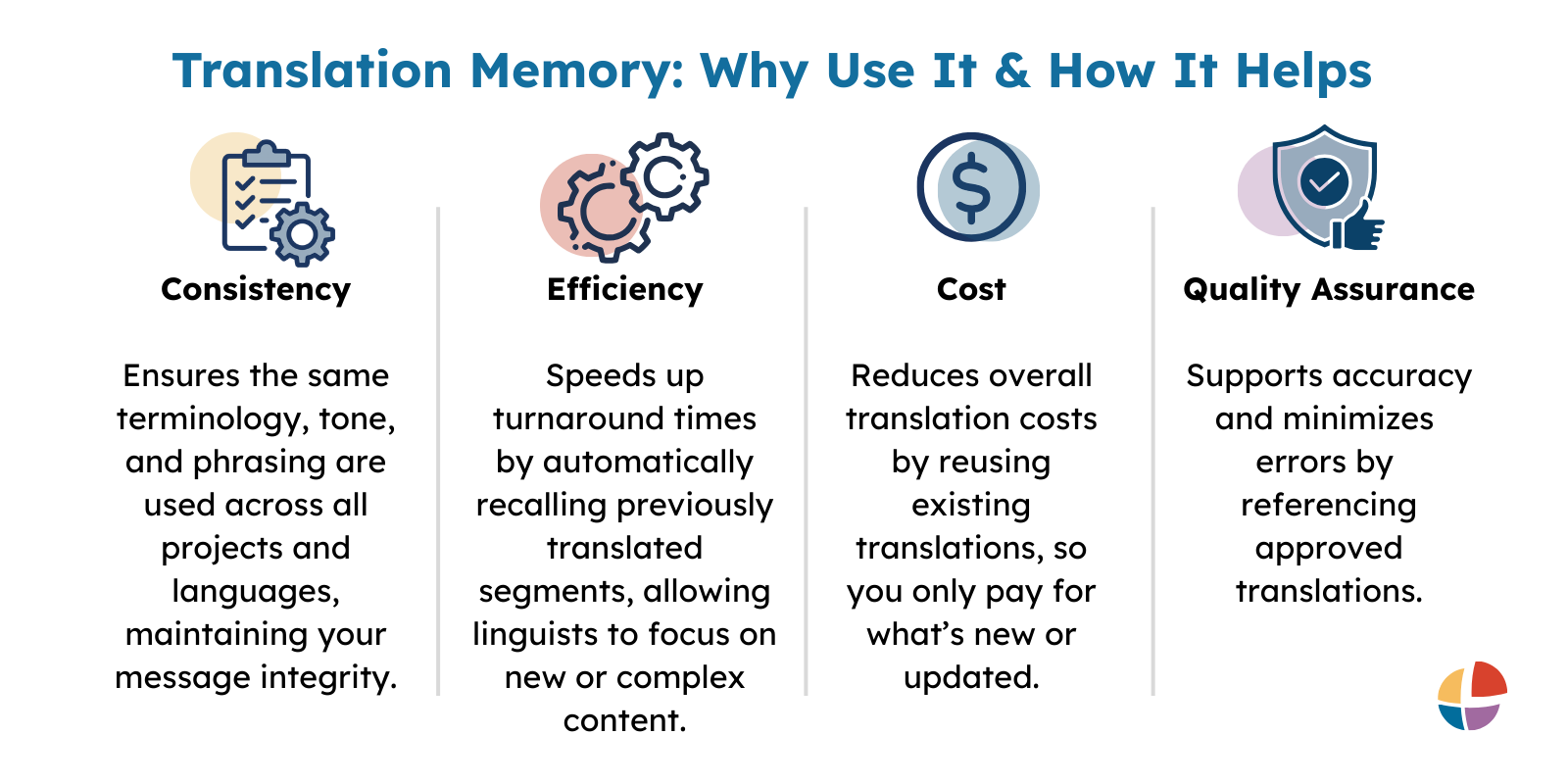
Translation Memory supports a multilingual marketing strategy through improved consistency, efficiency, cost savings, and translation quality.
What’s the Best Way to Translate Video Content for International Markets?
Video is a powerful marketing tool, but translating video content requires more than just subtitles. Key strategies include:
- Using voiceover or dubbing for better audience engagement.
- Adding translated on-screen text and captions for accessibility.
- Ensuring subtitles are culturally-appropriate.
- Adapting pacing and graphics to fit different reading speeds and regional preferences.
For example, Netflix localizes its content not just through subtitles but also region-specific dubbing and cultural adaptation, ensuring that humor, idioms, and slang resonate with local audiences.
How Do I Handle Content Updates for Translated Materials?
As businesses release new product updates, seasonal campaigns, and regulatory changes, translated materials must be updated accordingly. Best practices include:
- Using a CMS that supports version control to track updates in different languages.
- Leveraging Translation Memory (TM) to avoid re-translating unchanged content.
- Assigning dedicated language teams to ensure continuity across updates.
- Setting up automated workflows for localization requests in content creation tools.
For example, Microsoft’s multilingual software documentation is continuously updated using an automated translation management system to ensure all regional versions remain up-to-date.
How Does AI-Generated Content Impact Translation?
AI-generated content has transformed the speed at which businesses create multilingual content, but it still requires human oversight. Key considerations include:
- AI-generated translations must be reviewed for cultural sensitivity and accuracy.
- AI works best for high-volume, repetitive tasks, such as e-commerce product descriptions.
- Human translators ensure creativity, brand voice, and legal compliance.
- Neural Machine Translation (NMT) can reduce costs but should be paired with human post-editing for quality assurance.
For example, Google’s AI-generated translations for its Knowledge Graph are refined by human linguists to prevent misinterpretations in different languages.

AI Translation and human Post-Editing workflow supporting a scalable multilingual marketing strategy for global content localization and delivery.
Conclusion: Why a Strong Multilingual Marketing Strategy Matters
Efficiently Leverage AI for Translation Today
Expanding into global markets requires more than just translation; it demands a comprehensive multilingual marketing strategy that ensures brand consistency, cultural relevance, and customer engagement. By implementing best practices in SEO, content localization, video translation, and social media adaptation, businesses can maximize their global reach, build customer trust, and drive international revenue growth.
Work with Interpro to build a strategic localization workflow that aligns with your content, your risk level, and your business goals.
Category: AI Translation
Service: AI Translation

Don't forget to share this post!



Stay Updated with Interpro
Subscribe to our newsletter for the latest updates and insights in translation and localization.