

Purchasing localization services doesn’t have to break your budget. This guide explains why costs vary, how to save using translation memory tools, and what hidden expenses to watch for, especially when relying on internal teams. Learn how to build a cost-efficient strategy and partner with vendors like Interpro who prioritize transparency, quality, and long-term value.
Purchasing localization services needs quality, but also cost efficiency. By understanding the key cost drivers, embracing Translation Memory Tools, and crafting the right localization workflow, organizations can get real value. In this guide, Interpro Translation Solutions helps B2B professionals navigate budgeting, spot savings opportunities, and avoid mistakes that lead to overpaying or underperforming.
Why Purchasing Localization Services is Confusing (and Costs Vary So Widely)
Per-word vs. per-page vs. hourly pricing
- Most translation services use per-word pricing, typically ranging from $0.09–$0.40 per word depending on language, complexity, and specialization (The Translation Company).
- Per-page rates (often $20–$100 per page) may apply for non-editable formats like PDFs or for certified translation requirements (Circle Translations).
- Hourly rates ($30–$150/hour) are used for tasks like proofreading or formatting-heavy documents.
Other impactful cost factors:
- Costs increase if heavy cultural or technical localization is required.
- Cost decrease if English materials are prepared for effective translation and localization.
- Costs decrease if a translation memory or other tools are leveraged.
Continue to reading to learn more about the factors that impact localization costs.
Editor’s Note: AI is rapidly reshaping the translation and localization landscape. As a result, pricing can vary widely based on the service provider, target language, content complexity, content preparation, communication goals, and localization workflow (human-only, AI, or hybrid). If your organization is focused on reducing costs without compromising quality or increasing risk, we recommend scheduling a consultation with our team to evaluate the most efficient and defensible approach for your content.
Global Growth Localization Consultative Guidance Pricing
Consultative guidance pricing shifts the focus from transactional output to strategic decision-making. Instead of paying solely for translated words, you invest in expert oversight that helps you determine when to use AI, hybrid, or human-only workflows, how to reduce risk, and where cost savings are defensible.
This model supports activities such as:
- Translation and AI readiness assessments
- Workflow design and optimization
- Risk, quality, and compliance advisory
- Vendor, tool, and cost-control recommendations
While purchasing localization services may carry a higher upfront cost than per-word translation alone, the consultative partnership often reduces total spend over time by preventing rework, mitigating compliance risk, and aligning translation investment with business impact. It treats localization as a managed operational asset, not a line-item expense, balancing cost, quality, liability, and long-term efficiency.
Key cost drivers in purchasing localization services:
- Language pair: Common languages like English–Spanish cost less; rarer language pairs cost more.
- Subject matter expertise: Legal, medical, technical, or regulated content demands specialized linguists.
- File format & design: Desktop publishing and multimedia content require more handling.
- Turnaround time: Rushed jobs may carry premium charges.
- Quality level: Choosing minimal human review vs. expert linguists influences pricing.
- Translation Approach: Human Translators versus AI or Hybrid Translation models.
- Engineering: Custom file types like XML, JSON, or proprietary LMS content often require engineering expertise to extract translatable content
- Project Management: Building custom workflow, coordinating moving parts, and ensuring timely delivery
Trying to learn how you could save on your translation budget? Check out the article 12 Ways to Save on Translation Costs.
Translation Memory Tools: How They Reduce Costs & Improve Consistency
What are Translation Memory Tools?
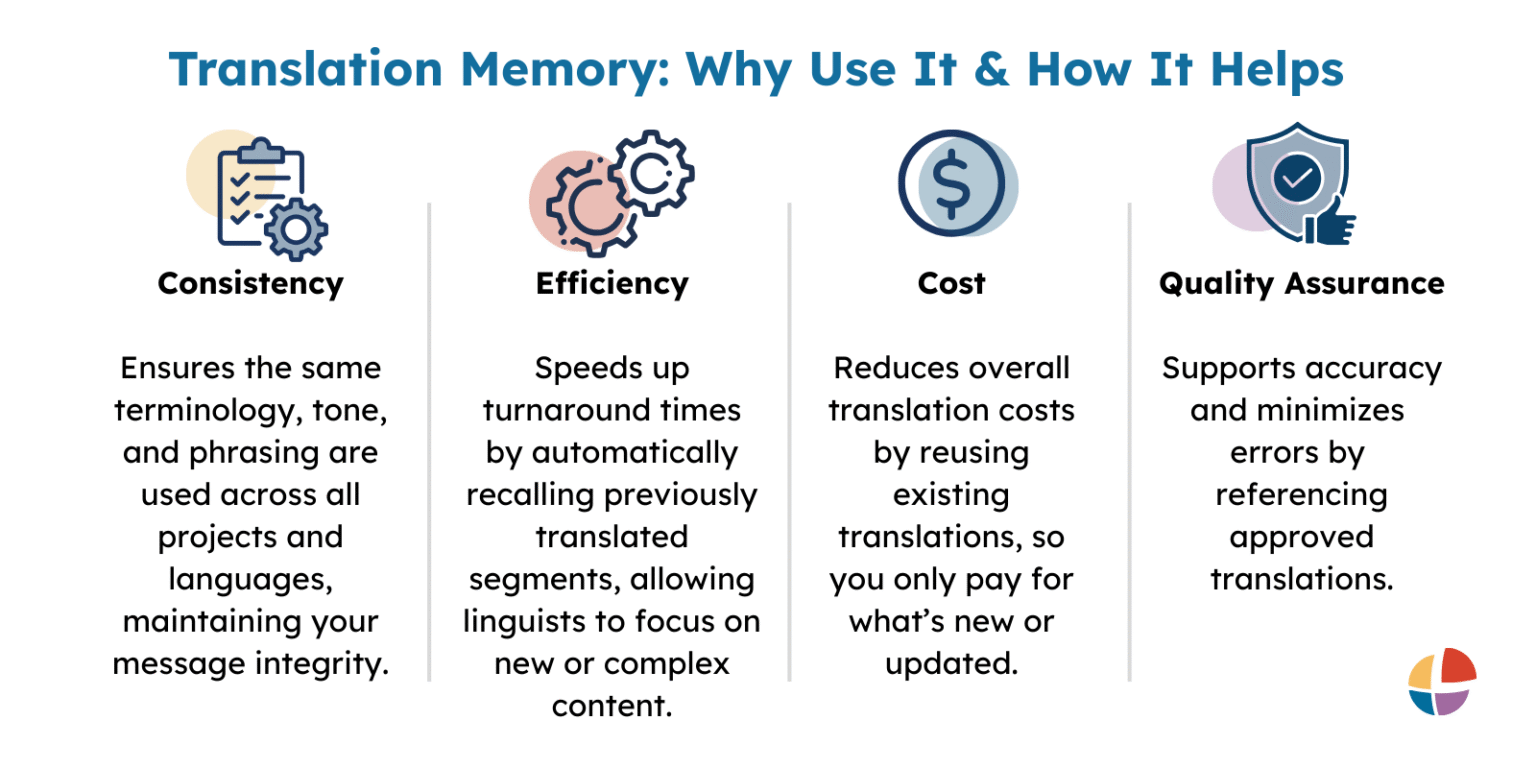
These CAT (computer‑assisted translation) tools store previously translated segments in a TM database. When similar content appears, translators reuse matches, which speeds translation and ensures consistency.
Benefits of Using Translation Memory Tools
- Cost savings: Repeated segments often attract discounts; some TM systems apply logic to reduce pricing on matches.
- Consistency: Terminology and phrasing remain uniform across documents and projects.
- Speed: Exact and fuzzy matches streamline translation tasks.
- Quality: Clear alignment helps avoid omissions and formatting issues.
Translation Memory Pitfalls to Avoid
- Error propagation: If an erroneous translation is stored, it may repeat unless caught in QA.
- Learning curve & maintenance: TM and terminology tools require setup, governance, and ongoing management.
Hidden True Costs of Internal Translation
Teams turning to leveraging internal resources for translation often underestimates full cost of translation (and the challenges of localization). Interpro’s analysis from over 30 years of working with clients shows that relying on internal resources may seem “free,” but hidden costs add up, including staff time, opportunity cost, lack of QA, and slower turnaround. Investing in professional localization services protects your brand from costly cultural missteps and reputational damage.
Building a Budget‑Smart Translation Strategy
Step 1: Assess your content type and volume
- Is your content repetitive (e.g., technical manuals)? Then, translation memory will deliver savings.
- Is it creative or a one-off? Expect higher rates since previous content reuse is minimal.
Step 2: Request detailed quotes that clarify the cost structure
Ensure quotes include:
- Base per-word or per-page rate
- Discounts applied for TM leverage (exact match, fuzzy match)
- Fees for file conversion, formatting, QA
- Revision cycles or post-delivery editing
- Engineering, file preparation, and project management costs
Align quotes “apple-to-apple” for comparison
Step 3: Choose the right provider model
- Centralized procurement model ensures consistency and volume discounts.
- Decentralized gives autonomy but risks splintered vendor terms.
- Hybrid model can combine control with flexibility.
Step 4: Leverage translation memory tools efficiently
Ensure your provider uses a robust TM system integrated with terminology management. Review TM coverage early, and plan updates after major translation cycles.
The Interpro team engaged in a discussion about Budget Smart Translation Strategy and how it can be used to help clients.
How Interpro Ensures Value & Control
Risk‑based estimates
We analyze your Translation Memory (TM) assets up front to identify matches and repetitions that lower your total cost. This insight helps you understand expected savings and make smarter decisions about where to invest time and budget.
Transparent quoting
Our quotes are fully itemized, no surprises. You’ll see clear line items for translation, revision, formatting, project management, file engineering, and more. This level of detail helps you justify spending internally and build accurate budgets across departments.
TM ecosystem
Interpro maintains your Translation Memory, glossaries, and style guides to ensure consistent voice and terminology across all projects. Over time, this leads to cost savings, faster turnaround, and brand-aligned multilingual content.
Hybrid workflows
For certain content types, we offer Machine Translation combined with expert human post-editing. This option helps reduce costs for high-volume, lower-risk content, without compromising on tone, accuracy, or cultural relevance.
Post-project review
After delivery, we gather your feedback and refine the TM to boost match accuracy in future projects. This feedback loop not only improves quality over time but also increases TM leverage, driving more value with every new request.
Frequently Asked Questions (FAQs)
What does “Translation Memory Tools” mean in procurement?
These are professional CAT tools that store previously translated text. When new content is similar or repetitive, translators can reuse it—with possible cost discounts and speed gains.
How should I budget for purchasing translation services?
Start by estimating your word or page volume, content complexity, source and target languages, number of languages, and existing TM coverage. Request detailed quotes and factor in formatting, review, and revision needs.
Are cheaper translation vendors a good value?
Low per-word costs may omit review or use unqualified translators. You may pay more later in corrections or brand damage. Value comes from quality, consistency, and scalability.
How do I compare internal vs external translation costs?
Internal translation often seems free but involves the hidden cost of staff hours, overhead, no TM reuse, lower quality control, and slower delivery. Outsourcing provides transparency and efficiency.
What factors reduce long-term translation costs?
Reusable translation memories, glossary consistency, ongoing vendor partnerships, and defined quality review cycles.
Can machine translation replace expert translation?
Not for high‑stakes content. Hybrid models (machine output + expert post-editing) offer speed and savings but still require oversight to ensure brand tone and accuracy.
Why does internal translation sometimes run “cheaper”?
Because hidden costs of staff, infrastructure, and inefficiency aren’t always tracked accurately.
How do TM discounts actually work?
Most vendors offer discounts for segments identified as exact or fuzzy matches. These may be tiered, e.g., 50% for 75–99% match or free for context matches.
Is TM always worth it?
Great for highly repetitive or versioned content. Less value for creative or one-off marketing content.
Can machine translation save money?
Yes, but only with structured human review to catch tone, consistency, and brand errors.
Purchasing Localization Services is Transparent with Interpro
Purchasing translation services wisely means balancing cost, quality, and efficiency. By understanding cost drivers, negotiating clear pricing, and partnering with vendors who harness Translation Memory tools, organizations unlock consistent, scalable translations at competitive prices. Interpro Translation Solutions offers transparent quoting, TM-based workflows, hybrid machine plus human options, and long-term partnership strategies that reduce overall costs while maintaining high quality.
If you’re evaluating translation vendors or looking to improve your internal workflows, we’re here to help. Contact Interpro today to get a tailored cost analysis, TM setup review, or sample quote that puts you in full control of your translation budget.
Category: Localization
Tags: About Interpro
Service: AI Translation, Document Translation, Software Translation, Translation Services, Website Translation, eLearning Translation

Don't forget to share this post!



Stay Updated with Interpro
Subscribe to our newsletter for the latest updates and insights in translation and localization.