

As AI has becomes one of the standard translation tools, expectations around localization are shifting fast. Interpro’s CEO shares his predictions for 2026, covering how AI is changing workflows, why confusion is growing across the market, and what leaders should consider when deciding where automation ends and human responsibility begins.
What is Interpro expecting from the localization industry in 2026?
As we head into 2026, I’ve been spending a lot of time thinking about disruption. If you need help implementing AI for translation, book your AI localization consultation here.
There’s no shortage of noise in the localization industry right now. AI translation is embedded everywhere. It’s built into authoring tools, design platforms, learning systems, and enterprise software. Clients are asking real questions:
- Can we just use AI for translation?
- Do we still need human review?
- What does AI translation cost? Can it save me money?
These aren’t naïve questions. They’re smart, practical questions coming from smart teams under pressure to move faster, publish more, and manage budgets responsibly.
But what I’ve learned in this industry is simple: when language goes wrong, the consequences are never technical. They’re human.
AI Has Impacted Localization Costs, but the Risk of Getting It Wrong Has Never Been Higher
2026 hasn’t arrived quietly. It’s arrived with:
- Embedded AI translation in enterprise tools
- An explosion of global content volume
- Leadership pressure to “be innovative”
- Mixed expectations around quality and speed
Some organizations are moving fully into human-in-the-loop AI translation post-editing. Others are prohibited from using AI translation altogether after being burned by poor-quality output. Many are stuck somewhere in between, unsure which path is safe, defensible, or scalable.
What we’re seeing isn’t a clean transition. It’s fragmentation.
And that fragmentation creates risk.
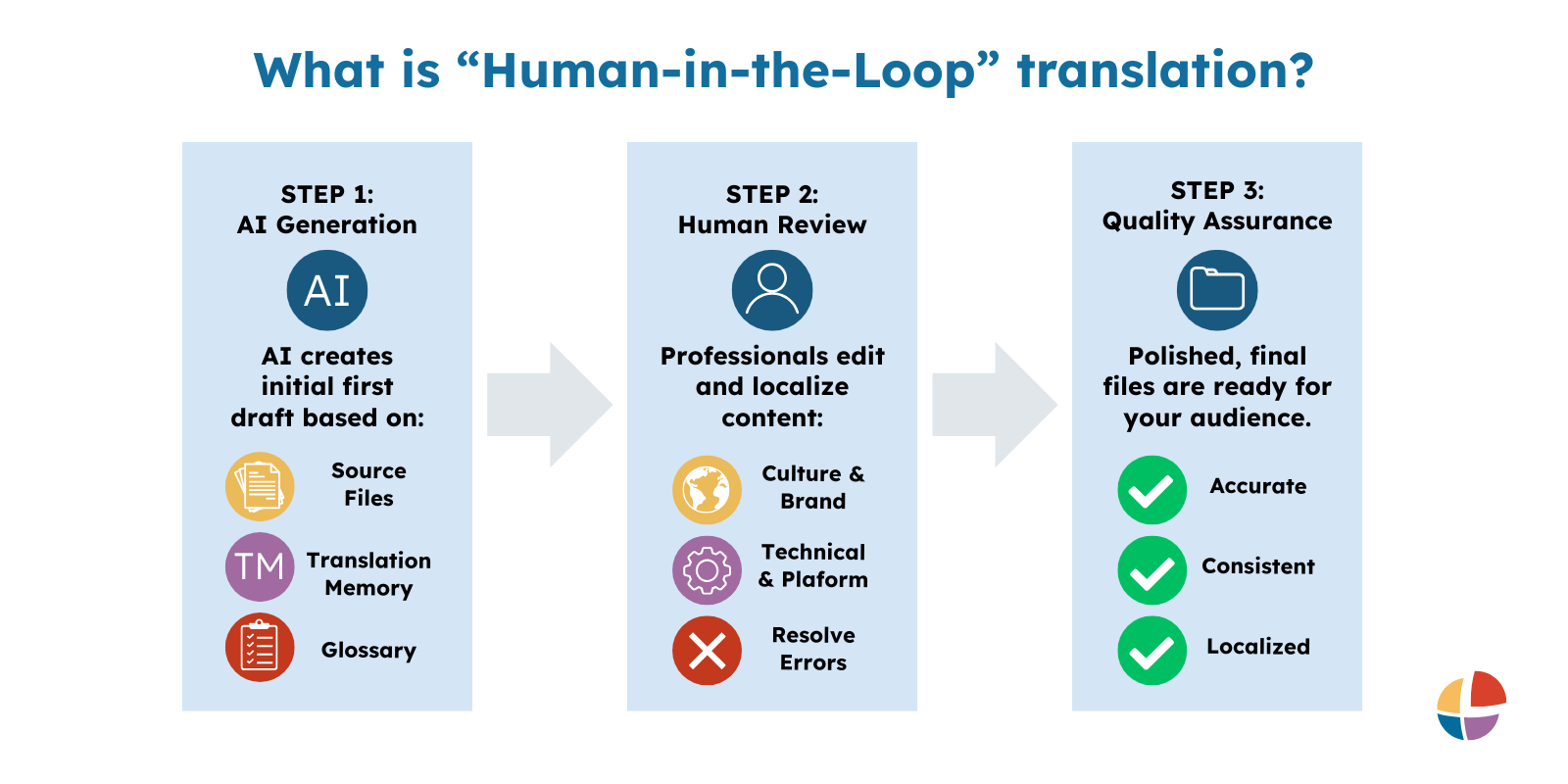
The Human-in-the-Loop translation workflow, showing three key steps: AI generation, human review, and quality assurance.
AI Localization Isn’t the Villain. Blind Adoption Is.
Let me be clear: AI translation isn’t the enemy.
It’s powerful. It’s improving quickly. In some languages and use cases, it performs surprisingly well. We see that it can save money and time in many industries. But the Human-in-the-Loop localization workflow is the best choice for integrating AI.
But it is not a universal solution.
What I see every day is this reality:
- AI works well for some languages, content types, and workflows
- AI struggles with nuance, regulatory language, and cultural context
- AI has no accountability when it fails
Some clients are comfortable accepting “good enough” output if it means speed and lower cost. Others absolutely cannot, especially when accuracy, compliance, or public trust are on the line.
The real danger isn’t AI itself. It’s using AI without understanding where it fits and where it doesn’t.
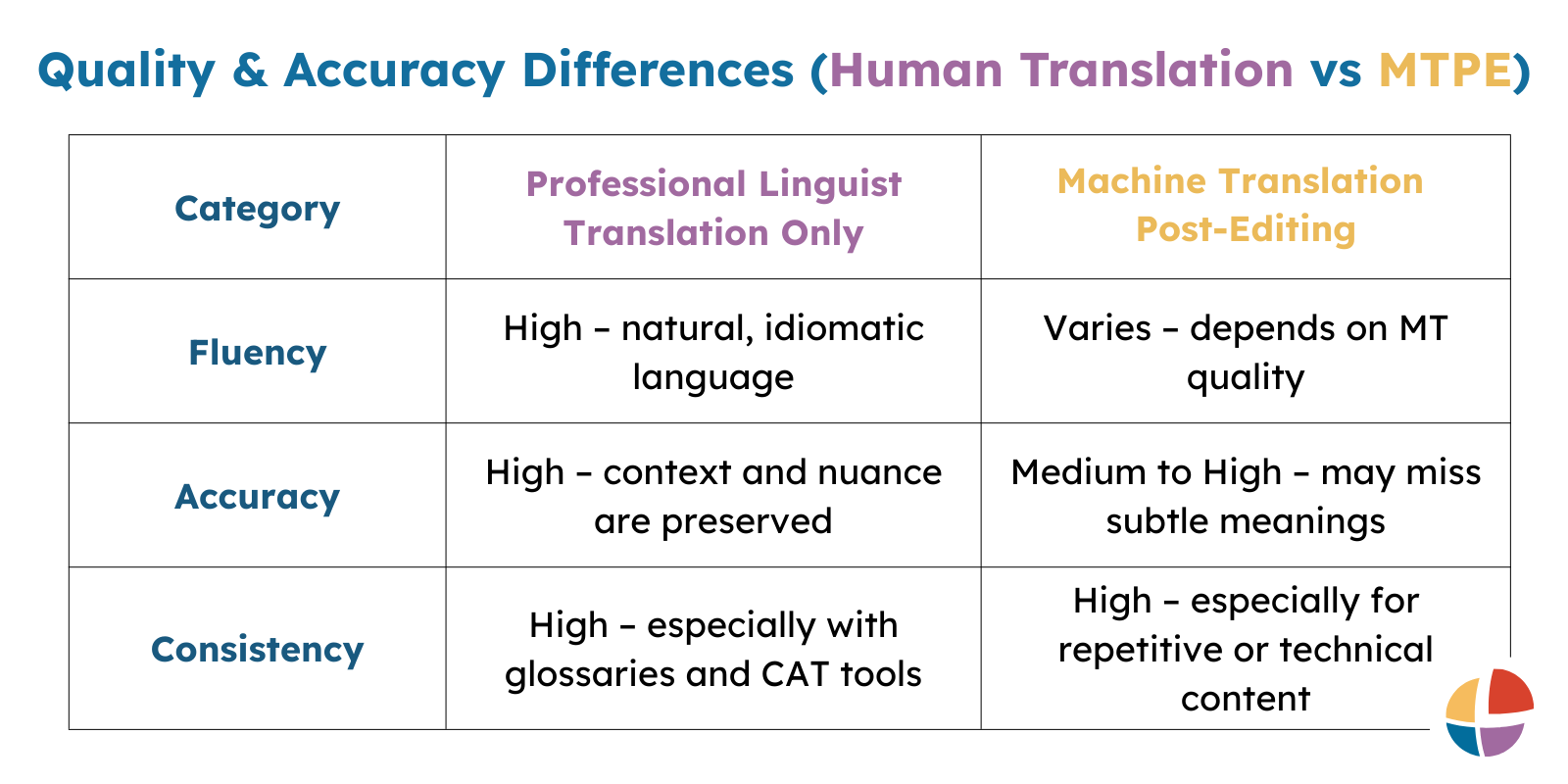
Quality and accuracy differences between professional human translation and machine translation post-editing (MTPE), emphasizing fluency, contextual accuracy, and consistency outcomes.
Localization in 2026 Is a Decision System, Not a Service
The biggest shift I see isn’t technological. It’s operational.
Localization is no longer a transactional task you hand off and forget. In 2026, it’s a decision system that requires:
- Content segmentation
- Risk assessment
- Language and market awareness
- Documented human oversight
Someone has to decide:
- Which content can safely use AI
- What level of human review is required
- Where mistakes would create legal, safety, or reputational risk
And more importantly, someone has to own that decision. That’s why we trademarked the phrase “The Language PeopleTM .”
Because behind every translation, every localization decision, and every AI workflow, there still needs to be people who understand the stakes and take responsibility for the outcome. We are the language people to help you do just that.
What This Means for the Organizations We Work With
AI has changed how content is created and distributed, but it hasn’t changed what organizations are ultimately responsible for. As localization becomes faster and cheaper, the real challenge for most teams isn’t translation itself. It’s managing communication at scale without eroding trust, clarity, or internal alignment.
For most organizations in 2026, localization decisions now directly impact:
- How clearly employees, members, and customers understand critical information.
- How confidently leadership can stand behind global communications.
- How well internal teams maintain compliance-regulated content, consistency, culture, and accountability across languages.
This is why localization is no longer just a production task. It’s an operational decision that touches HR, legal, compliance, marketing, and leadership at the same time. It has to be done right.
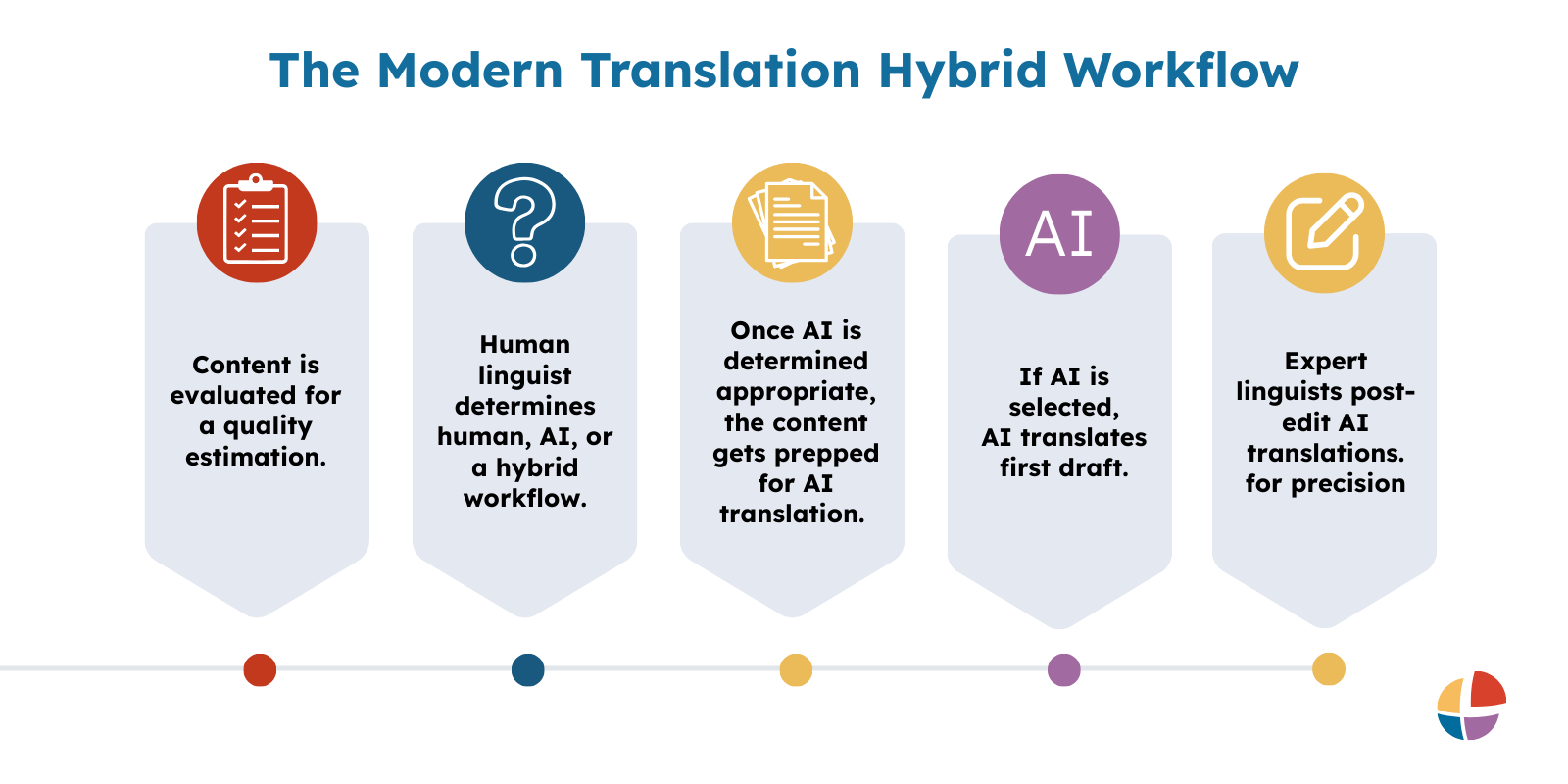
The modern translation workflow is a hybrid of both human and AI technology.
Healthcare, Life Sciences, and Regulated Industries
In regulated environments, AI translation without governance is a liability.
These teams face:
- Regulatory scrutiny
- Data privacy requirements
- Auditability expectations
You don’t just need translations. They need defensible workflows and localizations that keep you compliant. Human-in-the-Loop processes aren’t optional here. They’re essential.
Utilizing a human-in-the-loop ensures:
- Traceability
- Quality assurance
- Risk mitigation
- Technical localization
The goal isn’t to avoid AI. It’s to use it responsibly, transparently, and with documented oversight.
Manufacturing and Global Enterprises
For global enterprises, speed and scale matter. But so does consistency.
AI translation with structured human oversight can deliver real value when:
- Terminology is controlled
- Translation memory is respected
- Subject-matter expertise remains involved
This is where AI translation helps you scale while mitigating risk.
Health Benefits, Insurance, and Internal Communications
For organizations managing health benefits, insurance information, and company-wide communications, localization is fundamentally about clarity and trust.
These teams are responsible for:
- Explaining complex benefits and policies
- Communicating changes that affect people’s livelihoods
- Supporting diverse workforces across languages and regions
AI translation can help move information faster, but speed alone doesn’t solve the real challenge. Misunderstood benefits, unclear policies, or culturally misaligned messaging can quickly erode employee confidence and internal credibility. The impact of poorly localized content can be devastating.
In 2026, these organizations need localization workflows that:
- Ensure critical information is clearly understood, not just translated
- Support a consistent internal culture and messaging across languages
- Provide confidence that communications won’t create confusion, complaints, or rework
As with many industries, human oversight isn’t about perfection. It’s about protecting comprehension, trust, and internal alignment when communication matters most.
Human-in-the-Loop Solutions: AI Disruption is Happening Across Industries with the Same Truth
I recently read Same as Ever, and it stuck with me because it reminds us that disruption isn’t new. Throughout the course of time, there are many instances of events that could not have been predicted, and shocked the world. What changes are the tools. What stays the same is the need for people to adapt, guide, and take responsibility. We know:
- AI will continue to improve.
- Translation features will continue to expand.
- Costs will continue to be scrutinized.
But when localization fails, the fallout is still human:
- Confused patients
- Misled members
- Non-compliance and regulatory exposure
- Damaged reputations
- Broken brand trust
- Learners that can’t pass certification exams
- Diluted culture
Technology doesn’t answer for those failures. People do.
What Human-In-The-Loop Adds
- Built-in Accountability: Every human edit and approval is meticulously logged, ensuring a transparent audit trail to support compliance and oversight.
- Cultural & Ethical Review: Human linguists catch what machines often miss; stereotypes, exclusionary language, and cultural missteps, safeguarding your brand’s integrity.
- Critical Oversight: For industries like healthcare, legal, and finance, dual human validation acts as a final checkpoint, ensuring content is both accurate and appropriate before it goes live.
- Human Judgment, Not Just Automation: Our translators assess tone, intent, and potential impact—making thoughtful decisions that AI simply can’t replicate.
- Regulatory Reassurance: When accountability matters most, regulators want proof that skilled professionals, not just algorithms, are in control. With Interpro, you can provide that assurance.
How can we help you with localization and global growth in 2026?
Localization in 2026 isn’t about choosing between AI or humans.
It’s about:
- Knowing when each is appropriate
- Understanding where risk lives
- Having someone accountable for the outcome
Our role at Interpro is to stand behind those decisions with experience, process, and people who understand where AI translation excels and where it quietly breaks down.
Because the future of localization doesn’t belong to tools, it belongs to the language people.
Category: AI Translation, Localization, News
Service: Consulting

Don't forget to share this post!




Stay Updated with Interpro
Subscribe to our newsletter for the latest updates and insights in translation and localization.