

Choosing the right Language Service Provider (LSP) is critical for successful global growth. This guide outlines 10 key evaluation pillars, including quality standards, security, scalability, and technology, along with red flags to avoid and a vendor scorecard to help teams make confident, data-driven decisions.
Your company’s global growth depends on you speaking your customers’ language. Most buyers are more comfortable purchasing when content is presented in their native language, and a significant portion avoid English-only websites altogether. Meanwhile, the language-services market will top USD 72.7 billion in 2024 and hit USD 95 billion by 2028. Picking the wrong partner can stall launches, spike costs, and tarnish brand trust. Picking the right one unlocks conversions, compliance, and scale. This guide shows you how to choose.
What Exactly Is a “Language Service Provider”?
A Language Service Provider (LSP) is a company that delivers end-to-end linguistic solutions like translation, localization, interpreting, desktop publishing, multilingual SEO, and, increasingly, AI-driven post-editing.
Translation vs Localization vs Interpreting
| Service | What It Does | Typical Use Cases |
| Translation | Converts written text word-for-word | Manuals, contracts |
| Localization | Adapts UX, imagery, currency, tone | Apps, e-commerce, ads |
| Interpreting | Real-time spoken conversion | Webinars, support calls |
Human-in-the-Loop Tech
Modern LSPs pipe Translation Memories, glossaries, and style guides into neural MT and LLMs, then route output to ISO-qualified linguists for final polish.
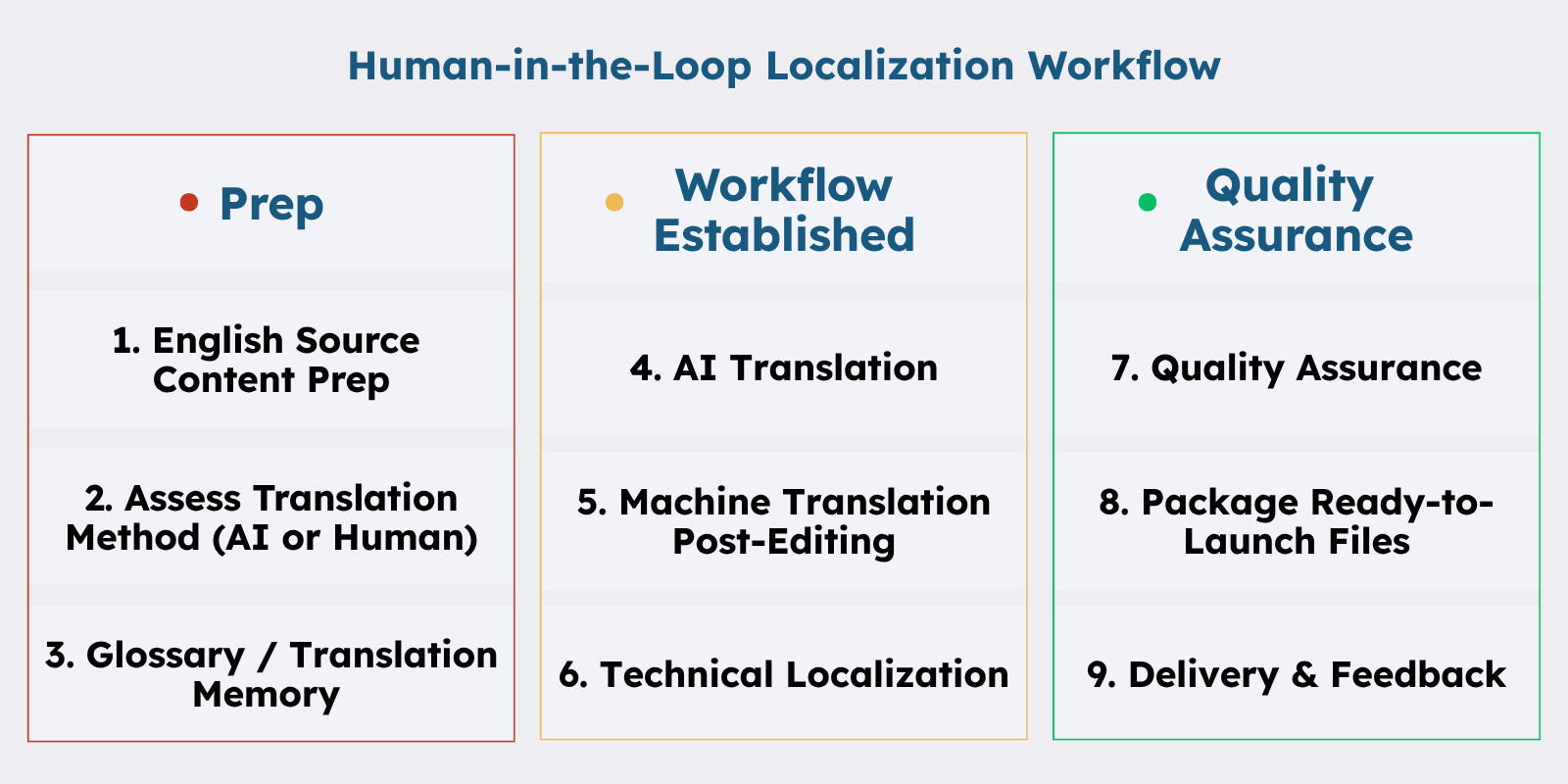
Human-in-the-Loop translation enhances quality by combining AI-generated initial drafts with subsequent expert human review and final quality assurance, ensuring accurate, consistent, and localized results from your LSP.
The Market Reality: Stats Every Buyer Should Know
- Market size: USD 67.9 billion (2023) ➜ USD 72.7 billion (2024) with 7% CAGR.
- Growth pressure: Buyers rank on-time delivery (84%) and quality (83%) as top vendor factors; price is a distant third.
- Revenue impact: 84% of marketing teams say localization has a moderate-to-extremely-positive effect on revenue.
10 Evaluation Pillars for Vendor Short-Listing
1. Quality Frameworks (ISO 9001/17100)
ISO Certifications ensure audited workflows, dual review, continual improvement, client satisfaction, and traceability.
2. Domain & Regulatory Expertise
Life science? Fintech? Legal? Verify sector-specific linguists and compliance history.
3. Scalability & Geographic Reach
Can the LSP ramp from 2 to 25 languages without breaking SLAs?
4. AI & Automation Capabilities
Ask about MT engines, LLM security, connectors, and continuous-deployment pipelines.
5. Security & Compliance (SOC 2, GDPR)
Sensitive data demands encryption, role-based access, and documented deletion.
6. Project Management Model & Communication
Is there a single point of contact? Weekly stand-ups? 24/5 coverage?
7. Pricing Transparency & Flexibility
Subscription, per-word, MTPE-blended? Research shows that buyers gravitate toward all-inclusive rates.
8. KPI & Reporting Dashboards
Real-time cost, quality, and turnaround metrics—no spreadsheets.
9. References, Case Studies, Culture Fit
Talk to peers in your industry; gauge responsiveness and shared values.
10. Sustainability & ESG Alignment
Becoming an increasingly common consideration in procurement decisions, especially for publicly traded firms
Comprehensive Interview & RFP Checklist
| Category | Questions to Ask a Translation Company |
| Quality | “Are you ISO 9001-certified? How often are you audited?” |
| People | “What % of linguists are full-time vs freelance? How do you vet SMEs?” |
| Process | “Describe your end-to-end workflow from file hand-off to delivery.” |
| Technology | “Which MT or LLM engines do you use? How do you secure prompts?” |
| Scalability | “Show an example of adding 5 languages in one quarter.” |
| Security | “Provide a SOC 2 report and GDPR compliance statement.” |
| Pricing | “List all surcharges (rush, DTP, engineering) up-front.” |
| Support | “What is your average PM response time during business hours?” |
| KPIs | “Which metrics appear on your client dashboard?” |
| Governance | “Who owns the Translation Memory and glossary assets?” |
(Adapted from industry checklists and hundreds of client interviews.)
Build-vs-Buy: Multi-Vendor or One-Stop Shop?
| Strategy | Pros | Cons |
| Single LSP | Unified voice, consolidated TM, fewer invoices | Risk of vendor lock-in; capacity limits for rare pairs |
| Multi-Vendor | Competitive pricing, niche expertise | Fragmented terminology; heavier PM burden |
Most enterprises start multi-vendor, then consolidate around one strategic partner once trust and tech fit are proven.
Scoring Matrix – Example (Weight by Business Priority)
| Evaluation Pillar | Weight | Vendor A | Vendor B |
| Quality & ISO | 25% | 9/10 | 7/10 |
| Domain Expertise | 20% | 8 | 8 |
| Tech & AI | 15% | 7 | 9 |
| Security | 10% | 10 | 8 |
| Pricing Model | 10% | 8 | 9 |
| References | 10% | 9 | 6 |
| Culture Fit | 10% | 9 | 7 |
| Total | 100% | 8.6 | 7.7 |
Common AI Translation Red Flags:
- “We use free Google Translate.” No MT security or post-editing.
- Opaque pricing tables with hidden engineering fees.
- No ISO or SOC 2 proof. Just “trust us.”
- Vendor-owned TM (makes switching painful).
- Poor communication cadence or revolving PMs.
- Over-promising language pairs with no verified linguist bench.
FAQs
How many quotes should I collect?
At least three to benchmark cost, tech, and culture fit.
Is the cheapest per-word rate ever the best choice?
Rarely. Quality and rework costs often erase savings.
What’s a realistic pilot project?
One high-impact asset, such as a landing page or email workflow, in two target languages.
How soon will I see ROI?
Many buyers see 30–50% TM savings and conversion lifts by project #3.
Can AI alone replace human linguists?
Not for brand-critical or regulated content. A hybrid MTPE approach remains best practice.
Who updates glossaries and TMs?
Your LSP should provide ongoing maintenance; ownership stays with you.
Efficiently Leverage AI for Translation Today
If you’re still trying to figure out how to use AI to reduce costs, maintain translation accuracy, and launch in more languages faster, you’re not alone. Many of our clients start by asking, “How can AI translation work for us?”
Our answer: It depends, but Interpro can help you craft a tailored localization strategy for your content, your industry, and your audience. A quick strategy call with the Interpro team provides you a complimentary consultative advice. We’ll help you:
- Identify which content types are a good fit for AI translation
- Estimate if there are cost savings by using AI translation + MTPE workflow
- How to integrate the AI workflow with your team
Work with Interpro to build a strategic localization workflow that aligns with your content, your risk level, and your business goals.
Category: AI Translation
Tags: AI, About Interpro
Service: AI Translation

Don't forget to share this post!



Stay Updated with Interpro
Subscribe to our newsletter for the latest updates and insights in translation and localization.