
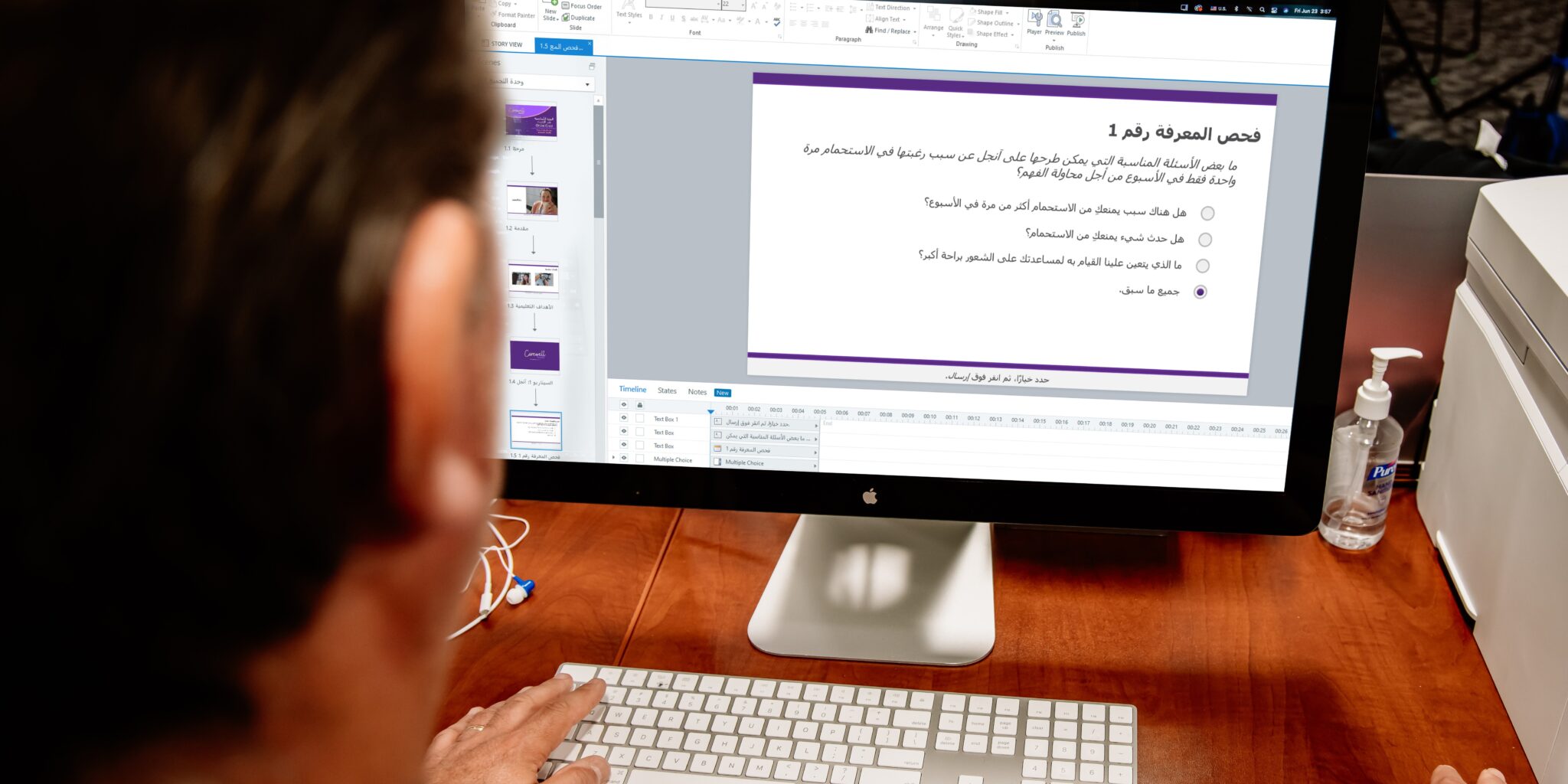
Translation as a Feature (TaaF) embeds real-time, AI-driven translation directly into software platforms, enabling users to toggle between languages instantly. It offers speed and scalability, but accuracy and compliance risks mean it’s most effective when combined with human-in-the-loop workflows. This article explains what TaaF is, why it’s gaining traction, how to implement it strategically, and how to avoid its common pitfalls.
What is Translation as a Feature?
Traditional localization provides complete end-to-end language support after a file is created, localizing everything from single-page documents to global training libraries.
Translation as a Feature (TaaF) bolts on AI translation to your tool. Think Outlook or Slack’s instant translation within the platform, or Airbnb’s auto-localized listings. If you can translate an entire file with the click of a button, or your users can toggle languages as easily as they toggle dark mode, then that’s TaaF.
It’s a quick, easy translation (accuracy is another matter, but we’ll cover that later). Slator defines TaaF as “translation capabilities delivered via APIs or SDKs, native to the product experience rather than a separate service.” (Slator)
Why the Market Is Moving This Way (Data & Trends)
- Consumer expectation: CSA Research’s Can’t Read, Won’t Buy study shows 76 % of global shoppers prefer products in their own language. (CSA Research)
- Competitive edge: DeepL’s 2025 Forrester brief notes that enterprises embedding translation at the feature level reach new markets six months faster than peers. (DeepL)
- Monetization: Netguru reports a 20 % average lift in conversions when websites localize UI text. (Netguru)
- Risk mitigation: Regulations like the EU Digital Services Act increasingly require equal-access language support for consumer platforms.
The Bottom line: Multilingual UX is not just a nice-to-have. It’s a requirement for breaking into a global market.
Core Components of a TaaF-Ready Tech Stack
Translation as a Feature (TaaF) is transforming how global users interact with digital platforms. Language access is now a built-in user experience, not an afterthought. In this post, we’ll break down what TaaF is, why it matters, and how you can leverage it to scale. For a deeper dive, download our free lead magnet.
File Prep Matters: Getting the Most from TaaF
Before you hit “translate” in your authoring tool, take a moment to prep your files. TaaF tools work best when your English source content is clean, consistent, and well-structured. That means using clear language, standardized terminology, and consistent formatting across slides, modules, or screens.
TaaF typically only translates visible text. voiceovers, video, quiz logic, and on-screen text often need to be gathered and translated separately. Prepping all assets in advance ensures nothing gets lost in translation and sets the stage for a smoother workflow, whether you’re relying solely on TaaF or combining it with professional post-editing
Quality Estimation & Glossaries
Machine translation quality can vary, but tools like Quality Estimation (QE) models help flag high-risk segments early, giving you a chance to apply pre-approved glossary terms and Translation Memory matches before errors slip through. At Interpro, we pair AI with Human in the Loop workflows to refine output, ensuring translations reflect your brand voice, comply with industry standards, and resonate with learners across languages. Learn how glossaries and style guides enhance consistency or explore our approach to human-edited AI translation.
TaaF is Built into Your Authoring Tools
You don’t need to understand how the AI behind TaaF works – just know that it’s embedded in authoring tools like Articulate Rise and Vyond to deliver instant, in-platform translations. With a few clicks, your on-screen content appears in another language, making it a fast and accessible option for teams looking to localize content quickly within their existing tools.
But not all TaaF is created equal, and sometimes you need to supplement TaaF with other language services. Check out this quick guide when to consider TaaF or other translation workflow options.
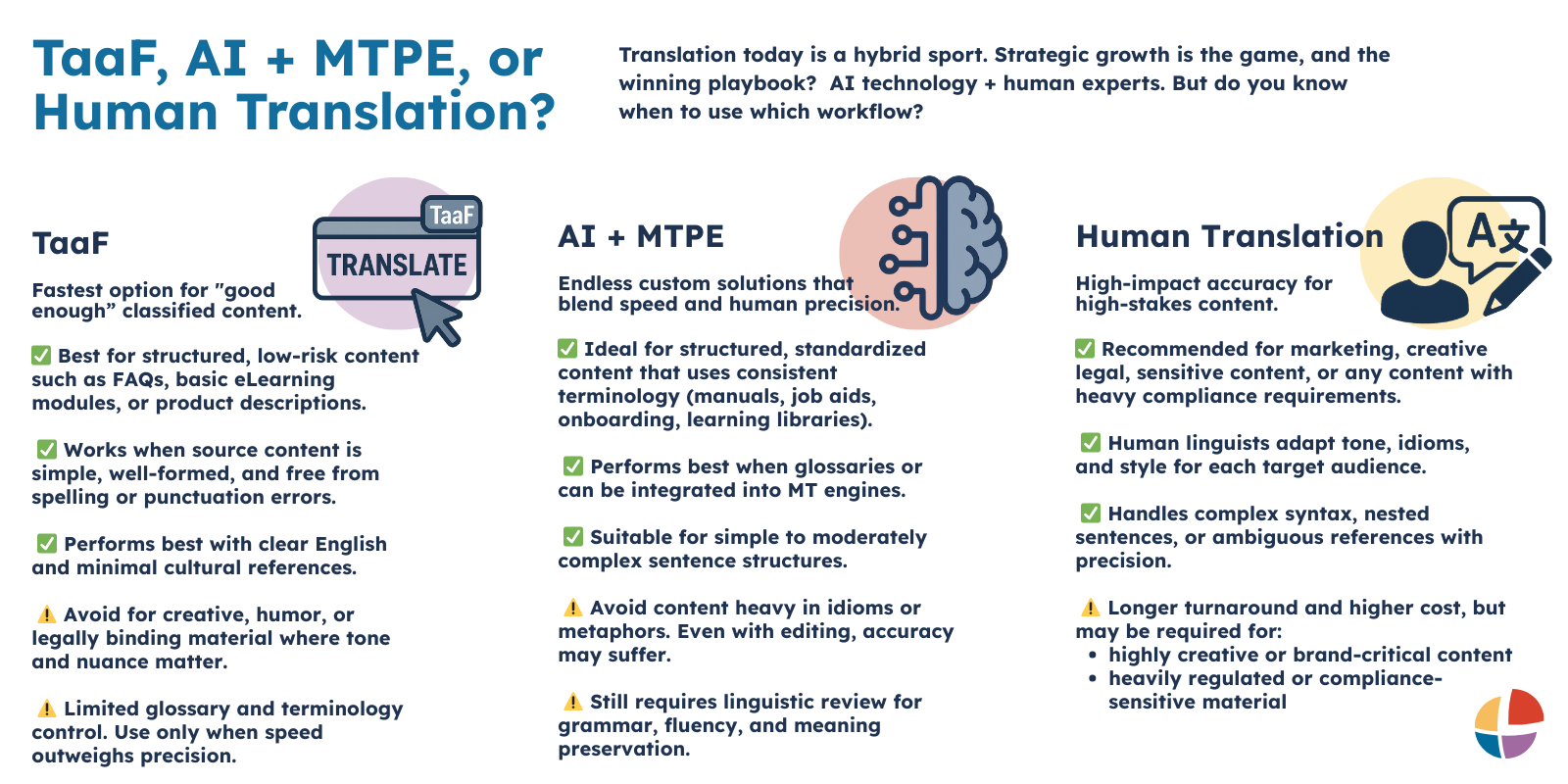
The benefits and limitations of TaaF, AI + MTPE, and Human Translation to help you choose the right localization approach.
TaaF with Human-in-the-Loop: Turn “Good Enough” Into Great
Translation as a Feature (TaaF) tools built into platforms like Articulate Rise or Vyond offer speed and convenience, but not always accuracy. When compliance, clarity, or brand voice matter, auto-translation alone won’t cut it.
That’s why Interpro integrates Human in the Loop review into your TaaF workflow. Our expert linguists validate and refine machine-generated content directly within your authoring platform. We apply your glossaries, enforce terminology, correct tone, and ensure on-screen text, captions, and course logic all align. The result? Content that’s not just fast, but learner-ready, audit-ready, and trusted by stakeholders.
Plus, our process feeds corrections back into your translation memory, continuously improving your TaaF output with every review cycle.
You get the speed of TaaF with the quality assurance of professional human translation, so nothing gets lost in translation.
Strategic Benefits of TaaF with Human-in-the-Loop Support
Translation as a Feature (TaaF) tools, like those built into Articulate Rise or Vyond, offer a fast and convenient way to generate multilingual content directly within your authoring platform. But when speed comes without strategy, quality and learner outcomes can suffer.
Here’s how integrating Human in the Loop support into your TaaF workflow delivers better results:
Speed Without Sacrificing Quality
TaaF tools dramatically reduce turnaround times by instantly translating on-screen content. But machine-generated translations often miss critical nuances, especially when it comes to tone, technical accuracy, or regulatory terminology. Human review ensures the final output is accurate, aligned with your brand, and ready for learners.
Protect Compliance and Minimize Risk
TaaF may be fast, but it doesn’t come with built-in safeguards for compliance-heavy content. A professional linguist can step in to apply approved glossaries, validate terminology, and flag issues before they become liabilities, especially for industries like healthcare, manufacturing, or HR.
Consistency Across All Course Components
TaaF typically focuses on visible text but ignores captions, voiceovers, quiz logic, and supporting materials. Interpro’s human-in-the-loop workflow ensures consistency across every element of your course, not just what appears on screen.
Build a Smarter, More Scalable Process
With every review cycle, Interpro feeds human corrections back into your glossary and translation memory. This improves future TaaF outputs, reduces editing cycles, and gives you a scalable framework for multilingual content development that grows smarter over time.
Implementation Roadmap: From Audit to Roll-Out
Slator predicts the TaaF segment will grow at 18 % CAGR through 2028, outpacing the wider language-services market. (Slator). If you plan to be part of the teams that integrate it, here is the general process to follow:
Content Audit
Identify high-impact strings (UI, emails, push notifications) and prioritize those for localization. This ensures you’re investing where it counts.
Glossary & Style Guide
Define and lock in key terms, voice, and tone before any code is written. This minimizes rework and keeps your brand consistent across languages.
API Integration
Integrate your MT provider into your back-end systems. Caching translated content reduces costs and improves load times, especially critical for real-time user interactions.
QE & Routing Rules
Set smart quality thresholds. For example, you might auto-publish content with a Quality Estimation (QE) score of 85 or higher, while routing lower scores for human review. This balances efficiency and accuracy.
CI/CD Hooks
Automate language builds within your continuous integration pipeline. This allows new or updated content to be localized without slowing down your release cycle.
User Testing
Launch with beta users in each locale to gather qualitative feedback. This real-world insight helps fine-tune your messaging and improves cultural resonance.
Analytics & Iteration
Track key performance indicators like conversion rates and NPS by language. Use that data to retrain models, refine your glossary, and improve user experience over time.
Tip: Start with one “anchor” locale. Perfect your tooling and workflow there before scaling to additional languages.
Get Started with TaaF Responsibly
Translation as a Feature (TaaF) tools make it easy to translate content with a single click, but that convenience can create hidden risks.
- Missed Content: TaaF often skips captions, voice-overs, quiz logic, and supporting materials such as PDFs
- No Glossary Control: Brand terms and tone may be inconsistent across modules.
- Error-Prone Output: AI struggles with complex, technical, or creative content.
- Compliance Risks: There’s no human QA to ensure legal or regulatory accuracy.
- No Learning Loop: TaaF doesn’t retain style preferences or reuse past translations.
When language access is baked into the very DNA of your product, growth follows naturally. Translation as a Feature converts browsing visitors into loyal customers, trims support costs, and future-proofs your platform against regulatory demands.
Contact Interpro Translation Solutions for a no-obligation consultation. Our engineers and linguists will audit your stack, design a TaaF roadmap, and help you launch in new markets, fast, fluent, and fully compliant.
Frequently Asked Questions
Is Translation as a Feature only for large enterprises?
No. SMBs often gain the most because they leapfrog manual workflows and enter new markets first.
What about quality? Will machine output hurt my brand?
QE models and Human in the Loop review ensure critical content is polished before users see it.
How much does it cost?
Usage-based MT APIs start at fractions of a cent per character; savings from reduced support tickets and increased conversions usually outweigh the spend within months.
Which languages should we launch first?
Prioritize markets with high traffic potential and legal obligations, often Spanish, German, Japanese, and Brazilian Portuguese.
Can we keep sensitive data private?
Yes. Many MT vendors offer on-prem or private-cloud deployments with zero data retention.
How do we measure success?
Track language-specific KPIs, conversion, churn, and NPS, plus operational metrics like glossary hit rate and QE scores.
Category: AI Translation, Translation
Service: AI Translation, Translation Services

Don't forget to share this post!


Stay Updated with Interpro
Subscribe to our newsletter for the latest updates and insights in translation and localization.