

Understanding the cost of professional translation can be confusing. This guide breaks down pricing factors, what should be included in a quote, and how to find a reliable partner, so you can make informed decisions and get the best value from your investment.
If your business is expanding into new markets or striving to serve a multilingual audience at home, you already know that professional translation isn’t just a box to check, it’s a strategic investment. Yet many organizations are unsure where to begin. Why do quotes vary so widely? What are you really paying for? And how can you be sure you’re working with a vendor who truly understands your needs?
This guide is here to answer those questions. Whether you’re a seasoned localization manager or sourcing translation for the first time, you’ll learn how translation pricing works, what to look for in a quote, and how to find a long-term partner who delivers value, quality, and trust.
When Do You Need Professional Translation?
Professional translation becomes critical when:
- You’re launching products or services in new regions
- Your workforce includes ESL or non-English-speaking employees
- You’re delivering training, eLearning, or compliance content
- You want to ensure brand consistency across international markets
DIY solutions like Google Translate may work for a quick phrase, but when accuracy, compliance, or brand trust are on the line, you need a professional team. SEIU 775 Benefits Group learned this firsthand. Supporting thousands of caregivers across Washington and Montana, they needed accurate, culturally sensitive training materials in over a dozen languages. Interpro stepped in not just as a vendor, but as a partner, translating handbooks, videos, websites, and eLearning courses with precision and compassion.
What should translation services cost?
Translation pricing is not one-size-fits-all. Costs are influenced by:
- Word count (unique vs. repeated words)
- Language pairs (some languages are more expensive than others)
- Number of languages
- File types (Word, InDesign, XML, JSON, SCORM, etc.)
- Content complexity (technical documents vs. marketing materials)
- Formatting and Desktop Publishing (DTP)
- Audio or video elements (voiceover, subtitles, etc.)
- Engineering and publishing requirements (eLearning SCORM packaging, CMS publication, app deployment, etc.)
- Consultative localization advice (glossary development, cultural adaptation, content readiness evaluation)
- Level of project management and subject matter expertise (dedicated PMs, linguists with industry-specific knowledge)
We recommend always providing your source files to get the most accurate quote. Armstrong International, a global leader in thermal utility management solutions, was able to reduce costs significantly by collaborating with Interpro early in the process and leveraging translation memory (TM) technology to avoid translating repeated content across campaigns.
Key takeaway: An online tool is going to cost much less than a language growth strategy consultant. Working with localization solutions professionals allows you to share your budget and goals, and we can guide you on realistic translation solutions for your challenges.
The Power of Translation Memory
Translation Memory tools store previously translated segments, so you never pay twice for the same content. This ensures consistency in terminology, speeds up delivery, and significantly lowers cost.
For example, Armstrong International avoided translating over 100,000 words across four languages, a six-figure savings, thanks to the TMs developed by Interpro. Interpro’s pricing model includes built-in TM discounts, and our policy has always been that client TMs are their intellectual property. You own them, always.
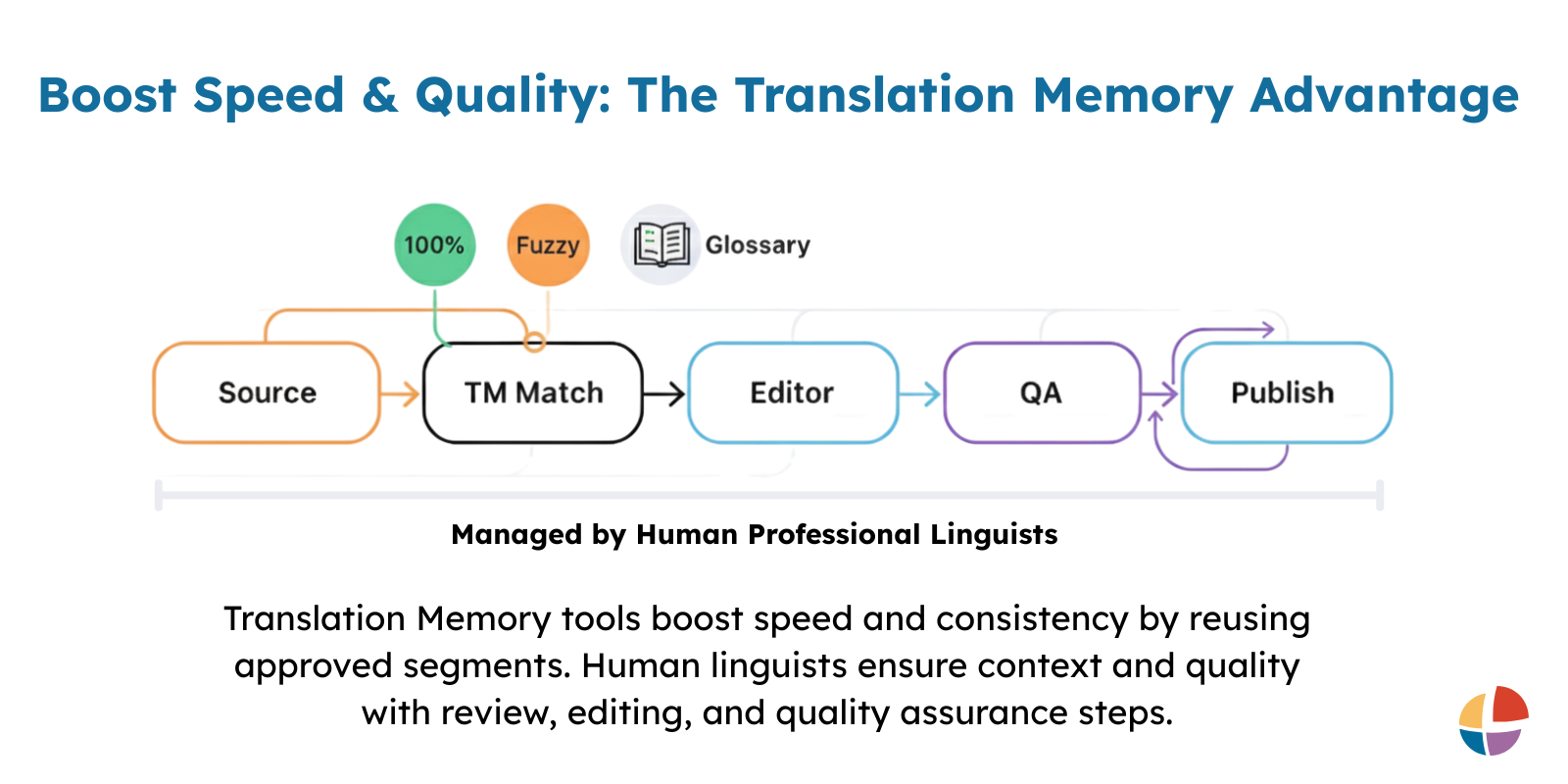
A workflow diagram illustrating how leveraging previously translated content reduces translation services cost and speeds up project delivery.
What Should Be in a Translation Quote?
A transparent, detailed quote should include:
- Translation (per-word breakdown)
- Proofreading and revision
- Desktop publishing (if applicable)
- Engineering and file prep
- Project management
- Voiceover and video localization (if relevant)
It should also clarify whether the price is based on source or target word count. Always insist on source word count for predictability.
File Engineering, DTP, and Final Deliverables
Many translation providers stop at raw text. At Interpro, we go further.
Our engineers handle:
- Extracting translatable content from complex file types
- Resizing dialogs and formatting for different character lengths
- Localizing embedded graphics and UI elements
- Rebuilding SCORM or HTML5 eLearning courses post-translation
Every deliverable is reviewed by a native-speaking linguist in context, ensuring that the final product is polished and ready to publish.
Handling Scope Changes Gracefully
Projects evolve. A strong translation partner will help you manage scope changes with clarity and flexibility. Interpro uses a Change Request Authorization process to evaluate cost and timeline impacts, only moving forward with written client approval. This ensures no surprises and smooth project execution.
Guaranteeing Quality and Supporting Revisions
Your translation provider should stand behind their work. At Interpro, our Guarantee of Workmanship covers any necessary corrections at no charge. We also include one round of stylistic or preferential changes as part of our standard service.
This kind of responsiveness helped us become the trusted localization partner for SEIU 775 Benefits Group. When they needed voiceover syncing, WordPress integration, and survey translation all at once, we delivered a seamless, validated product, without adding stress to their team.
What Makes a Translation Partner Stand Out?
Look for a provider who offers:
- In-country, native-speaking linguists
- Subject matter expertise
- ISO-certified processes (Interpro is certified to ISO 9001:2015 and 17100:2015)
- Transparent communication and project updates
- Experience with your file types, platforms, and industries
- A successful track record of delivering quality consistently
Armstrong International appreciates Interpro’s ability to scale one English campaign across 100 countries with cultural sensitivity, accuracy, and technical know-how. For them, it wasn’t just about language; it was about maintaining global brand integrity.
Ready to Start Building a Strategic Partnership?
Translation is more than a service; it’s a partnership. Whether you’re managing global training, marketing across continents, or supporting ESL communities at home, your language partner should feel like an extension of your team.
At Interpro, we don’t just deliver files. We deliver trust, quality, and long-term value. Our team of linguists, engineers, and project managers works in sync with yours to ensure success in every language.
Let’s talk about your next project. Reach out for a consultation and discover how Interpro can help you scale, localize, and succeed in global markets.
Category: Translation
Tags: About Interpro
Service: Consulting, Translation Services

Don't forget to share this post!



Stay Updated with Interpro
Subscribe to our newsletter for the latest updates and insights in translation and localization.