

The U.S. Hispanic market represents over 20% of the population and more than $2.3 trillion in purchasing power, making it a group with a major opportunity for sales growth. Effective US Hispanic Market Localization goes beyond translation, requiring culturally-relevant messaging, the right Spanish variant(s), and audience-specific strategies. Businesses that take this approach see stronger engagement, better conversions, and more authentic connections.
With Hispanics now comprising nearly 20% of the U.S. population and commanding $2.3–$2.4 trillion in spending power, the U.S. Hispanic market is now central to growth strategies. Successfully reaching this demographic means more than just translating into Spanish; it requires tailored US Hispanic Market Localization. Interpro Translation Solutions shares market insights, key considerations, localization best practices, and FAQs to help B2B organizations effectively engage this vital and diverse audience.
Understanding the US Hispanic Market
Market Size & Growth
- The Hispanic population in the U.S. has grown from ~62 million in 2020 to 68.5 million+, now representing over 20% of the total population.
- Forecasts project the community to reach nearly 75 million by 2030.
- Economic clout: U.S. Hispanics command over $2.3–$2.4 trillion in buying power as of early 2025.
Cultural & Linguistic Diversity
- Heritage varies: ~60% of U.S. Hispanics identify as of Mexican origin, ~9.6% Puerto Rican, ~3.9% Cuban, ~3.7% Salvadoran, among others.
- Spanish proficiency is high, but usage preferences vary: bilingual households, English-dominant younger generations, and regional dialects all matter.
Why Localization Matters Beyond Translation
Avoid “Latino Coating”—Go Deeper
- A superficial “Latino coating” (just translating generic English ads) falls flat with consumers seeking authenticity.
- Brands must consider tone, visuals, idioms, and cultural references, especially across origin groups and regions.
Digital Engagement & Multichannel Behavior
- U.S. Hispanics are digitally-savvy, being early adopters of augmented reality (AR), streaming, and shoppable content formats.
- Many US Hispanics prefer online shopping and contactless pickup, driven by convenience and, in some cases, fear of or uncertainty around in-person shopping.
Key Considerations for US Hispanic Market Localization
Choosing the Right Spanish Variant
- Interpro distinguishes between US Hispanic Spanish, Mexican Spanish, Latin American Spanish, European Spanish, and Universal Spanish.
- For national messaging, US Hispanic Spanish, which blends natural phrasing with broader understandability, is often most effective.
Cultural Nuance & Messaging Tone
- Brands need to reflect values, generational language, and cultural touchpoints (e.g. family-centric messaging).
- Avoid stereotypes and generic visuals; instead, craft culturally-relevant themes and idioms based on target origin (e.g. Mexican vs Puerto Rican).
Regional Market Focus
Some U.S. states and cities have high Hispanic concentrations:
| Region/State | % Hispanic Population | Notes |
| California | ~39% | Over 15M Hispanics, the largest overall population |
| Texas | ~39% | ~11.4M Hispanics, high Mexican-origin dominance |
| Florida | ~26% | Diverse, including Cuban, Puerto Rican, and Caribbean |
| NYC & Chicago | ~17–20% | Diverse, including Mexican, Puerto Rican, and Dominican |
Localization Strategy & Workflow
Step 1 – Market Segmentation & Persona Definition
- Define primary U.S. Hispanic segments (e.g. Mexican-origin Millennials in CA/TX; bilingual Puerto Rican households in NYC; bilingual Cubans in FL, etc.).
- Tailor tone and format per segment (e.g. younger bilingual audiences may expect digital-first, Spanish-English fluid content).
Step 2 – Language Variant Selection & Glossary Set-Up
- Use US Hispanic Spanish variants and revise glossaries to reflect neutral yet culturally resonant phrasing.
- Avoid literal translation; use local idioms and context-aware terminology.
Step 3 – Localization Execution
- Native Spanish translators residing within and familiar with U.S. Hispanic markets are essential.
- Adapt visual assets, date formats, currencies, imagery, name forms, and cultural references.
Step 4 – Quality Assurance & Feedback
- Conduct linguistic QA with in-market testers and internal reviewers from target communities.
- Review tone, cultural relevance, legal/regulatory compliance, and brand voice alignment.
Step 5 – Multichannel Execution & Performance Tracking
- Deploy content across emails, web, mobile apps, social media, and print materials.
- Monitor analytics: engagement, conversion, retention, and iteration of content based on performance.
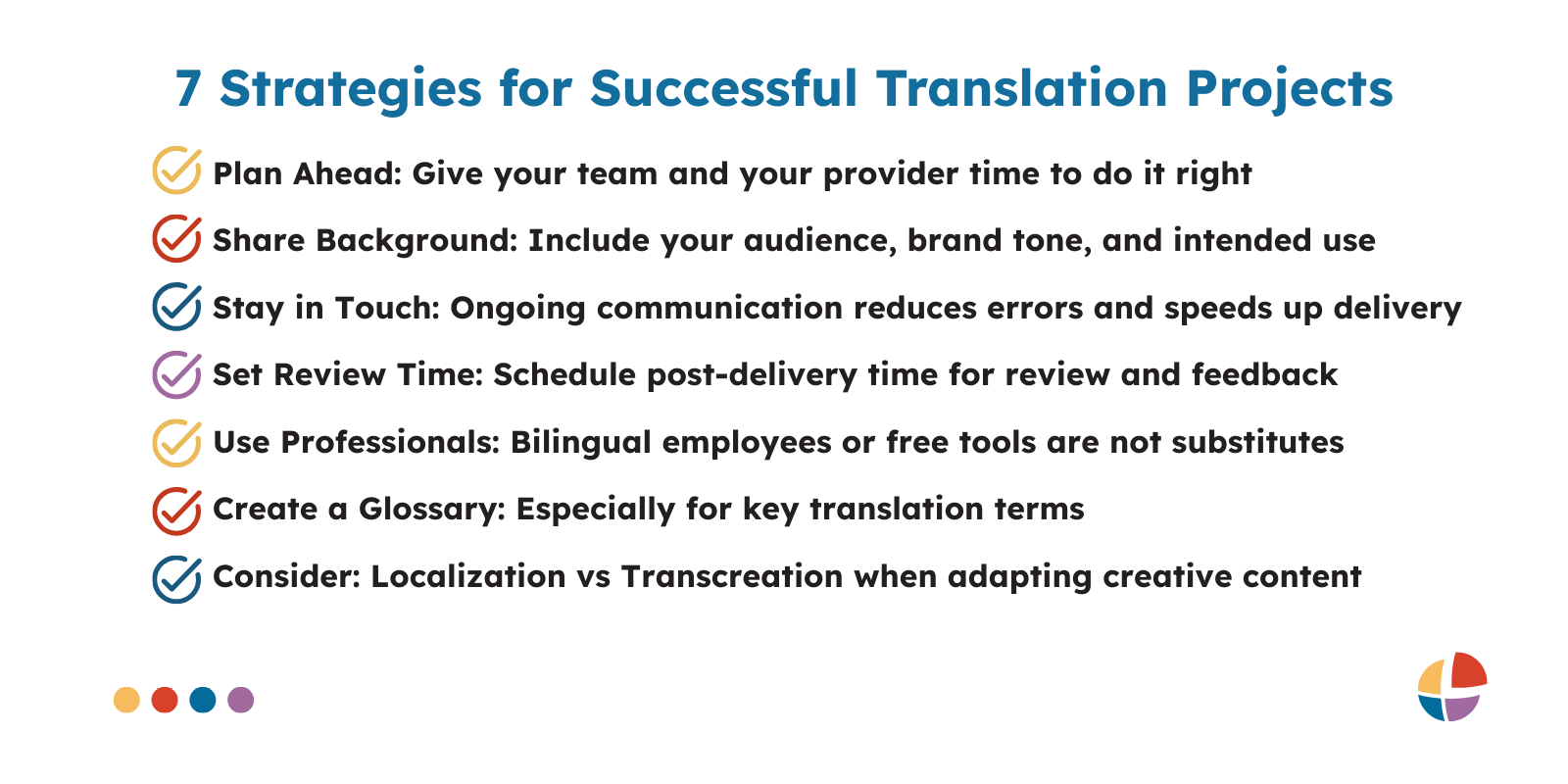
Successful US Hispanic market localization requires clear processes, collaboration, and culturally-informed translation strategies.
Benefits for Businesses & Pain Points Addressed
Pain Points Clients Often Face
- Mistranslation or mis-targeting due to cultural differences
- Poor engagement from Spanish content that feels generic or inauthentic
- Confusion over which Spanish variant to choose or how to execute across regions
- Internal teams lacking cultural expertise or appropriate native speakers
How Interpro Helps
- Offers specialized US Hispanic Spanish translation services with native linguists grounded in cultural context.
- Guides clients in selecting specific language variants and focus markets.
- Provides a full localization workflow, from glossary to QA to deployment, adapted per segment.
Frequently Asked Questions (FAQs)
Why is US Hispanic Market Localization different from general Spanish translation?
Localization accounts for U.S. cultural preferences, idioms, mixed-language usage, and regional behaviors, instead of only translating text literally.
Which variant of Spanish should you choose?
Most national messaging uses US Hispanic Spanish, which blends clarity, neutrality, and cultural resonance. For state-specific campaigns, Mexican or Caribbean variants may perform better.
How do brands avoid sounding generic or stereotyped?
Avoid token-driven visuals or messaging. Use authentic language, test with real audience segments, and collaborate with linguists from each origin group.
Does localization require recreation of assets?
Yes, localization often means reworking visuals, dates, currency formats, testimonials, product names, and legal disclaimers to suit audience expectations.
How do you measure success in localization?
Track engagement metrics like time on site, conversion rate, bounce rate, click-throughs, and then A/B test language variants or visual packages.
Can I use machine translation for Hispanic content?
It may be a starting point, but expert human review is crucial. Automated translations often lack cultural nuance and may misinterpret idioms or spelling variants.
Key Takeaways
- The U.S. Hispanic market represents 20+% of the U.S. population, with a rapidly growing economic impact reaching $2.3–$2.4 trillion in purchasing power.
- Localization vs translation: selling to U.S. Hispanics effectively requires culturally-aware messaging, tailored storytelling, and the correct Spanish variant(s).
- Market-specific approaches: California, Texas, Florida, New York, and Chicago each have distinct Hispanic communities needing unique localization strategies.
- Interpro offers professional US Hispanic Spanish localization, cultural consulting, and language-variant expertise tailored for major U.S. regions.
- Ongoing iterations, analytics, and feedback loops help refine messaging and optimize effectiveness.
Conclusion & Next Steps
The U.S. Hispanic market is not monolithic, and adopting an authentic, culturally-informed US Hispanic Market Localization strategy will deliver higher engagement, conversions, and long-term brand loyalty. Interpro Translation Solutions offers the expertise needed, from selecting the right Spanish variant to deploying translators with cultural insight to executing localization across channels.
If you’re planning outreach to U.S. Hispanic communities or want multilingual content that truly resonates, reach out to Interpro Translation Solutions. Let’s craft messaging that engages culturally, performs strategically, and reflects your brand authentically.
Category: Localization
Tags: About Interpro

Don't forget to share this post!


Stay Updated with Interpro
Subscribe to our newsletter for the latest updates and insights in translation and localization.