

Global growth requires a localization strategy. Without addressing the nuance of language, your growth is at risk. This blog explores why professional language translation services are essential for international success, covering the business case, market data, and how the right partner accelerates revenue, compliance, and brand trust.
Why Localization is No Longer Optional for Global Growth
Your product may live in the cloud, but your revenue lives in a human being’s native language. Picture two identical e-commerce sites. One shows prices in U.S. dollars, jokes in American slang, and ships only from Ohio. The other auto-switches to euro pricing, swaps idioms for local ones, and offers a UPS drop-point in Lyon. Which site wins French buyers?
Data says the localized one: 76% of online shoppers prefer to buy when content appears in their own language, and Fortune 500 firms that increased language budgets were 1.5× more likely to grow revenue. That’s why localization benefits have shifted from “nice to have” to “board-level KPI.”
Localization vs. Translation vs. Internationalization
Translation converts words. Localization adapts the whole experience: currency, imagery, cultural nuance, and legal norms. Internationalization (i18n) is the engineering work that makes localization possible (think Unicode, resource files).
Quick-Compare Table
| Feature | Translation | Localization | Internationalization |
| Main Goal | Language accuracy | Market fit & resonance | Code/content readiness |
| Scope | Text only | Text + design + UX + legal | Architecture & workflow |
| Ideal Timing | Post-production | Parallel to dev & marketing | Before localization |
| Owner | Linguist | Cross-functional team | DevOps & architects |
The Three Types of Localization You Must Know
Cultural Localization
Cultural localization ensures your message feels natural and relevant in every market. It adapts tone, phrasing, and context so your audience connects with your content, not just understands it. Done right, it builds trust and strengthens your brand globally.
Technical Localization
Technical localization makes sure your translated content works flawlessly in its final format. From eLearning files to websites and videos, it protects functionality, formatting, and user experience. You get back content that is ready to launch with no fixes required.
Platform Localization
Platform localization focuses on how your content integrates within your CMS, LMS, or website environment. It ensures translations align with your systems and workflows, making multilingual expansion smooth and scalable.
How Internationalization Lays the Groundwork
Without i18n, every new language becomes a retrofit headache: hard-coded strings, date-format, units of measurement, and currency bugs, broken layouts. Interpro’s engineers refactor code to externalize text, enable RTL scripts, and automate locale switching, saving 30% on downstream localization costs.
Eight Business-Critical Localization Benefits
- Higher Conversions – Customers are far more likely to engage and complete purchases when content is available in their native language. English-only websites often miss significant opportunities to connect and convert.
- Revenue Growth – Companies that invest in multilingual strategies consistently outperform competitors, reporting stronger top-line growth and expanded market reach.
- Market Expansion – Nimdzi pegs the language industry at $72.7bB in 2024, proving global demand.
- Regulatory Compliance – Localized safety docs avert fines and recalls.
- Customer Loyalty – 84% of marketers say localization boosts repeat business.
- SEO Lift – Native-language keywords win SERPs otherwise dominated by local competitors.
- Brand Trust – Culturally-aligned imagery reduces bounce and refund rates.
- Operational Efficiency – Reusable TMs and termbases trim per-word costs 30–50%.
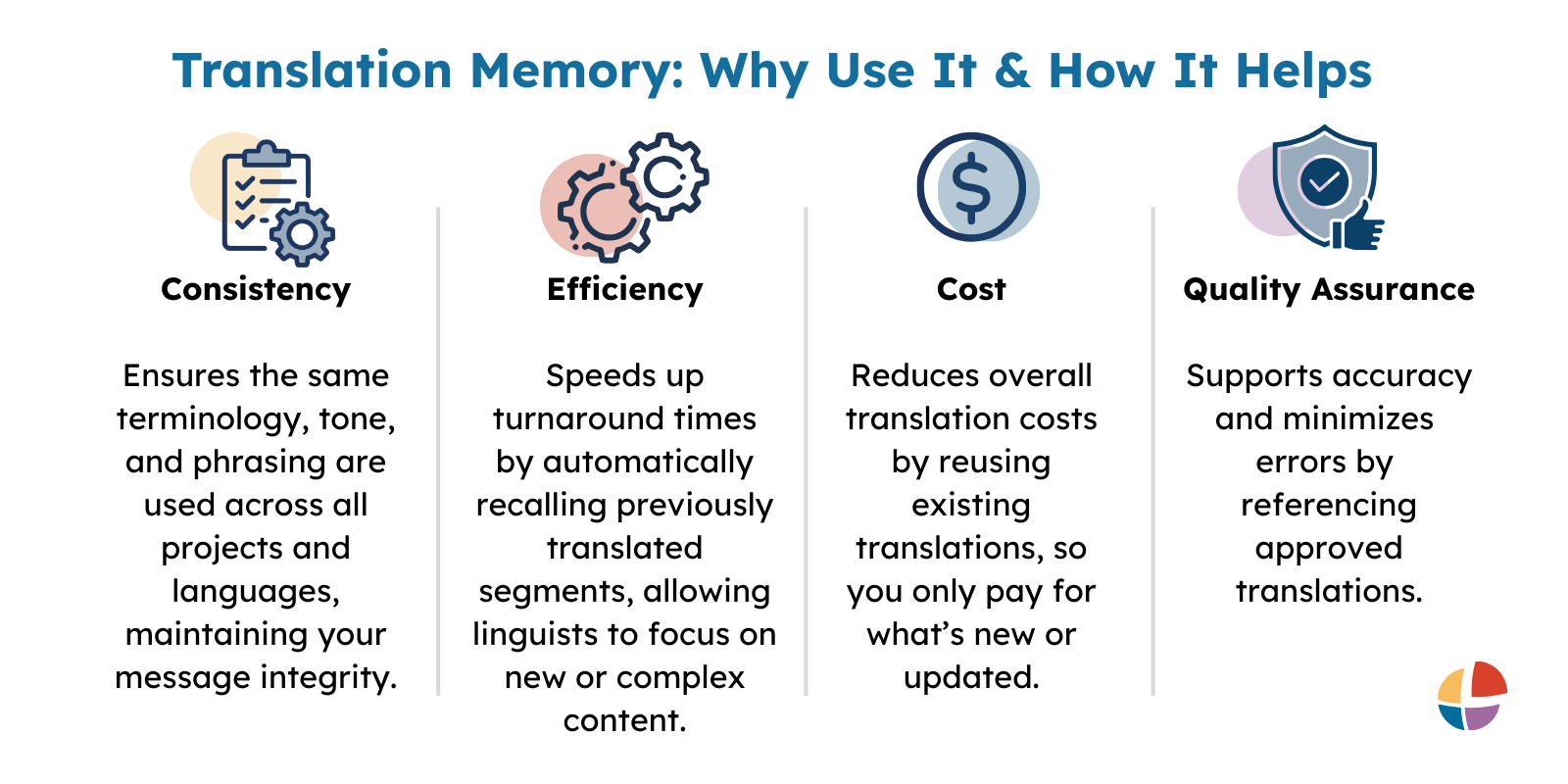
How translation memory improves consistency, efficiency, cost, and quality
Strategic Implementation Framework (Interpro’s 6-Step Model)
Many teams struggle with the same problems across the localization workflow:
- Fragmented brand voice across regions
- Launch delays from hard-coded strings
- Legal exposure from mistranslated disclaimers
- Ballooning translation budgets with zero reuse
- Poor analytics due to language-segmented data silos
Interpro tackles each problem through centralized project management, ISO-certified linguists, and experienced localization workflows.
Step 1 – Market & Locale Research
Which countries and which dialects? Our Which Country, Which Language? matrix cushions you from false assumptions.
Step 2 – Content Tiering & Asset Audit
We bucket assets into premium, standard, and raw tiers, mapping effort to ROI.
Step 3 – Engineering & Authoring Tool Connections
Developers externalize strings; Interpro hooks into Git, WordPress, or Figma for zero-touch hand-offs.
Step 4 – Linguist & SME Alignment
ISO-qualified linguists plus in-country subject-matter experts, dual-vetted for domain + culture.
Step 5 – Localization, QA & Testing
AI-assisted CAT, glossary enforcement, linguistic QA, and on-device functional testing.
Step 6 – Launch, Measure, Improve
A/B tests, locale-specific analytics, and continualTM clean-ups feed a continuous-improvement loop.
Ready to grow globally?
Localization benefits span revenue, compliance, and brand trust. Start with i18n, choose the right localization type for each asset, and follow a data-driven framework. Interpro’s ISO-certified linguists, seasoned engineers, and AI-powered workflows make the journey predictable and profitable.
Ready to unlock new markets? Book your free localization strategy call with Interpro Translation Solutions.
FAQs
Is localization always more expensive than translation?
Upfront, yes, but TMs, glossaries, and higher conversions deliver stronger ROI long-term.
Which assets should I localize first?
High-traffic web pages and compliance documents; tier the rest.
How many locales can I add per quarter?
With i18n done, clients often add 3–5 new locales every release cycle.
Do I need separate SEO for each language?
Yes. Interpro’s LSEO specialists map native keywords to ensure ranking.
What about right-to-left (RTL) scripts?
Our dev team adjusts CSS, mirroring, and font stacks for flawless RTL UX.
How do I measure localization ROI?
Track locale revenue, conversion rates, and cost-per-word savings over time.
Category: Localization
Service: Translation Services

Don't forget to share this post!



Stay Updated with Interpro
Subscribe to our newsletter for the latest updates and insights in translation and localization.