

Whether you’re translating a marketing campaign, a user manual, or a voice-over script, Internal Localization demands more than literal translation; it requires precision, consistency, and cultural clarity. That’s where Linguistic Quality Assurance (LQA) becomes the critical final check. In this guide, Interpro Translation Solutions outlines the essentials of effective review workflows, how they address common client pain points, and the benefits of integrating LQA into your localization projects.
Understanding Linguistic Quality Assurance (LQA)
What LQA Is, and Why It Matters
LQA is a structured method in which expert linguists evaluate translations using predefined error categories, severity levels, accuracy, fluency, terminology consistency, grammar, formatting, and style. Unlike simple proofreading, LQA offers measurable, consistent quality and data-driven feedback.
How LQA Differs from Standard Review
- Standard review is subjective and inconsistent; LQA relies on objective metrics and scoring.
- LQA reveals recurring quality issues, enabling correction at scale and not just one-off fixes.
Market Trends & Growth of LQA
- The global LQA industry was valued at USD 15.1 billion in 2023 and is projected to grow to USD 26.3 billion by 2031, with a CAGR of 10.8%.
- Demand is rising across sectors such as IT, healthcare, and e‑commerce, reflecting localization’s critical role in global business.
The Importance of Internal Localization Reviews
Integrating LQA into Internal Localization
- Engaging internal reviewers early ensures corporate terminology and brand voice are consistently applied.
- Interpro’s Internal Localization Review Tips stress early planning, glossary creation, single-reviewer assignment, and a defined timeline.
Common Client Pain Points
- Inconsistent terminology within and across documents or projects
- Slow feedback loops, especially across time zones
- Overload on reviewer teams, who often balance localization with existing core roles
Interpro’s Five‑Tips Framework for Effective Internal Localization Review
1. Plan Early
- Bring linguistic review into project planning from the kick-off or quotation stage to avoid bottlenecks. This is especially critical for time-sensitive deliverables like voice-over scripts.
2. Start with Glossary Development
- Develop and approve a bilingual glossary before translation begins. This up-front consistency reduces back-and-forth and increases internal review speed.
3. Assign One Reviewer per Language
- Having too many reviewers leads to inconsistencies. Assign one final reviewer per language to maintain clarity and efficiency.
4. Agree on a Timeline
- Establish review deadlines early, deliver files in a dual-column format, and build in buffer time to accommodate slower languages or busy reviewer schedules.
5. Embrace It as Workflow, Not Burden
- Internal review should feel collaborative, not like extra work. Framing the process as part of shared success improves participation and outcomes.
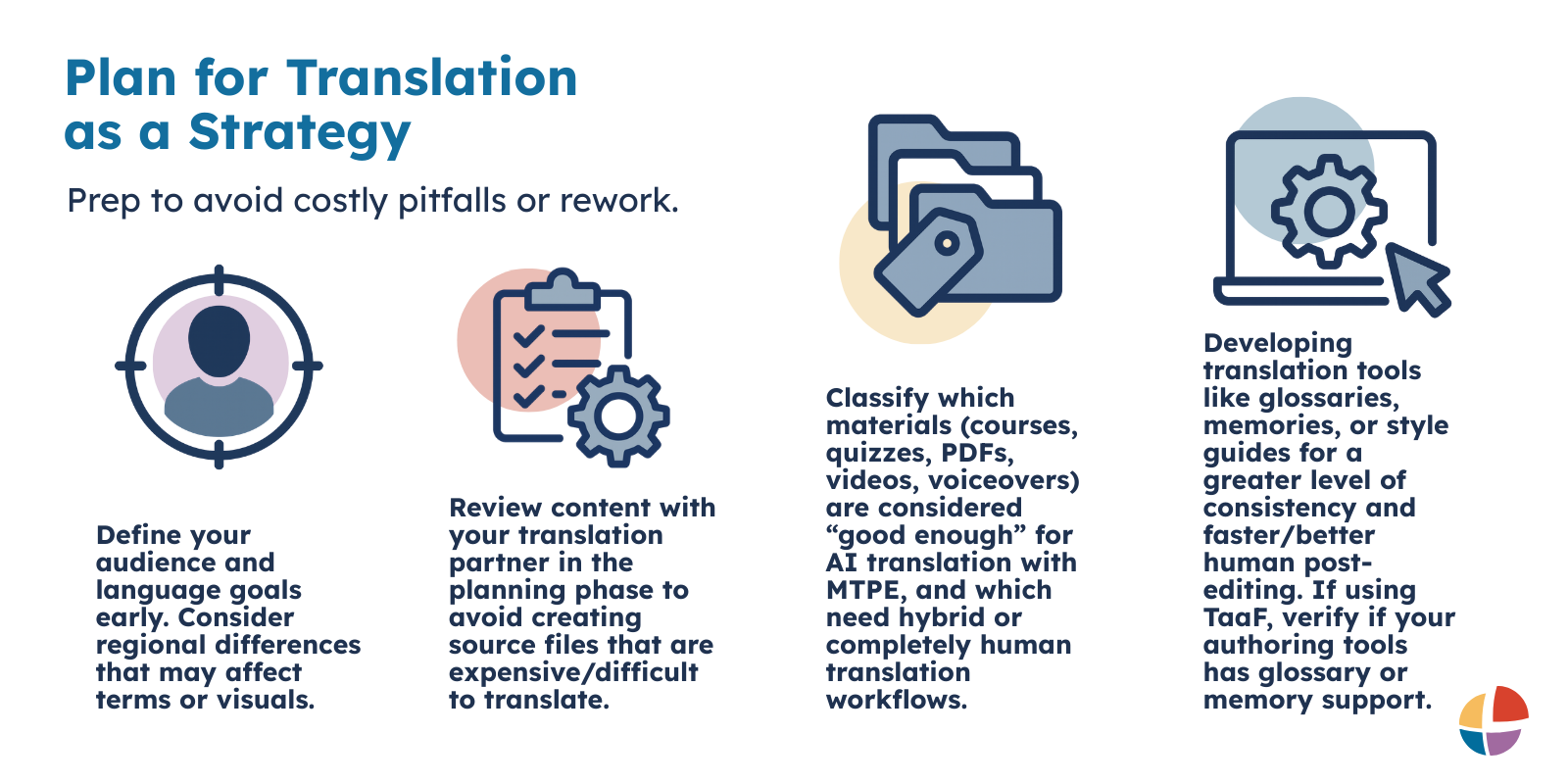
Planning early is critical to Linguistic Quality Assurance, helping teams define goals, align workflows, and reduce costly translation errors before they happen.
Building a Comprehensive LQA & Internal Review Workflow
Workflow Overview
| Phase | Key Actions |
| Planning & Glossary | Develop and approve glossary; align style guide |
| Translation & Dual‑Column Delivery | Provide translated content in an editable format alongside the source |
| Internal Review | Assigned reviewer checks translation accuracy, grammar, terminology, formatting, tone, brand voice |
| LQA Stage | Linguists perform structured error scoring and feedback |
| Correction & QA | Translators update and re-run checks |
| Final Approval | Client signs off; Interpro provides reports |
Error Categories & Severity Levels
Common LQA error categories:
- Accuracy (missing or incorrect content)
- Fluency/style (unnatural phrasing)
- Terminology (inconsistency with glossary)
- Grammar/punctuation
- Formatting/layout issues
Severity levels (e.g., minor, major, critical) help prioritize corrections and guide translators.
Leveraging Technology & Tools
- Use a Translation Management System (TMS) integrated with a glossary, Translation Memory, and LQA reports for consistency and speed.
Benefits of LQA and Internal Review for Clients
- Brand consistency and clarity: helps maintain corporate voice and approved terminology across languages.
- Faster turn-around and fewer revisions: glossary and single‑reviewer model reduce cycles.
- Cost savings over time: structured LQA reduces costly rework.
- Trust and confidence: high‑quality multilingual content builds credibility in global markets.
- Risk reduction: minimizes errors that may lead to miscommunication or legal exposure.
Frequently Asked Questions (FAQs)
What is Internal Localization?
Internal Localization refers to the process by which content generated within an organization (e.g., marketing, support, legal) is translated and reviewed internally before final quality assurance steps. It aligns brand voice and terminology early.
Why is LQA essential for Internal Localization?
LQA ensures translations meet objective quality standards. When paired with internal review, it catches errors early, reduces back-and-forth, and ensures consistent output across languages.
How do error categories work in LQA?
Each translation is checked against fixed categories like accuracy, fluency, grammar, terminology, and formatting, with severity scoring. This helps teams prioritize corrections and track improvement trends.
Can machine translation be used with LQA?
Yes, machine translation can speed up initial draft phases, but human LQA is critical in catching subtle errors, maintaining tone, and ensuring brand consistency.
How long should internal review take?
It depends on the content volume and complexity. Plan early and build in buffer time. Interpro suggests a dual-column format and agreed timelines to streamline the process.
What happens after LQA scoring?
Translators receive annotated feedback, make corrections, and then perform a final QA round to confirm issues are resolved. The completed glossary and style guide can be updated for future use.
Key Takeaways
- Internal Localization plus Linguistic Quality Assurance ensures content is accurate, consistent, and on-brand in every language.
- Interpro’s Five-Tip Internal Review Framework helps teams plan, streamline workflows, and minimize revisions.
- Structured LQA provides objective scoring and measurable improvements, driving better results over time.
- Clients benefit from time savings, reduced errors, and global readiness with confidence.
High‑quality multilingual content depends on more than translation; it requires structured review, brand consistency, and a data-driven QA framework. By integrating Internal Localization strategies with Linguistic Quality Assurance, Interpro Translation Solutions helps B2B clients deliver accurate, polished content that resonates globally. Our Five‑Tips Review Process, glossaries, and LQA methodology combine to minimize risk and maximize clarity. For businesses looking to scale language operations without sacrificing quality, this guide shows why LQA is essential.
Build Your Custom Localization System with Confidence
Book a consultation to assess the best localization strategy for you.
Interpro helps you evaluate your current localization workflow, identify where AI can be applied safely, and design a Human-in-the-Loop process that protects compliance, quality, and brand integrity.
Whether you need AI translation services, MTPE, full human translation, or strategic localization consulting, we’ll help you build a system that scales without exposing your organization to unnecessary risk.
Contact Interpro Translation Solutions today to learn how our experts can help you integrate effective reviews and best-in-class LQA.
Category: Localization
Tags: About Interpro
Service: Consulting

Don't forget to share this post!
Related Articles



Stay Updated with Interpro
Subscribe to our newsletter for the latest updates and insights in translation and localization.