

Translation Quality Estimation (QE) helps predict the quality of machine-translated content before human review, making it a vital tool for organizations using AI translation or MTPE. It enables smarter, safer workflow decisions, especially for high-volume or compliance-sensitive content, by identifying risk, estimating post-editing effort, and guiding production strategies.
If you’re exploring AI translation, machine translation post-editing (MTPE), or hybrid workflows, you’ve probably seen the term Quality Estimation (QE). For many teams, QE still feels abstract. But for organizations translating training content, HR and compliance materials, technical documentation, or global communications, understanding QE is becoming essential.
Simply put, Translation Quality Estimation helps you predict the quality of a machine-translated text before human review ever begins. It is a risk-management tool for organizations needing accuracy, consistency, and defensibility across languages.
This guide breaks down what QE is, how it works, why it matters, and how professional language partners like Interpro use it to help you choose the safest and most efficient translation workflow.
What Is Quality Estimation in Translation and Localization?
Translation Quality Estimation is a method of predicting the quality of a translation without requiring a human linguist to read and evaluate every segment first.
Instead of relying solely on manual inspection, QE uses:
- Statistical models
- Linguistic features
- Machine learning
- Historical Translation Memory (TM) data
- Glossary and terminology consistency patterns
- Source-segment complexity
QE then produces a quality score, usually at the segment, document, or system level.
This score helps you determine whether AI or MT output is good enough for post-editing, or whether the content must be routed to a human-only workflow.
In plain terms: Quality Estimation helps you decide when AI translation is good enough, and when you still need a human. It balances speed, cost, and quality before you commit.
Why Translation Quality Estimation Matters More Than Ever
Organizations are accelerating global content: more courses, more documents, more updates, more languages. AI and MT help with speed, but speed without quality checks creates risk.
Without QE, translation teams often experience:
- Over-editing machine-translated text
- Undetected errors in compliance-critical content
- Unpredictable post-editing time
- Workflow mismatches (AI used where human-only is required)
- Misalignment with brand voice or technical terminology
- Rework, delays, and increased cost
Quality Estimation helps solve these challenges by giving you data-backed clarity before production begins.
Top Organizational Pain Points QE Helps Solve
Problem: “We don’t know whether AI translation is safe for our content.”
Solution: Quality Estimation predicts translation quality, helping you decide whether AI, MTPE, or human workflows are appropriate.
Problem: “We can’t predict post-editing effort.”
Solution: QE estimates the time and effort required for editing machine translation, making planning and resource allocation more accurate.
Problem: “We need a level of quality we can defend during audits.”
Solution: With documented quality scores and risk assessments, QE supports audit-readiness and compliance reporting.
Problem: “Our content volume is growing faster than our translation capacity.”
Solution: QE helps prioritize translation work and automate safer segments, enabling scalability without compromising quality.
Problem: “We need a workflow that is fast and accurate for global learners.”
Solution: QE guides you toward the most efficient, high-quality path—whether that’s human, hybrid, or AI-assisted.
Problem: “We can’t risk mistranslations in HR, legal, or compliance materials.”
Solution: QE flags high-risk content before it’s translated, ensuring sensitive materials are handled by qualified human linguists.
Quality estimation gives you the insight needed to pick the right workflow—human, hybrid, or AI-assisted.
How Quality Estimation Works: The Simple Version
While QE systems can be mathematically complex, the core process is straightforward.
1. Analyze the source text
Assessment of complexity, clarity, formatting, and domain (legal, medical, technical, etc.).
2. Evaluate the machine translation output
Algorithms review the MT output for patterns associated with high or low quality.
3. Compare patterns to historical linguistic data
Models learn from previous translations, TMs, glossaries, and human feedback.
4. Produce a quality score
Often shown as:
- Segment-level QE score
- Document-level QE score
- Post-editing effort score (HTER)
- Risk score
5. Provide workflow recommendations
The QE system signals whether the content:
- Needs human-only translation
- Is viable for MTPE
- Is suitable for AI-assisted workflows
- Contains high-risk segments needing special review
This gives teams a more predictable, defensible process.
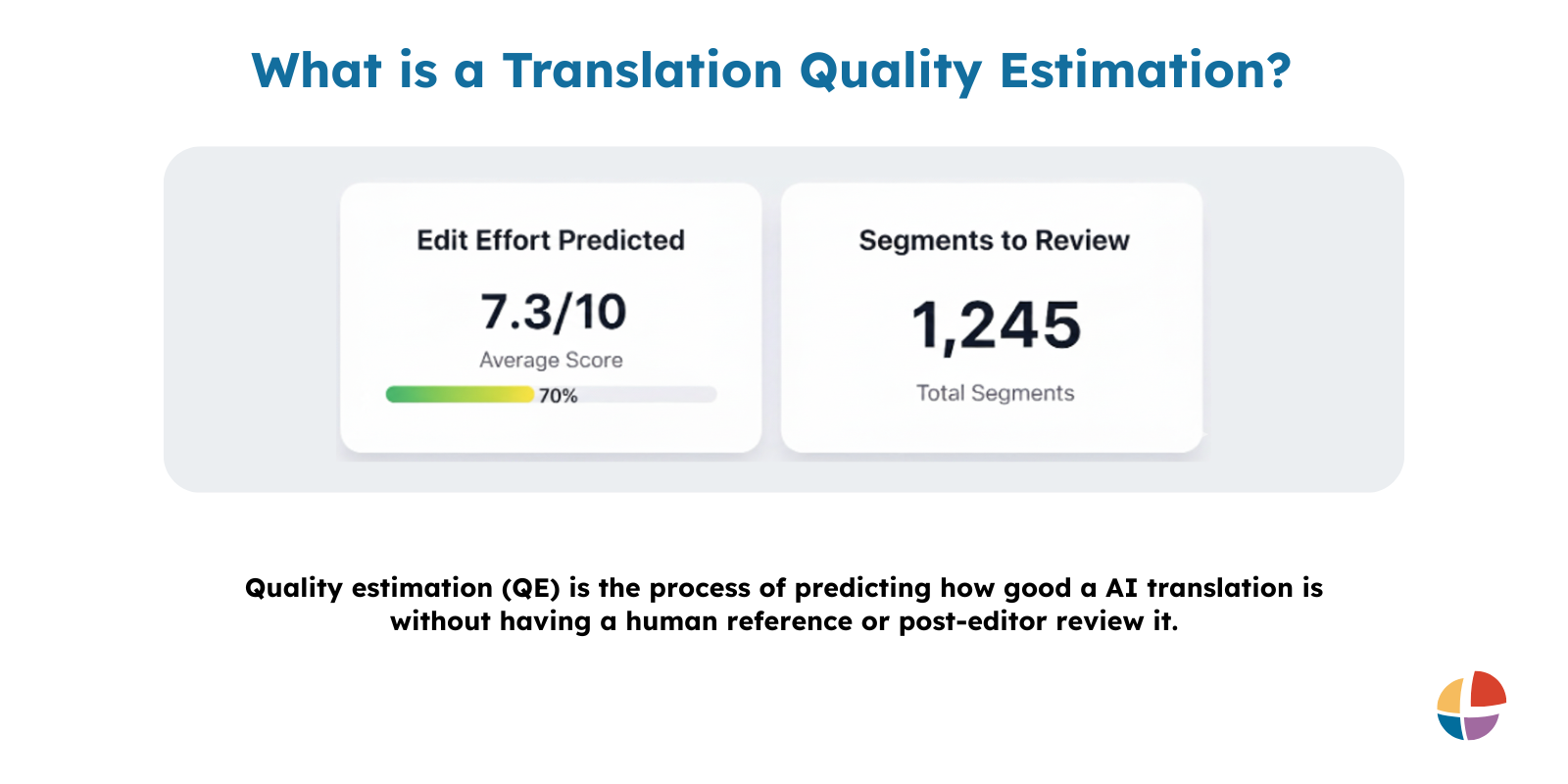
Translation Quality Estimation (QE) provides a predictive score of AI translation accuracy without requiring an immediate human reference.
Where Quality Estimation Fits in the Translation Workflow
Quality Estimation is useful in three critical places:
Before Translation (Preparation)
QE helps determine:
- Can this content use MT or AI?
- Should it be human-only?
- How much post-editing effort should the team expect?
High compliance risk = low QE score = human workflow.
During Translation (Production)
QE tools can flag segments that:
- Contain terminology inconsistencies
- Have low-confidence MT output
- Need extensive post-editing
- Should skip MT entirely
This helps teams intervene early.
After Translation (Post-Production)
Human linguists use QE scores to:
- Prioritize high-risk segments
- Reduce unnecessary rework
- Validate quality for audits or reporting
QE does not replace human QA. It simply concentrates human effort where it matters.
These concepts often get confused. Here’s how they differ:
| Concept | What It Is | When It Happens | Who Performs It |
| Quality Estimation (QE) | Predicts quality without reference translation | Pre-, mid-, post-production | AI system + linguists |
| Quality Assurance (QA) | Ensures format, consistency, and style adherence | Post-editing | Human linguist or QA specialist |
| Quality Evaluation (LQA) | Scores translation against a reference | Final review | Human linguist using scoring model |
Key Takeaways: QE is predictive. QA is corrective. LQA is evaluative. Together, they create a defensible quality pipeline.
When Should Your Organization Use Translation Quality Estimation?
Quality Estimation is great anytime you want to test the quality of the translation using AI before beginning a complex or high volume project. QE can be useful for many different business materials:
- eLearning courses
- HR policies
- Benefits guides
- Technical documentation
- Knowledge bases
- Safety training
- Legal policies
- Medical content
- Regulatory documentation
What Translation Quality Estimation Can and Cannot Do
What QE Can Do
Predict likely translation quality
QE uses machine learning models trained on previous translations to score the quality of AI-generated content.
Example: Before translating a batch of technical manuals into Japanese, QE scores indicate high accuracy for common segments and low confidence for domain-specific terminology, guiding the team to review only the high-risk sections.
Flag risky segments
QE highlights parts of the translation that are likely to contain errors or require human review.
Example: In a multilingual employee handbook, QE flags certain compliance-related sections as low-quality in French and German, triggering a switch to human-only review for those segments.
Estimate post-editing effort
By analyzing linguistic complexity and MT output patterns, QE predicts how much human editing will be required.
Example: An eLearning module is run through QE, which estimates 35% of the content will need moderate editing, helping allocate the right amount of post-editing resources upfront.
Support workflow selection
QE informs whether content is best suited for machine-only, hybrid, or human-only translation.
Example: A marketing team evaluates whether to use AI for product descriptions. QE results show strong quality for Spanish but weak output in Korean, leading to different workflows per language.
Improve efficiency
By streamlining how content is routed and reviewed, QE reduces wasted time on segments that don’t need human intervention.
Example: A software firm accelerates their release schedule by skipping human review for high-confidence strings identified by QE in UI text.
Provide transparency
QE delivers clear, data-backed insights that help justify translation decisions to stakeholders.
Example: During a compliance audit, an organization shares QE reports that document why certain training content was translated with human workflows.
Reduce unnecessary rework
By concentrating human effort where it’s most needed, QE prevents over-editing and repeated revisions.
Example: A translation team avoids redundant corrections on simple content by relying on high QE scores for repetitive instructional text.
What QE Cannot Do
Replace human linguists
QE can predict risk, but it cannot understand meaning the way humans do. It does not interpret intent, context, or consequences.
Example: QE may score a legal clause as “high quality,” but only a trained linguist can confirm that the phrasing aligns with local legal standards and intent.
Certify compliance readiness
QE supports risk assessment, but it does not provide legal or regulatory certification.
Example: Even with strong QE scores, safety training or healthcare content still requires human review to meet audit or regulatory requirements.
Guarantee cultural nuance
QE evaluates patterns and probabilities, not cultural appropriateness or tone.
Example: A leadership message translated with AI may score well technically, yet sound overly direct or inappropriate in Japanese or Korean business cultures—something QE cannot fully detect.
Identify every error
QE highlights likely problem areas, not every possible mistake. Subtle errors, omissions, or context-related issues can still pass through.
Example: A mistranslated benefit term in an HR document may not trigger a low QE score but could still confuse employees.
Replace final quality assurance (QA)
QE happens early and guides decisions, but final QA ensures accuracy, consistency, and formatting before publication.
Example: QE may indicate low post-editing effort, but human QA is still required to confirm terminology, layout, and brand standards.
QE is the early-warning system, not the final checkpoint.
How Interpro Prioritizes Quality for Clients
When you work with Interpro Translation Solutions, quality is the foundation of a responsible, human-in-the-loop workflow.
Our Approach Includes:
- Review of content complexity
- Risk assessment for AI/MT viability
- Workflow recommendation (human-only, MTPE, hybrid)
- TRP workflow (translation, revision, proofreading)
- Localization (adjusting nuanced content and resolving technical challenges)
- ISO-certified processes (ISO 9001, ISO 17100, ISO 18587 for MTPE)
- Human linguists validating any machine-generated output
Interpro gives you a path to using AI responsibly without compromising the safety, clarity, or accuracy of your global content.
FAQs About Translation Quality Estimation
What is Translation Quality Estimation?
It’s a method of predicting the quality of a machine-translated text without needing a human reviewer first.
Does QE replace human translators?
No. QE identifies risk, predicts effort, and helps you choose the right workflow. Human oversight remains essential.
Is QE the same as quality assurance (QA)?
No. QE happens earlier and predicts issues. QA is human review after translation.
When should we use QE?
When working with high-volume content, mixed complexity, AI/MT workflows, or compliance-critical materials.
What languages work best with QE?
Languages with large bilingual datasets (e.g., English ↔ Spanish) typically see stronger QE performance than low-resource languages.
Can QE be used on highly regulated content?
Yes, but usually only as a risk tool. Human-only workflows are still recommended for compliance-critical materials.
How does Interpro use QE?
As part of a responsible, ISO-certified process to evaluate risk, improve efficiency, and guide workflow selection.
How can Interpro help you with Quality Estimation of your materials?
Translation Quality Estimation gives you the clarity needed to make smarter decisions about AI translation, MTPE, and human workflows. It ensures you move quickly without sacrificing quality and creates a more responsible, defensible translation process.
If you want to explore whether your content is ready for AI translation, or you need a partner to build a responsible workflow, Interpro is here to guide you.
Category: AI Translation, Translation, Uncategorized
Tags: About Interpro
Service: Consulting

Don't forget to share this post!



Stay Updated with Interpro
Subscribe to our newsletter for the latest updates and insights in translation and localization.