
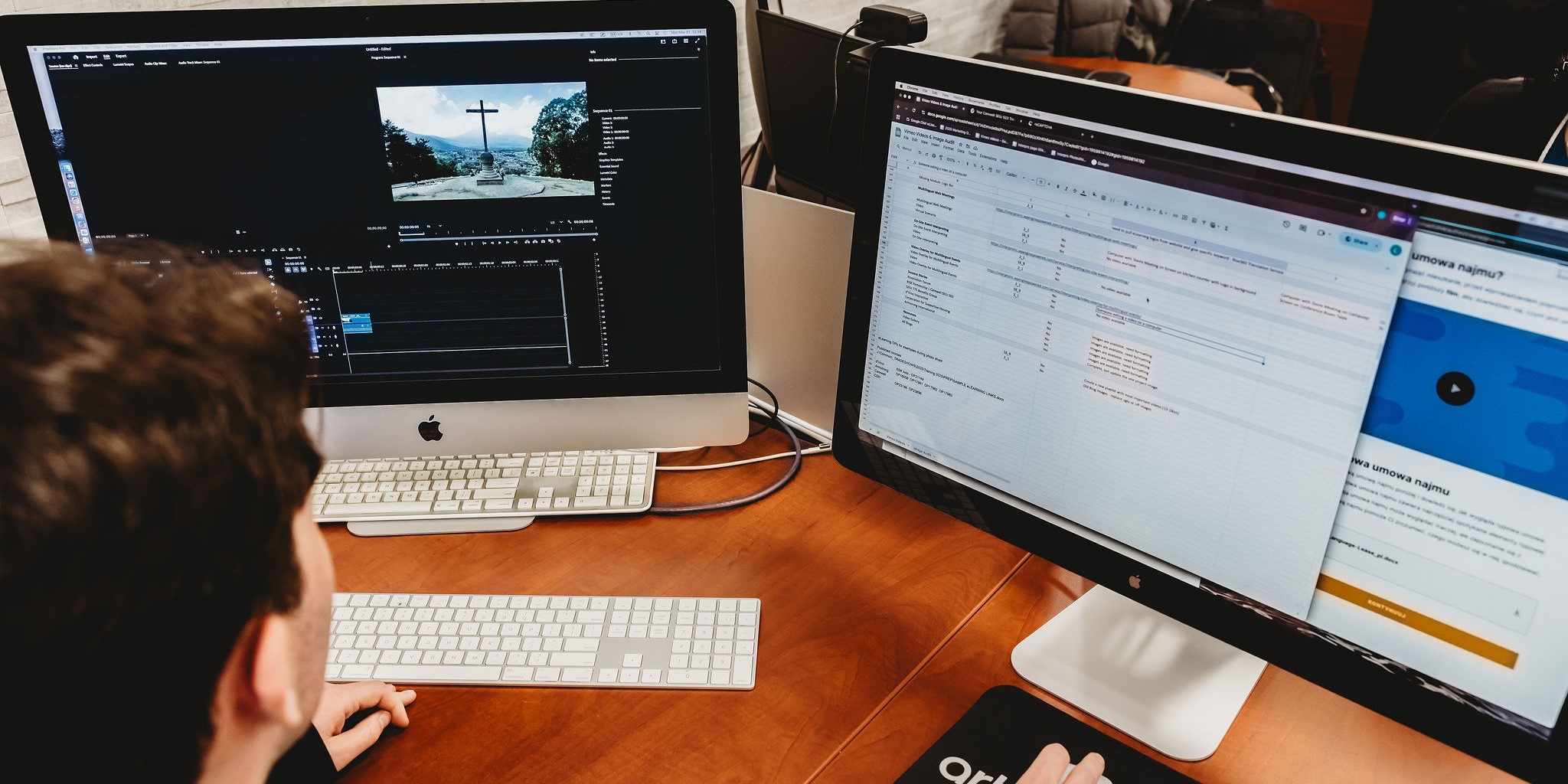
Most video localization workflows hit a wall when source files are missing. Legacy MP4s, locked assets, or third-party content often make traditional translation impossible. Today, AI-powered video text detection is changing that with tools that translate from final files without source files. But how good are these tools? When should you use them?
Interpro helps organizations localize their videos by removing language barriers to scale global content.
Can you translate a video without source files?
Yes, video localization without source files is now possible using AI-powered text detection combined with structured human review workflows. Tools like Vozo make this possible.
Traditionally, video translation required:
- Editable project files (After Effects, Premiere Pro, etc.)
- Source scripts or subtitles
- Access to production teams
When those were unavailable, teams faced:
- Rebuilding content from scratch
- Skipping localization entirely
- Accepting lower-quality workarounds
Today, newer approaches allow translation directly from finished MP4 files, extracting on-screen text, audio, and visual context, even when original assets are locked or lost.
This shift is especially important for global teams managing:
- Legacy content libraries
- Compliance or training videos
- Marketing assets from external vendors
- Distributed content across multiple systems
However, while the technology exists, successful execution still depends on process design and not just tools.
What changed: AI-powered video text detection and extraction
From file dependency to content accessibility
Modern AI models can now:
- Detect and extract on-screen text (OCR in video)
- Transcribe spoken dialogue with high accuracy
- Identify timing, scenes, and contextual cues
This enables teams to work from:
- Final exported MP4 files
- Embedded subtitles or burned-in captions
- Voiceover audio tracks
Instead of asking, “Do we have the source files?”, organizations can now ask: “Do we have the final video?”
That shift alone removes a major operational bottleneck.
What AI can do well (and where it needs structure)
AI enables:
- Fast transcription and text extraction
- Base-level translation across multiple languages
- Initial subtitle file generation
But AI alone does not guarantee:
- Terminology consistency
- Regulatory compliance
- Brand alignment
- Cultural accuracy
This is where Interpro’s approach aligns with buyer reality:
AI is already in the workflow, but without structure, it introduces risk.
Interpro’s governed workflows, supported by AI translation services, ensure that:
- AI outputs are reviewed at the right points
- Glossaries and translation memory guide consistency
- Human linguists validate meaning, not just words
Why traditional video localization fails without source files
Tools like Vozo work best with simpler, well-structured content. It’s not replacing full localization or subject matter expertise, but it does open the door to translating more day-to-day communications at scale.
Most legacy workflows assume:
- Delivery timelines
- Access to design layers
- Script availability
When those assumptions break, teams encounter:
1. Rebuild Costs
Reconstructing video projects can cost more than the original production.
2. Timeline Delays
Localization gets deprioritized due to resource constraints.
3. Quality Tradeoffs
Teams rely on subtitles-only solutions or partial localization.
4. Internal Friction
Operations, marketing, and compliance teams struggle to align on what’s possible.
For AI-pressured operations leaders, one of Interpro’s core personas, this becomes a systems problem, not just a translation problem.
A better model: Translating from MP4 with a structured video localization workflow
Backed by real-world results and proven delivery models, this workflow powers high-impact video localization, combining scalable AI with expert review to deliver measurable outcomes across global audiences.
Step 1: Extract
AI tools identify:
- On-screen text
- Speech-to-text transcription
- Subtitle timing
Step 2: Translate
Translation is performed using:
- AI-assisted models
- Terminology control
- Translation memory, where applicable
Supported by AI machine translation post-editing
Step 3: Human-in-the-Loop review
Linguists validate:
- Accuracy
- Tone and clarity
- Cultural nuance
Step 4: Rebuild or overlay
Output formats can include:
- Subtitles (SRT, VTT)
- Voiceover scripts
- Video overlays and localized captions
Delivered through solutions like video translation services and AI multimedia localization
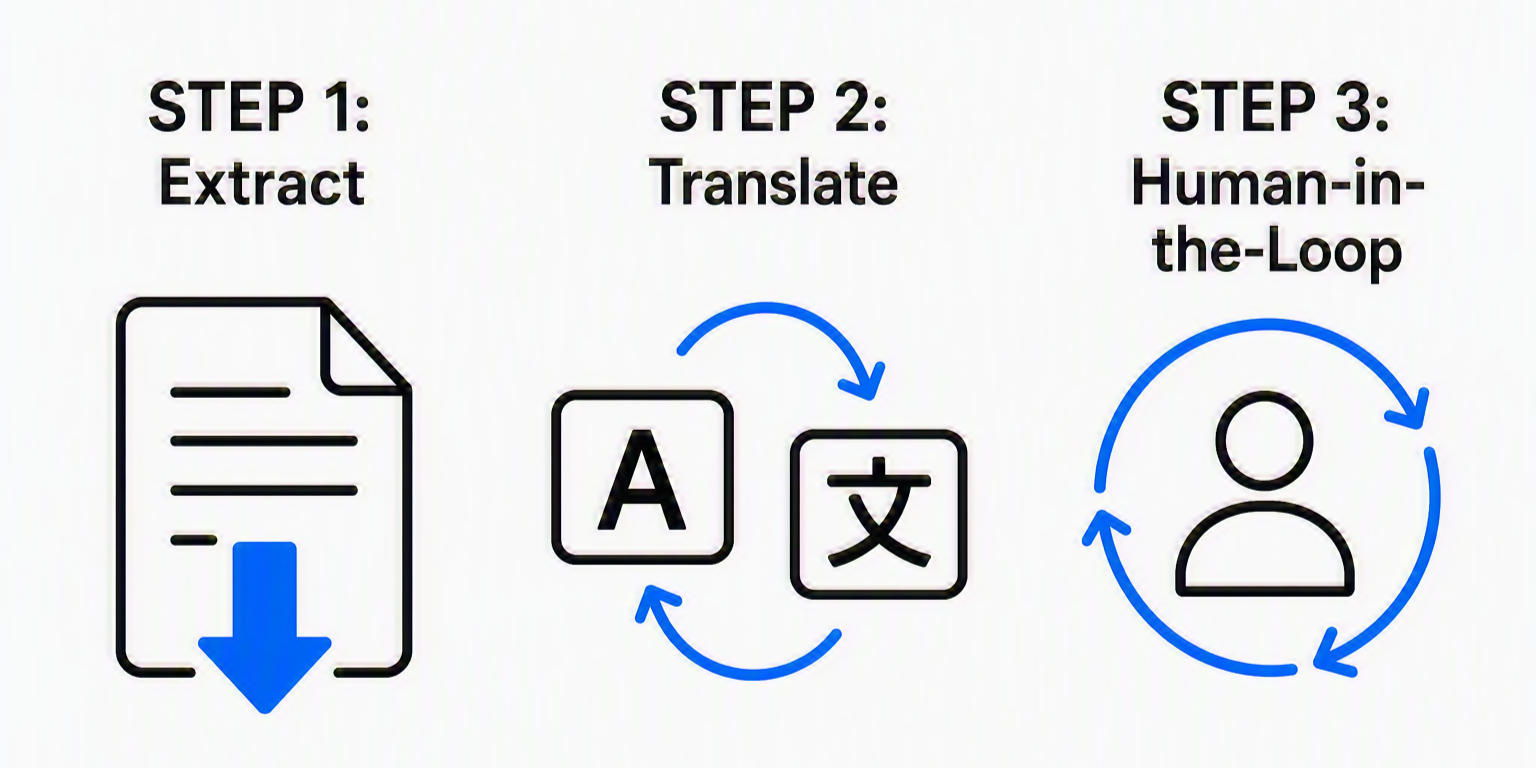
A three-step localization workflow showing content extraction, translation, and Human-in-the-Loop quality review for scalable multilingual content delivery.
Where this approach delivers the most value
1. Legacy video libraries
Organizations with years of archived content can now:
- Localize without re-editing
- Extend content lifespan
- Unlock global reach
2. eLearning and training programs
Training teams benefit from:
- Faster localization cycles
- Reduced dependency on original developers
- Scalable updates
Supported by eLearning translation solutions
3. Compliance and regulated content
For high-stakes environments:
- Human review ensures accuracy
- Structured workflows support governance
- Documentation provides traceability
Aligned with Interpro’s consulting via localization consulting services
4. Marketing and communications teams
Brand and comms leaders gain:
- Faster turnaround for campaigns
- Consistent messaging across markets
- Reduced reliance on creative agencies
Service level matrix: choosing the right approach
| Service Level | Best For | Risk Level | Human Oversight | Typical Use Case |
| Freelance / Ad-hoc | Simple, one-off videos | High | Minimal | Internal content |
| Basic AI + subtitles | Speed-focused projects | Medium | Low | Informational videos |
| Hybrid AI + review | Most business use cases | Low | Moderate | Training, marketing |
| Full-service localization | High-stakes content | Very Low | High | Compliance, brand content |
| Managed team extension | Scaled programs | Very Low | Embedded | Ongoing global operations |
Interpro’s advantage:
Flexible engagement models, not forcing teams into rigid workflows.
Quality and risk management: why process matters more than tools
Built for scale and precision, our localization process drives faster delivery, lower costs, and reliable quality across multilingual video content.
Without governance, risks include:
- Mistranslation of key terms
- Inconsistent messaging across videos
- Regulatory exposure
- Brand misalignment
Interpro mitigates these risks through:
- ISO-aligned workflows
- Defined QA checkpoints
- Terminology governance
- Human-in-the-Loop validation
This directly supports risk and compliance stakeholders who need:
- Process clarity
- Accountability
- Repeatability
Video Localization Without Source Files FAQs
What is video localization without source files?
Video localization without source files is the process of translating a finished video (such as an MP4) using AI-powered text detection, transcription, and structured human review, eliminating the need for original editing assets like project files or scripts.
How does AI detect text inside videos?
AI detects text in videos using optical character recognition (OCR) to extract on-screen text and speech recognition to transcribe audio. These technologies allow translation workflows to begin even when captions or source files are unavailable.
Is translating from MP4 files accurate enough for business use?
Yes, translating from MP4 files can be accurate when supported by Human-in-the-Loop review. AI provides the initial output, but professional linguists validate terminology, tone, and context to ensure quality and reduce risk.
When should you use human review in video translation?
Human review should be used when accuracy, compliance, or brand consistency matters. This includes training content, legal materials, and marketing videos where errors could lead to reputational or regulatory issues.
What industries benefit most from this approach?
Industries with large video libraries or compliance requirements benefit most, including healthcare, manufacturing, higher education, and global enterprises managing multilingual training or communications content.
Can this method be used for eLearning localization?
Yes, this method works well for eLearning content. Organizations can localize training videos without rebuilding courses, making it a practical solution for scaling localization of eLearning courses across multiple languages.
How do you maintain quality when using AI for video translation?
Quality is maintained through structured workflows that combine AI translation with glossary control, translation memory, and human review. This ensures consistency, accuracy, and alignment with brand and regulatory requirements.
Video Translation Services
Need to localize video without source files?
Explore how Interpro enables scalable, high-quality video localization:
Video Translation Services
Stay informed on evolving localization strategies:
Subscribe to Interpro’s Newsletter
Book a Consultation
Looking for a tailored approach?
Every organization’s video ecosystem is different.
Book a consultation to assess your workflows and identify the right localization model
Meeting global teams where they are
Video localization no longer needs to be blocked by missing source files.
With AI-powered text detection and governed workflows:
- Content becomes accessible
- Localization becomes scalable
- Risk remains controlled
The key insight:
AI enables the possibility, but structured systems enable success.
Interpro operates at that intersection, helping organizations move forward with confidence, without forcing them to rebuild what they already have.
Category: Localization
Tags: AI Services, Consulting Services, Interpreting Services, Translation & Localization Services
Service: Video Translation

Don't forget to share this post!

Stay Updated with Interpro
Subscribe to our newsletter for the latest updates and insights in translation and localization.