
How to Prepare for AI Localization: A Practical, Step-by-Step Framework for Business Teams


AI localization success depends on more than translation alone. Organizations need structured content, well-designed prompts, rigorous quality review, and continuous feedback to ensure accuracy, consistency, and compliance. The most effective teams treat AI translation as a governed workflow that improves over time, not a one-click solution.
AI translation is fast. That’s the easy part.
The hard part is everything around it: preparing the right data, guiding the model, validating outputs, and building a system that improves over time.
If you skip those steps, AI doesn’t reduce risk… it multiplies it.
This guide breaks down the four critical components of a successful AI localization workflow(opens in new tab) and shows exactly how your team should prepare for each one:
- Data selection and preparation
- Prompt design and refinement
- Output evaluation and refinement
- Continuous monitoring and feedback
These aren’t optional steps. They’re the difference between “AI that translates” and AI that your organization can actually trust and scale.
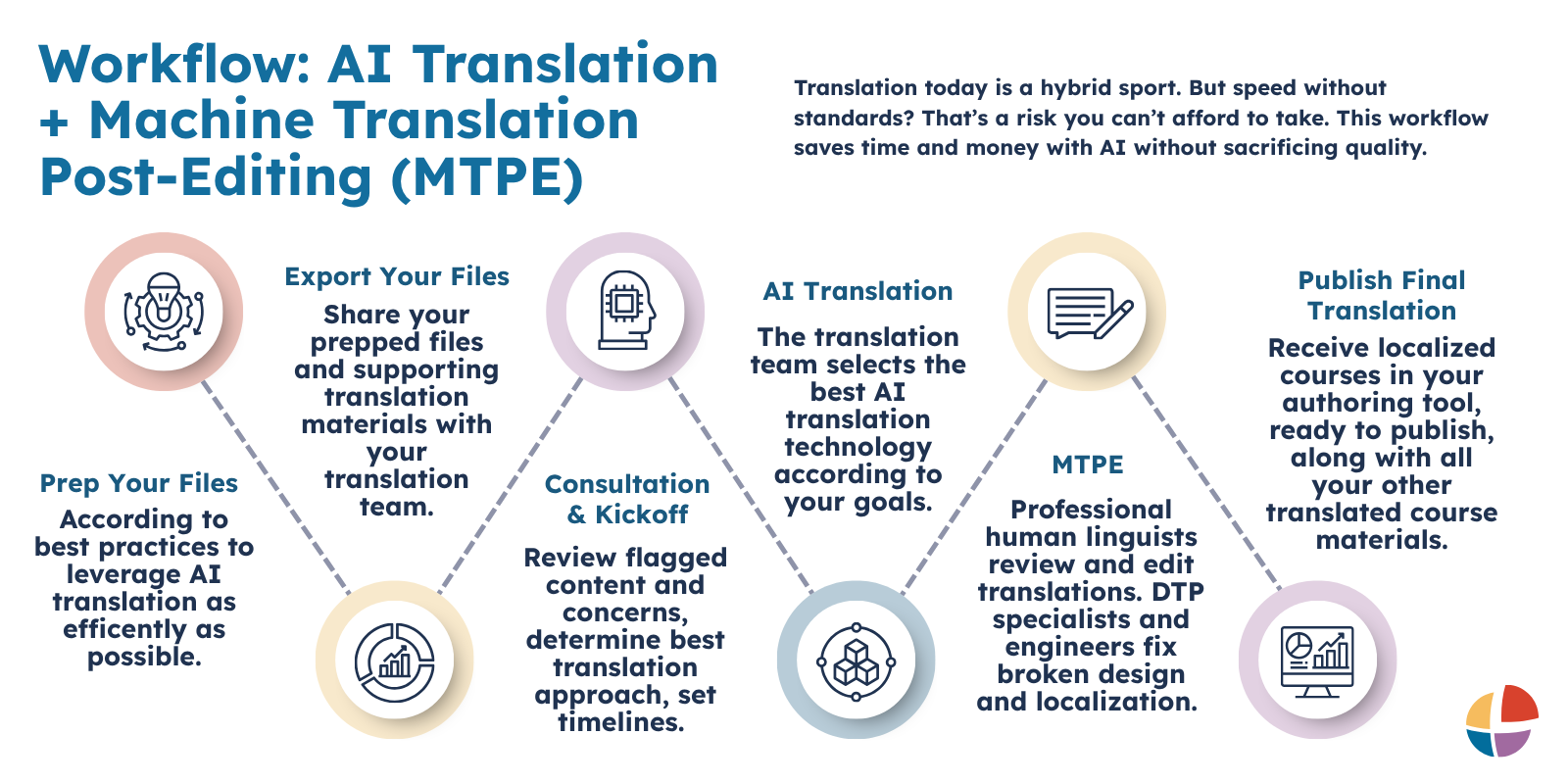
AI translation paired with machine translation post-editing (MTPE) helps organizations balance speed and quality.
Data Selection and Preparation
“Your AI is only as good as what you feed it.”
This is where most AI localization efforts quietly fail.
Teams jump straight to tools without preparing the content, and then wonder why outputs are inconsistent, inaccurate, or unusable.
What “good data” actually means in localization
It’s not just “a lot of content.” It’s:
- Relevant to your use case (training, legal, marketing, technical, etc.(opens in new tab))
- Consistent in terminology and tone
- Clean and structured for translation workflows
- Aligned with previously approved translations
If your source content is messy, AI will scale that mess across every language.
How to prepare your data the right way
Clean and standardize your English source content
AI performs best with:
- Clear sentence structure
- Controlled vocabulary
- Minimal ambiguity
This aligns directly with best practices outlined in your internal AI translation workflows, where clear, structured source content reduces errors and rework
Example:
- Bad: “Run this by legal before pushing it live globally(opens in new tab)”
- Better: “Submit this document to the legal team for approval before publishing globally”
Build foundational linguistic assets
Before AI touches anything, you should have:
- Translation Glossary(opens in new tab) → approved terminology
- Style Guide(opens in new tab) → tone, voice, formatting rules
- Translation Memory (TM)(opens in new tab) → previously approved translations
These aren’t “nice to have.” They are control mechanisms that prevent AI from drifting across languages.
Segment content by risk level
Not all content should go through AI the same way.
You need to classify:
- Low-risk: FAQs, internal docs → AI-friendly
- Medium-risk: training, onboarding → AI + human review
- High-risk: legal, medical, compliance → human-led
This risk-based segmentation is critical for regulated industries and aligns with how enterprise buyers evaluate AI adoption today
Centralize and structure your assets
Before translation:
- Gather all files(opens in new tab) (scripts, videos, UI text, PDFs)
- Standardize naming conventions
- Ensure version control
Disorganized inputs = broken outputs.
What this step really does
Data preparation transforms AI from:
“a tool that generates translations”
into:
“a system that produces consistent, scalable multilingual content”
Prompt Design and Refinement
“Prompts are your governance layer.”
If data is the fuel, prompts are the steering wheel.
Most teams treat prompts like simple instructions.
High-performing teams treat them like quality controls.
What a strong localization prompt includes
A good prompt doesn’t just say “translate this.”
It defines:
- Target audience
- Tone and brand voice
- Terminology constraints
- Cultural expectations
- Output format
Example: Weak vs. strong prompt
Weak prompt:
Translate this into Spanish.
Strong prompt:
Translate this content into Spanish for healthcare professionals in Mexico.
Maintain a formal tone, use approved glossary terms, and ensure compliance with medical terminology standards. Avoid literal translation of idioms.
That second prompt reduces:
- ambiguity
- rework
- compliance risk
Prompt design best practices
Anchor prompts to your linguistic assets
- Reference glossary terms
- Enforce style guide rules
- Reinforce brand tone
Use role-based context
Example:
- “Translate for HR leaders”
- “Translate for frontline healthcare workers”
This improves relevance dramatically.
Iterate prompts like a system, not a one-off task
Prompt refinement should be:
- Tested across multiple content types
- Adjusted based on output quality
- Documented for reuse
This mirrors how AI content is optimized for performance across systems like ChatGPT and search engines, where structured, context-rich inputs improve output quality
What this step really does
Prompt design ensures your AI:
- Doesn’t “guess”
- Doesn’t drift
- Doesn’t create brand risk
It turns AI from reactive to predictable.
Output Evaluation and Refinement
“AI gives you a draft. Your process makes it usable.”
This is where organizations either:
- build trust in AI
- or lose it completely
Because raw AI output is never the final product.
What you should evaluate
Every AI-generated translation should be reviewed for:
- Accuracy → Is the meaning preserved?
- Terminology → Are approved terms used?
- Tone → Does it match your brand?
- Cultural relevance → Does it make sense locally?
- Compliance → Does it meet regulatory standards?
The role of Human-in-the-Loop (HITL)
AI alone cannot guarantee:
- regulatory compliance
- cultural nuance
- contextual accuracy
That’s why Machine Translation Post-Editing (MTPE)(opens in new tab) exists.
Human reviewers:
- correct errors
- align tone
- validate terminology
- ensure audit readiness
This hybrid approach is increasingly expected by enterprise buyers(opens in new tab) who want speed without sacrificing accountability
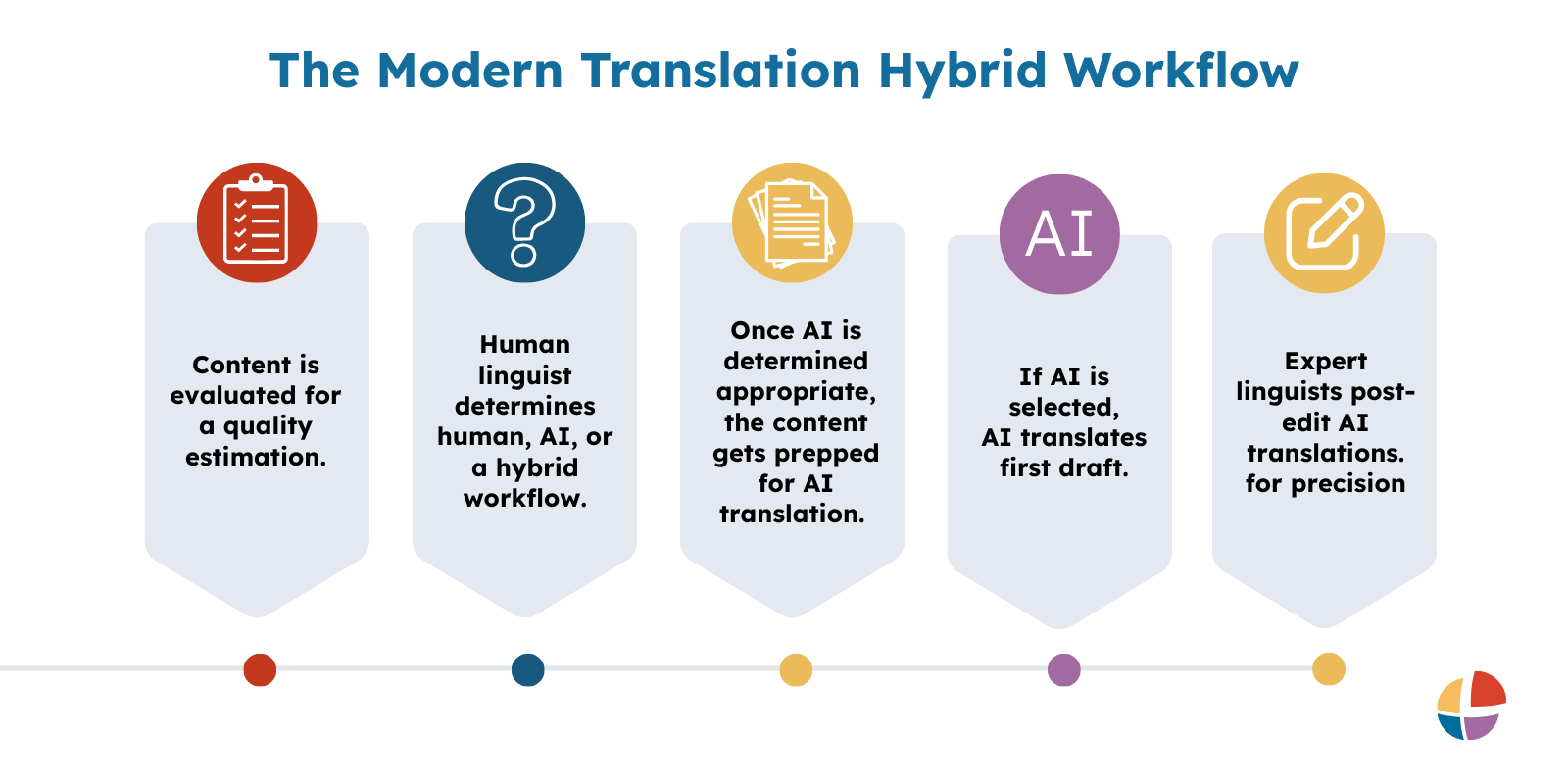
A hybrid workflow combines AI translation with human expertise to improve quality and consistency.
Build a structured evaluation framework
Instead of subjective reviews, use:
- Quality scoring models
- Error categorization (critical vs minor)
- Pass/fail thresholds by content type
Example evaluation workflow
- AI generates translation
- Linguist reviews and edits (MTPE)
- SME validates critical content
- QA checks formatting, functionality, compliance
- Final approval and documentation
What this step really does
Evaluation turns AI output into:
- defensible content
- publishable content
- trusted content
Continuous Monitoring and Feedback
“If your AI isn’t improving, your system is broken.”
Most teams stop after delivery.
High-performing teams build feedback loops.
What continuous monitoring looks like
You should be tracking:
- Translation error patterns
- Terminology inconsistencies
- Post-editing effort levels
- Content types where AI fails
- Reviewer feedback
Build a feedback loop into your workflow
Capture post-editing data
- What errors are recurring?
- Which prompts fail most often?
Update your system
- Refine prompts
- Expand glossary
- Improve source content
Retrain or adjust AI usage
- Shift high-risk content to human workflows
- Optimize AI usage where it performs well
Why this matters now more than ever
The market is shifting fast:
- AI is widely adopted
- Buyers expect hybrid workflows
- Organizations are accountable for AI decisions
And most importantly:
AI is not a “set it and forget it” system. It’s a managed process.
That’s exactly why organizations are looking for partners who can provide governance, structure, and accountability across the full translation lifecycle
Putting It All Together
AI localization is not a tool. It’s a system.
If you step back, these four components form a loop:
- Data Preparation → sets the foundation
- Prompt Design → controls the output
- Evaluation → ensures quality and compliance
- Monitoring → improves the system over time
Skip one, and the system breaks.
Key Takeaways
- AI translation without preparation leads to inconsistent, risky outputs
- Prompts act as governance, not just instructions
- Human review is essential for accuracy, compliance, and trust
- Continuous feedback transforms AI into a scalable localization system
- The goal isn’t faster translation; it’s defensible global communication
Category: AI Translation
Service: AI Translation
Don't forget to share this post!



Stay Updated with Interpro
Subscribe to our newsletter for the latest updates and insights in translation and localization.